

More news on this day
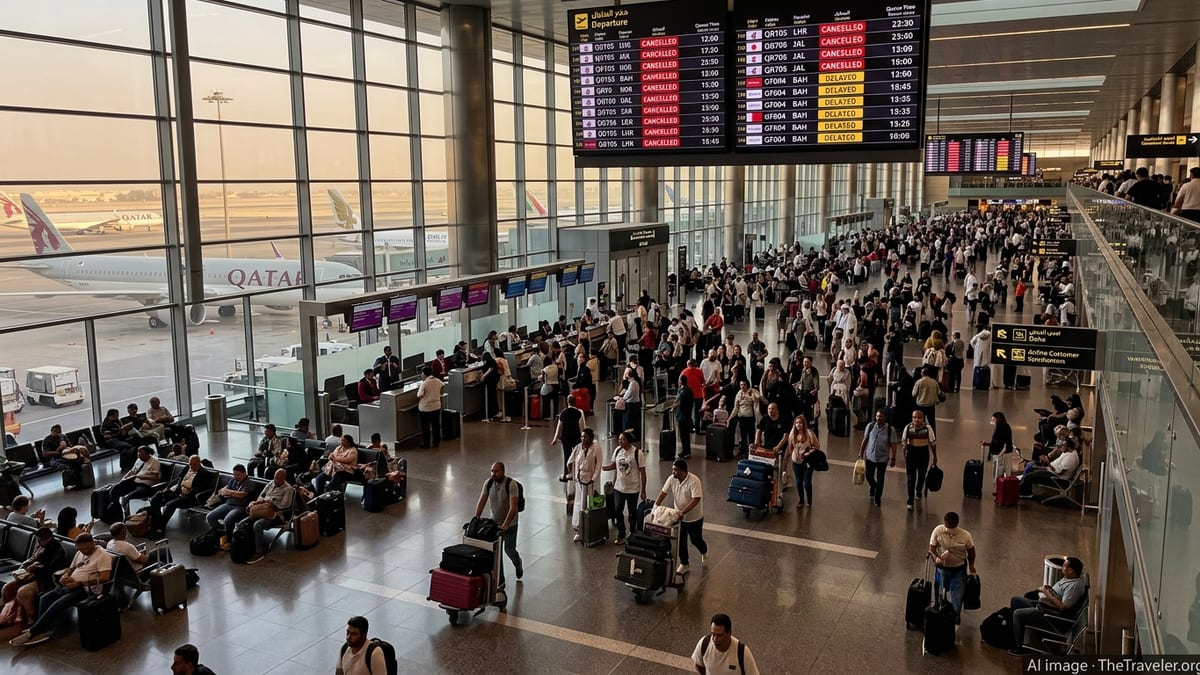
Passengers transiting through Doha are still grappling with extensive cancellations and rolling delays, as constrained airspace over Qatar continues to disrupt operations for Qatar Airways, Gulf Air and Malaysia Airlines, creating fresh travel turmoil at Hamad International Airport weeks after the first missile strikes in the region.
Get the latest news straight to your inbox!
Ongoing Airspace Restrictions Keep Hamad International Under Strain
Flight disruption in Doha has persisted well into late March 2026, with publicly available information indicating that Qatar’s airspace remains subject to tight operating constraints following the outbreak of the 2026 Iran war. Missile and drone activity in the Gulf region led to the initial closure of Qatari airspace at the end of February, and although limited corridors have since been reopened, normal commercial activity at Hamad International Airport has not fully resumed.
According to published coverage of the conflict and its impact on civil aviation, the Qatar Civil Aviation Authority moved from a full closure to a restricted reopening, allowing only evacuation and cargo flights under emergency conditions. Standard scheduled passenger services through Doha have therefore been operating at sharply reduced levels, if at all, increasing pressure on any airline still attempting to move people through the hub.
This backdrop has turned Hamad International, usually one of the Gulf’s most efficient transfer airports, into a bottleneck for stranded travelers. Reports from passenger forums describe departure boards dominated by cancellation notices and a smaller number of flights shown as heavily delayed, underscoring how fragile the current operating window remains.
While authorities have signaled an intention to gradually re-expand air navigation as security conditions allow, the situation on the ground suggests that the path back to pre-crisis schedules will be uneven. Each new adjustment to airspace restrictions translates into another wave of timetable changes, with knock-on effects spreading across airline networks linked to Doha.
Qatar Airways Faces Network-Wide Cancellations and Limited Relief Flights
Qatar Airways, the dominant carrier at Hamad International and one of the world’s largest long-haul airlines, has been at the center of the disruption. Travel advisories and airline communications compiled by industry observers indicate that the carrier’s regular scheduled operations were suspended when Qatari airspace first closed, with subsequent updates emphasizing that only select relief and repatriation services would be permitted.
In early March, a small number of outbound flights operated from Doha to major European hubs such as London, Paris, Madrid, Rome and Frankfurt under special authorization, primarily to repatriate stranded passengers. These flights were described in public updates as exceptional operations rather than evidence of a broad restart, with seats pre-assigned to those who had been stuck in Doha for days.
Despite these limited corridors, travelers continue to report a pattern of repeated cancellations affecting journeys that would normally connect through Doha between Europe, Asia, Africa and the Americas. Some passengers with tickets for mid- and late-March departures describe receiving multiple cancellation notices in succession, with rebooking options constrained by both the airspace situation and heavy demand for any available seats.
Consumer-facing guidance from airline and travel-industry materials stresses that passengers should monitor their booking status closely and avoid assuming that previously confirmed itineraries will operate as planned. With the carrier’s global network so tightly bound to its Doha hub, even small changes in airspace availability can cascade quickly through schedules.
Gulf Air and Malaysia Airlines Also Caught in the Doha Disruption
The difficulties in Qatar have not been limited to its national airline. Gulf Air and Malaysia Airlines, which use Doha for selected routes and codeshare services, have also seen flights affected as the hub’s capacity has shrunk. Publicly available timetable data and traveler accounts indicate that services linking Doha with Bahrain, Kuala Lumpur and other regional or long-haul destinations have faced cancellations or lengthy delays.
For Gulf Air, which operates a relatively short sector between its Manama base and Doha, the disruption has undermined connectivity for passengers relying on onward links via Qatar Airways. Canceled feeder flights into Doha can break entire long-haul journeys, leaving Gulf Air customers seeking alternative routings through other Gulf hubs where possible.
Malaysia Airlines, which partners with Qatar Airways on connections between Southeast Asia, Europe and the Middle East, has likewise been forced to adjust. Published schedule updates suggest that some services that would usually rely on seamless transfers in Doha have been rerouted or temporarily suspended, as the airline weighs demand against the operational uncertainty surrounding Qatar’s airspace.
These knock-on effects illustrate how deeply integrated airline networks are across the Gulf region. When a single major hub like Doha is constrained, partner and codeshare carriers quickly find their own schedules under pressure, even if their home airports remain fully open.
Passengers in Doha Report Long Waits, Limited Information and Complex Rebooking
For travelers already in Doha, the practical impact of the disruption has been significant. Accounts shared on public forums and social media describe passengers who arrived in Qatar in late February or early March and remained there for days, unable to secure confirmed onward flights as cancellations mounted.
Many of these travelers report difficulties in reaching airline customer-service channels, whether by phone, chat or at physical ticket desks, particularly during the initial days of the airspace closure. As airlines prioritized operational planning and repatriation efforts, some passengers said they were advised simply to wait for further announcements on airspace status before attempting to rebook.
Accommodation and welfare arrangements have varied, according to these public accounts. Some passengers indicate that they received hotel stays and meal support, while others say that they were left to arrange their own lodging while monitoring flight updates. The uneven experience appears to reflect a mix of ticket conditions, travel-insurance coverage and the sheer scale of the disruption facing carriers.
Rebooking has also become more complex as the situation has dragged on. With many later-dated flights now subject to schedule changes or possible suspension, passengers with tickets for late March have expressed uncertainty over whether their trips will proceed, and whether they should proactively seek alternative routing through different hubs such as Dubai, Abu Dhabi or Riyadh.
Uncertain Outlook as Late-March Travel Plans Hang in the Balance
As of March 26, 2026, publicly available information suggests that a full restoration of normal air traffic through Doha remains some distance away. While there are signs of incremental progress, including references to potential expansion of flight operations toward the end of March, the overall environment for travelers remains highly uncertain.
Travel analysts note that even once airspace restrictions ease, airlines will need time to reposition aircraft and crew, rebuild schedules and clear the backlog of stranded passengers. That process typically unfolds over days or weeks rather than overnight, particularly when multiple carriers and partner networks are involved.
For Qatar Airways, Gulf Air and Malaysia Airlines, the coming weeks are likely to involve a careful balancing act between adding capacity back into Doha and maintaining operational resilience in a still-volatile regional security context. Timetables may continue to shift at short notice as conditions change and civil-aviation authorities update their guidance.
Passengers planning to transit through Doha in the near term are therefore being urged, in publicly available travel advisories, to remain flexible, check flight status frequently and consider alternative routing options where feasible. Until Qatar’s airspace is fully reopened and stable, the travel turmoil seen at Hamad International in recent weeks is expected to linger, with further waves of cancellations and delays a real possibility.