

More news on this day
Thousands of travelers across the Middle East, Europe and North America faced fresh disruption today as airports in the United Arab Emirates, Bahrain, Kuwait, Saudi Arabia and neighboring states reported 691 flight cancellations and 291 delays, snarling operations for Gulf Air, IndiGo, Saudia, KLM and other major carriers on routes touching Doha, Dubai, Rome, Frankfurt, Boston and Dallas.
Get the latest news straight to your inbox!
Conflict-Linked Airspace Restrictions Trigger New Wave of Disruptions
Publicly available aviation data and industry coverage indicate that the latest wave of cancellations is closely tied to the ongoing Iran war and associated airspace closures and restrictions across the Gulf. Authorities in multiple Middle Eastern countries have limited or suspended standard commercial operations in recent weeks, forcing airlines to cut frequencies, reroute or suspend services altogether on key corridors linking the region with Europe, Asia and North America.
Analysts tracking global schedules report that carriers have been operating on reduced timetables since late February, when parts of Middle Eastern airspace were first closed or heavily constrained. The additional 691 cancellations and 291 delays reported today add to a mounting backlog of disrupted itineraries, as aircraft and crews are left out of position and alternative routings around restricted zones lengthen flight times and complicate scheduling.
Published briefings from aviation risk consultancies describe a patchwork of limitations, with some Gulf hubs operating under capped capacity and others maintaining only evacuation and cargo flights during certain periods. The result is a fragile operating environment in which even modest new constraints can quickly cascade into widespread cancellations like those recorded across the UAE, Bahrain, Kuwait and Saudi Arabia today.
Major Carriers From Gulf Air to KLM Forced to Cut and Reroute
Regional and international airlines with significant exposure to Middle Eastern hubs have again borne the brunt of the turmoil. Gulf-based operators such as Gulf Air and Saudia, alongside large South Asian low cost carriers like IndiGo, have made repeated schedule adjustments in recent days as they attempt to navigate the latest round of capacity and routing restrictions.
European network carriers including KLM and other alliance partners are also affected, particularly on services that traditionally rely on overflying or connecting through the Gulf to reach destinations in South and Southeast Asia, Australia and Africa. Publicly available timetables show multiple rotations scrubbed or retimed as airlines work around closed or congested airspace and seek to avoid conflict zones.
Industry trackers note that many of the cancellations recorded today represent follow on disruptions created by earlier schedule cuts and diversions. Aircraft that would typically rotate through Gulf hubs to continue to Rome, Frankfurt, Boston or Dallas are instead grounded or reassigned to alternative routes, limiting the ability of airlines to clear backlogs and rebook stranded passengers in the short term.
Key Hubs from Doha and Dubai to Rome and Frankfurt Under Strain
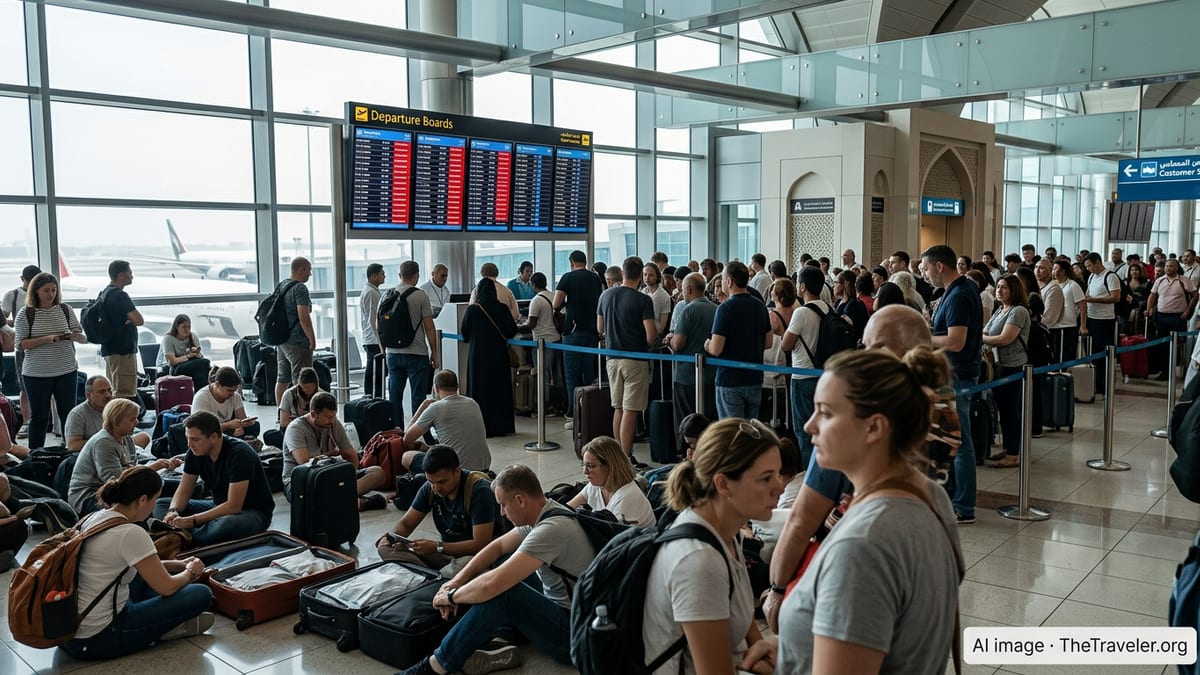
The latest data highlight the global reach of the Middle East conflict’s aviation fallout. Hamad International Airport in Doha and Dubai International, two of the world’s largest connecting hubs, continue to experience reduced operations and irregular schedules, sharply curtailing their role as bridges between East and West. Travel industry reporting describes departure boards in these airports dominated by cancellations and severely delayed departures.
The disruption is no longer confined to the region. Long haul links from Gulf hubs to major European gateways such as Rome and Frankfurt have seen repeated cancellations and extended delays, leaving aircraft stands filled and transfer passengers stranded between flights. Operational reports indicate that crew duty time limits and turnaround constraints are making it difficult to restore normal rotations even on days with more favorable conditions.
Across the Atlantic, the impact is visible in North American airports with strong Gulf connectivity, including Boston and Dallas. While local weather and domestic factors continue to play a role in US operational performance, the loss or reduction of scheduled services from Gulf carriers has translated into last minute cancellations and schedule gaps on certain transatlantic and transpacific itineraries that depend on Middle Eastern connections.
Thousands of Travelers Face Missed Connections and Lengthy Rebookings
For passengers, the statistical tally of 691 cancellations and 291 delays translates into thousands of missed connections, unexpected stopovers and prolonged rebooking processes. Travel forums and social media posts from across the region describe overnight queues at customer service desks, crowded airport lounges and limited availability of alternative flights, especially for travelers bound for secondary cities beyond major hubs.
Publicly available statements from airlines and travel advisories emphasize that affected passengers are generally being offered rebooking, travel credits or partial refunds, but the combination of reduced capacity and long haul route complexity means many are being re accommodated days rather than hours later. In some cases, travelers are being rerouted via less affected hubs in Europe or Asia, adding multiple stops and extended layovers to journeys that would normally involve a single, seamless connection through the Gulf.
Travel planners caution that the rolling nature of the disruption makes it difficult for passengers to predict which specific flights will operate on any given day. Even flights that remain on departure boards can be susceptible to last minute cancellation or significant delay if aircraft arrive late from previous sectors, or if air traffic control flow restrictions tighten with little warning.
Travel Advisories Urge Flexibility as Outlook Remains Uncertain
Government travel advisories and airline notices issued in recent days consistently urge travelers with itineraries touching the Gulf to maintain a high degree of flexibility. Passengers are being encouraged to monitor airline apps and departure boards closely, allow additional time for connections, and consider alternative routings that bypass the most affected hubs when possible.
Aviation analysts note that while some carriers have published provisional revised schedules into late March, the trajectory of cancellations remains closely tied to the evolving security situation and the status of regional airspace. Any further escalation in restrictions, or damage to additional airport infrastructure, could prompt further cuts beyond the 691 cancellations and 291 delays recorded today.
For now, publicly available industry forecasts suggest that airlines and airports across the UAE, Bahrain, Kuwait and Saudi Arabia will continue operating on constrained and highly dynamic timetables. Travelers planning to pass through Doha, Dubai, Rome, Frankfurt, Boston, Dallas and other linked hubs in the coming days are being advised to review booking conditions carefully, keep contact details updated with airlines and be prepared for last minute changes as the crisis continues to reshape global air connectivity.