

More news on this day
Hundreds of passengers faced missed connections and overnight stays this week as a cluster of operational problems delayed 477 travelers across four major U.S. hubs, underscoring how fragile the country’s airline network remains in April 2026.
Get the latest news straight to your inbox!
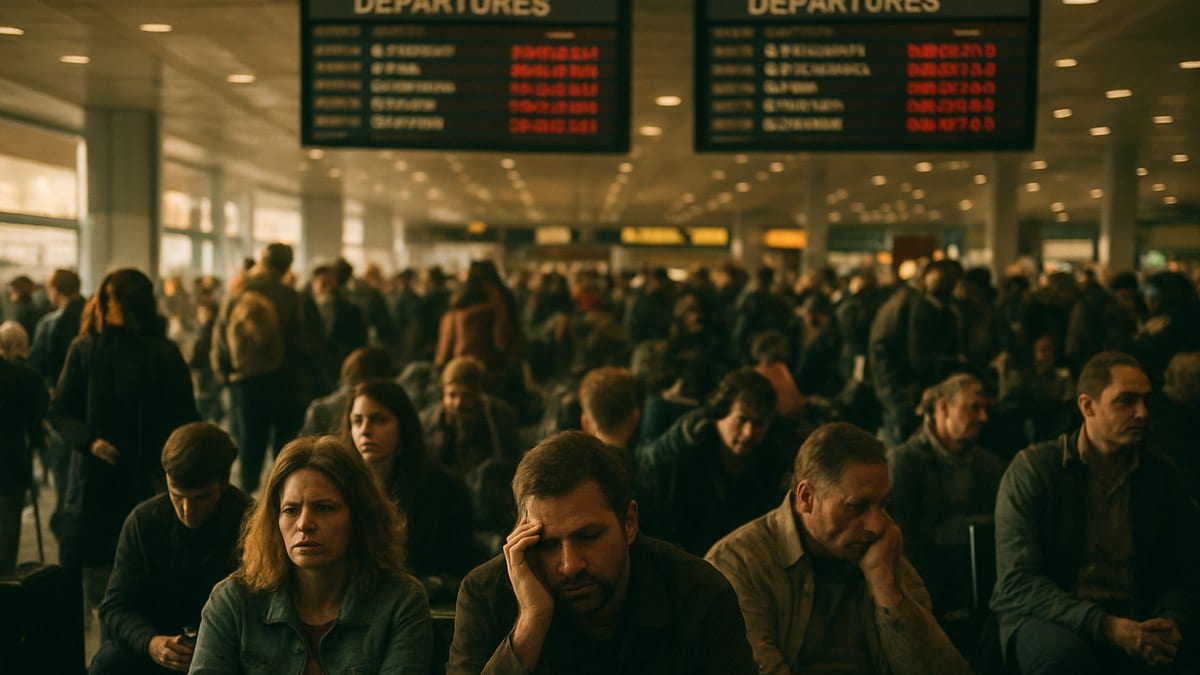
Four Hubs, One Chaotic Travel Day
The latest disruption unfolded as part of a broader pattern of April turbulence for U.S. aviation, with flight-tracking data pointing to pressure points at large connecting airports such as Atlanta, Chicago, Dallas–Fort Worth, and the New York area. Recent nationwide tallies have already shown several days with thousands of delays and hundreds of cancellations, and the newest incident pushed another 477 travelers into extended waits as delayed departures rippled through these hubs.
Publicly available data for early April shows how quickly problems compound when large hubs are involved. One analysis of activity on April 6 reported more than 4,700 delayed flights and over 300 cancellations across the United States, heavily concentrated at primary connecting airports including Hartsfield–Jackson Atlanta International, Chicago O’Hare, Houston Intercontinental, Minneapolis–Saint Paul, New York area airports, Philadelphia, and Las Vegas. Within that broader disruption picture, the 477 passengers affected at the four highlighted hubs illustrate how even a relatively small slice of national totals can translate into serious individual disruption.
Industry trackers note that this latest episode comes on the heels of several high-impact days in late March and early April when systemwide delays topped 4,000 or even 6,000 flights globally, with a large share touching U.S. airports. While most flights ultimately departed, many left hours behind schedule, turning what looked like routine day trips or short connections into all-day ordeals.
The clustering of delays at hub airports matters because these locations sit at the center of complex banks of connecting flights. When just a handful of early departures run late, incoming aircraft and crews miss their scheduled connections, gates remain occupied longer than planned, and later flights are forced to wait. The 477 passengers caught in this week’s disruption were effectively at the wrong point in that chain reaction, trapped as the network attempted to catch up.
Weather, War, and a System Under Strain
The April surge in delays reflects a convergence of familiar and new pressures. Spring weather has already produced its share of thunderstorms and low clouds over key hubs, following a winter that brought large, disruptive systems across much of North America. Even when severe weather is local rather than nationwide, it can trigger ground stops, reroutes, and longer taxi times that slow operations across multiple airports.
At the same time, the aviation system is still absorbing the impact of geopolitical tensions and airspace closures linked to the ongoing conflict involving Iran. International coverage has documented how airspace restrictions across parts of the Middle East have forced carriers to reroute long-haul flights, burning more fuel and squeezing schedules. That strain does not stay confined to one region; aircraft and crews operating transatlantic or transpacific routes ultimately feed back into U.S. hubs, narrowing the margin for error on busy April travel days.
Elsewhere, labor actions and infrastructure pressure in Europe, including recent mass cancellations at Frankfurt and heavy congestion at airports from Amsterdam to Athens, have complicated global connections. When flights from Europe arrive late into U.S. gateways, onward domestic legs often depart behind schedule or with swapped equipment, adding to the delay cascade that domestic travelers experience, even if their own journeys never leave the United States.
The upshot for the 477 delayed passengers this week is that their experience, while frustrating, is part of a much larger story. Rather than a single, dramatic failure, the latest bout of chaos reflects a system that is already close to capacity and therefore highly sensitive to every additional shock, whether it arises from a thunderstorm over Dallas–Fort Worth or a diverted long-haul flight that arrives hours late into Newark or Chicago.
How 477 Delays Translate Into Missed Connections
On paper, 477 delayed travelers may appear modest against a backdrop of several thousand daily disruptions nationwide, but the practical effect is far more serious than the number alone suggests. Many of those passengers were not simply late arriving at their final destinations; they also lost carefully timed connections, missed events, and in some cases had to rebook for the following day.
In hub-and-spoke networks, banks of arrivals are scheduled to arrive within short windows, feeding into onward departures to cities across the country. When one or two inbound flights are delayed, connecting passengers can sometimes still make their onward flights with a brisk walk across the terminal. When an entire arrival bank runs behind schedule, however, the delay pushes those connections beyond what is realistically possible, especially at sprawling airports where walking times and security checkpoints add minutes to every transfer.
Travel disruption services and consumer-rights groups emphasize that airlines often prioritize keeping aircraft and crews in the right place for subsequent days over holding departures for every connecting passenger. That means a flight may depart near on time, even when dozens of connecting travelers from another delayed service have not yet reached the gate. For the individuals affected, the delay of a first flight morphs into a missed connection and a potential overnight stay at the hub.
In this week’s case, publicly available data indicate that some of the 477 delayed travelers were forced into last-minute hotel searches in already busy airport districts, while others attempted to salvage plans by switching to alternate routings through less congested airports. These coping strategies add further cost and stress, turning relatively short schedule slips into multi-day travel disruptions for a subset of passengers.
Why Recovery Is So Slow at Major U.S. Hubs
Analysts who track on-time performance point to structural factors that make recovery from a bad operational day more difficult than it was a decade ago. Airlines operate leaner fleets with tighter aircraft utilization, meaning planes spend more time in the air and less time parked, and there are fewer spare aircraft and crews to plug gaps when something goes wrong.
Recent coverage of disruptions at Dallas–Fort Worth and other large hubs has illustrated how even a few dozen delayed flights can propagate across an entire day’s schedule when there is little slack in the system. Once crews approach duty-time limits, airlines must decide whether to cancel later flights entirely or continue operating at the edge of allowable working hours, which increases the risk of additional cancellations if any further delay occurs.
April also brings heavier seasonal demand, particularly around Easter and spring holidays, which fills more seats and reduces the chances of easily accommodating disrupted passengers on alternative flights. When aircraft depart nearly full, there are fewer standby seats available for those who missed their original connections, leaving more people stranded at hubs until airlines can position extra capacity or the next day’s schedule opens up.
These dynamics help explain why the 477 delayed travelers this week are more than just a footnote. Each delay represents yet another instance in which the system had little capacity to absorb disruption, causing a relatively contained operational problem at four hubs to echo across the country as passengers struggled to rejoin the network.
What April’s Chaos Means for Upcoming Trips
For travelers with flights booked later in April, the latest disruptions are a warning sign that careful planning is increasingly important on even routine domestic trips. Reports from flight-tracking platforms and consumer travel outlets emphasize that while airlines are moving large volumes of passengers successfully, on-time performance at some hubs remains volatile and particularly vulnerable to afternoon and evening storms.
Travel experts and passenger-advocacy organizations commonly recommend building longer connection windows than in the past, aiming for at least 90 minutes on domestic transfers and more for international connections, especially through congested hubs. They also highlight the value of early-morning departures, which are less likely to be affected by knock-on delays from earlier flights and provide more rebooking options if something goes wrong.
Published coverage further suggests that travelers should monitor flights closely through official airline apps and airport information screens, as day-of adjustments to aircraft type, crew, or routing can signal brewing delays before they appear in public delay statistics. In the context of this week’s 477 delayed passengers, many of those caught in the worst of the chaos might have benefitted from rebooking earlier in the disruption cycle, before later flights filled up.
As April 2026 continues, the experience at these four U.S. hubs highlights a sobering reality. Even without a single catastrophic failure, a combination of tight schedules, volatile weather, and global operational pressures can turn an ordinary travel day into a cascade of missed connections and overnight stays for hundreds of people. For anyone with a ticket in hand, the lesson is clear: the margin for error in U.S. air travel this spring is slimmer than it appears on the departure board.