

More news on this day
Passengers traveling between Mexico and the United States are facing a fresh wave of flight disruptions today after a cluster of delays and cancellations at Monterrey’s General Mariano Escobedo International Airport rippled across busy routes to Cancun, Houston, San Antonio, San Francisco and other major destinations.
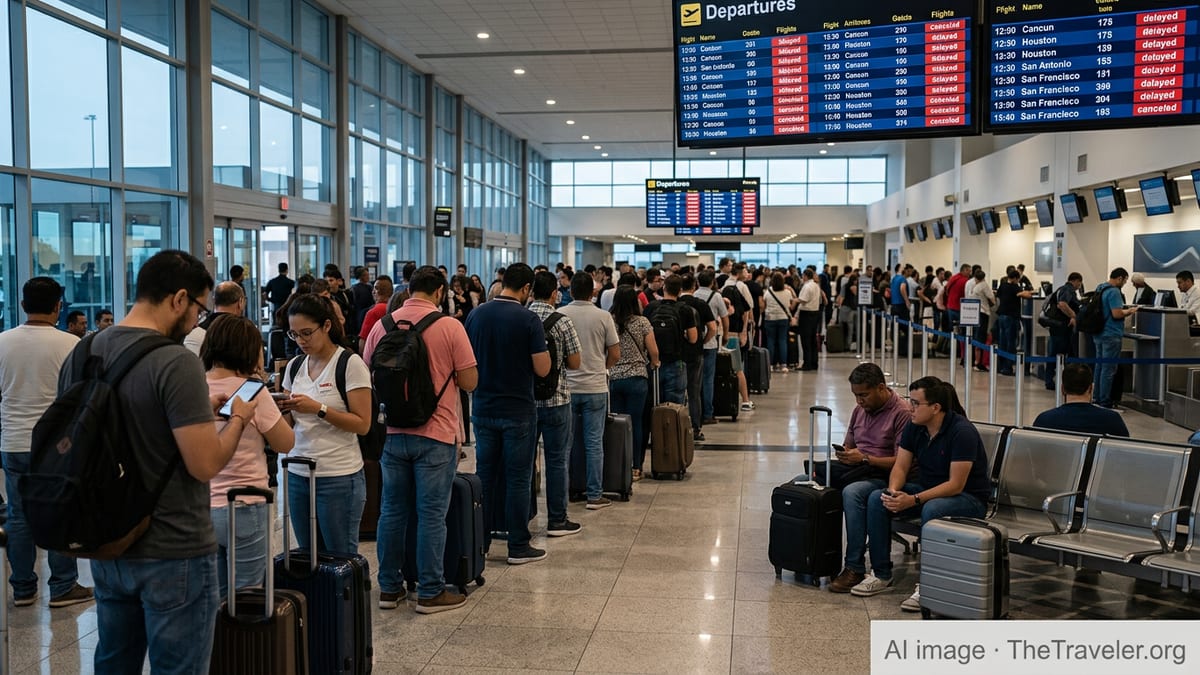
Disruptions Centered on General Mariano Escobedo International Airport
General Mariano Escobedo International Airport, which serves Monterrey and the wider industrial corridor of Nuevo León, has reported at least 11 delayed flights and 18 cancellations over the current operating period, according to real-time tracking data and local airport operations reports. The interruptions have primarily affected cross-border and domestic links that feed some of the region’s most heavily trafficked leisure and business markets.
While the raw numbers may appear modest compared with large-system weather events, the pattern of cancellations and rolling delays is proving particularly disruptive because many affected flights are key connectors. Services linking Monterrey to resort destinations such as Cancun, as well as to US hubs including Houston, San Antonio and San Francisco, are central to both weekend leisure traffic and weekday corporate travel, amplifying the impact of each individual schedule change.
The airport, one of Mexico’s busiest outside the capital region, has in recent years become a growing gateway for cross-border services to Texas and the US West Coast. That role means that operational issues in Monterrey can quickly cascade outward, stranding passengers far beyond northern Mexico as aircraft and crews fall out of position across the network.
Early indications suggest that a mix of operational constraints, tight aircraft rotations and knock-on effects from wider North American weather and airspace pressures have combined to create a fragile operating environment. Airlines are working flight by flight to restore schedules, but passengers are being urged to expect continued disruption through the short term.
Routes to Cancun, Houston, San Antonio and San Francisco Hit Hardest
The most heavily affected routes include the busy leisure corridor between Monterrey and Cancun and cross-border services into Texas, particularly Houston and San Antonio. These flights are widely used by Mexican families heading to the Caribbean coast as well as by US travelers connecting through Monterrey to reach beach destinations or industrial hubs in northern Mexico.
Several services between Monterrey and Houston, a key US hub airport, have either been delayed or removed from the schedule as carriers juggle aircraft availability and crew duty limits. Because Houston also functions as a major connection point for onward flights across the United States, disruptions here are rippling out into secondary markets, leaving travelers facing missed connections and extended overnight stays.
San Antonio and San Francisco have also seen schedule adjustments tied to aircraft and crew originating or rotating through Monterrey. West Coast-bound passengers have reported extended ground waits and last-minute gate changes, while some Texas-bound flights have been consolidated, forcing those with fixed plans to accept later departures or alternative routings via other Mexican gateways.
Downline impacts have been felt in Cancun, where delays arriving from northern Mexico are colliding with already crowded departure banks for outbound US and European services. In practical terms, this means some travelers are arriving late into Cancun only to find their onward flights have closed, pushing rebooking queues well into the evening.
What Is Driving the Latest Wave of Disruptions
Aviation analysts point to several overlapping factors behind the current wave of cancellations and delays. Across North America, airlines and airports are still operating with relatively tight buffers, which leaves little margin when weather, airspace congestion or technical issues emerge elsewhere in the system. In that environment, a handful of disrupted rotations at a mid-sized hub such as Monterrey can create outsized volatility.
Recent severe weather episodes across the United States have already stretched crew and fleet resources as carriers reposition aircraft, work through maintenance backlogs and absorb air traffic control flow restrictions. When aircraft scheduled to operate into or out of Monterrey arrive late from other parts of the network, it can quickly force airlines to compress turn times or cancel subsequent sectors to stay within regulatory and safety limits.
Industry observers also note that strong demand on cross-border and resort routes leaves little spare capacity to backfill canceled flights. As a result, once an operation begins to slide, airlines may be forced into a series of defensive cancellations rather than scattering passengers across nearly full alternate services. That dynamic appears to be at play on several Monterrey-linked routes today.
Local operational factors, including gate availability and ground handling constraints during peak departure banks, can further compound the problem. Even short delays in deplaning, catering or fueling may push an aircraft into a tighter air traffic control slot, triggering additional hold times either at the gate or on taxiways.
How Travelers Are Being Affected on Both Sides of the Border
For passengers, the most immediate effects are long waits at departure gates, last-minute cancellations and missed connections throughout the day. Travelers in Monterrey reported overnight that departure boards were in near-constant flux, with estimated departure times repeatedly revised as airlines sought updated slot allocations and crew clearances.
In Houston, San Antonio and San Francisco, the knock-on disruption is more subtle but no less frustrating. Some travelers connecting from Europe or the US Midwest into Texas hubs have discovered only upon landing that their onward service to Mexico has been delayed or canceled, forcing unplanned hotel stays or long ground transfers to alternate airports.
Leisure travelers heading to Cancun and other resort areas during peak holiday periods face particular uncertainty. Families with tightly scheduled vacation packages have expressed concern that losing even a single travel day could significantly diminish the value of their trips, especially where hotel bookings and tours are non-refundable or only partially flexible.
Business travelers, meanwhile, are contending with missed meetings and production line visits across the manufacturing belt around Monterrey. Several export-oriented companies in the region rely on just-in-time travel for engineers and executives shuttling between plants in Mexico and headquarters in the United States, and any sustained air travel disruption can complicate already complex supply chains.
What Passengers Should Do If Their Flight Is Affected
Airlines serving General Mariano Escobedo International Airport are advising passengers to check flight status frequently on the day of departure and to allow extra time at the airport. With schedules shifting rapidly, carriers are making frequent gate changes and issuing rolling updates that may not always be reflected immediately on static airport information screens.
Travelers whose flights have been canceled outright are generally being offered rebooking on the next available service, though availability may be limited on peak routes such as Monterrey to Cancun and Monterrey to Houston. In some cases, airlines are using alternate routings via Mexico City, Guadalajara or US hubs to move passengers, which may significantly lengthen travel times.
Those with tight connections in Houston, San Antonio, San Francisco or Cancun are being urged to consider building in additional buffer time where possible, either by voluntarily moving to earlier departures or by asking airlines to protect them on later downline services. Travel advisors also recommend that passengers keep essential items, including medications and a change of clothes, in their carry-on luggage in case checked bags are separated during rebooking.
Passengers who purchased tickets directly with airlines typically have the most straightforward path to assistance through official customer service channels. Those who booked via online travel agencies or package operators should contact those intermediaries for support with itinerary changes, hotel arrangements and any associated claims.