

More news on this day
Travelers passing through Amman’s Queen Alia International Airport faced a day of mounting disruption as publicly available data showed 38 flight cancellations and 22 delays affecting key routes to Cairo, Dubai, London, and other major hubs, with Royal Jordanian, Ryanair, Qatar Airways, and additional carriers adjusting schedules amid wider turbulence in Middle East air travel.
Get the latest news straight to your inbox!
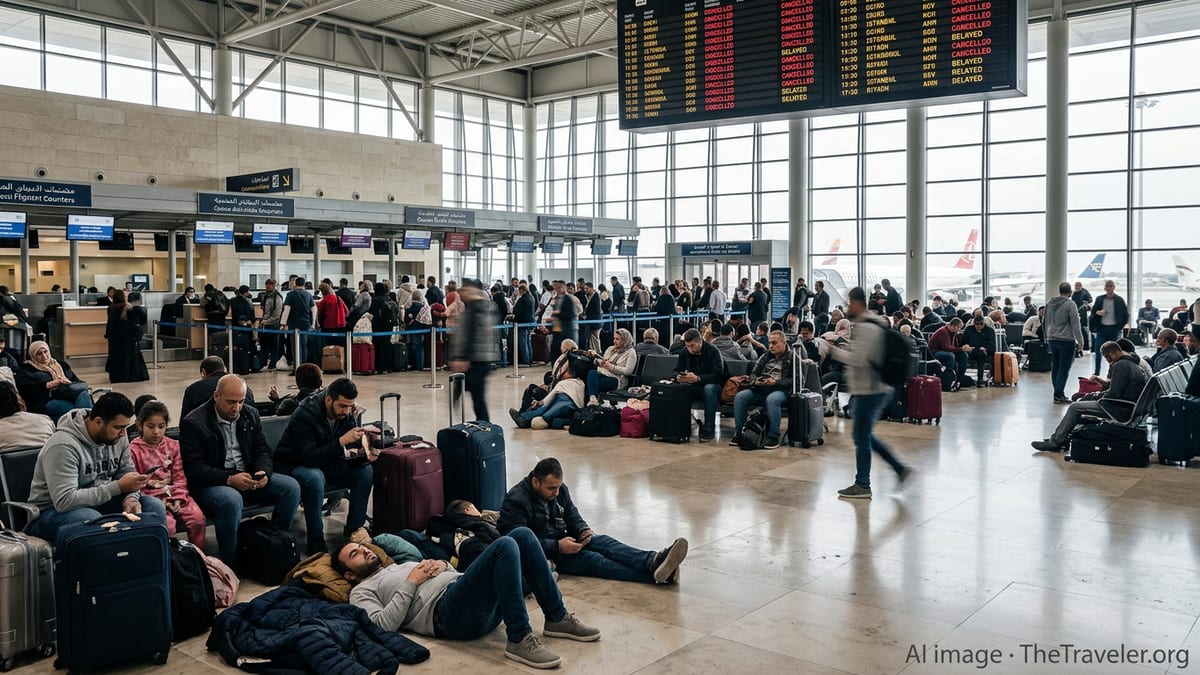
Queen Alia Operations Strained by Wave of Disruptions
Operational data from airport information boards and flight-tracking platforms on Saturday indicated that Queen Alia International Airport experienced an unusually high volume of disrupted services concentrated within a single operational window. The total of 38 cancellations and 22 delays represented a marked spike compared with typical daily movements at Jordan’s main gateway.
The interruptions affected a mix of short and medium haul services, with regional flights to Cairo and Dubai particularly impacted alongside longer routes connecting Amman with London. While some cancellations appeared clustered within specific time bands, delays were spread throughout the day, creating knock-on congestion at check in, security, and departure gates.
Publicly available information shows that the disruption did not stem from a single identifiable failure at the airport itself but rather from a combination of external factors facing the airlines operating there. As carriers adjusted rotations, aircraft availability, and crew positioning, Queen Alia’s schedule became increasingly compressed, leaving passengers facing long waits and uncertain departure times.
Despite the operational strain, core airport services remained functioning, with ground handling teams and terminal facilities continuing to process passengers from flights that did operate. However, the irregular pattern of departures and arrivals resulted in fluctuating crowding levels, with busy surges followed by extended quiet periods as additional cancellations filtered through systems.
Royal Jordanian, Ryanair, Qatar Airways and Others Adjust Schedules
Among the airlines most visibly affected at Queen Alia were Royal Jordanian, Ryanair, and Qatar Airways, along with several other regional and international carriers. Royal Jordanian, as Jordan’s flag carrier and the dominant operator at Amman, recorded multiple cancellations and rescheduled services as aircraft were reassigned and turnaround times revised to navigate the evolving situation.
Ryanair, which in recent seasons has expanded its footprint in the Jordanian market with low cost links between Amman and European destinations, also appeared on cancellation boards. Affected passengers on its London services reported schedule changes and rebookings as the carrier sought to consolidate operations on routes with sufficient aircraft and crew availability.
Qatar Airways, a major connector between Amman and the wider global network via Doha, was likewise drawn into the disruption pattern, with selected departures delayed or removed from the schedule. Other Gulf and European airlines operating through Amman made more limited timetable adjustments, but even minor changes contributed to an overall picture of instability for travelers trying to make onward connections.
Publicly accessible booking and status tools for multiple airlines showed tight availability for same day rebooking, indicating that many services on alternative routings were already heavily subscribed. As a result, some passengers faced the prospect of overnight stays in Amman or at intermediate transit points before continuing to Cairo, Dubai, or London.
Knock-On Effects for Cairo, Dubai, and London Routes
The concentration of cancellations and delays on services linking Amman with Cairo, Dubai, and London underscored the interconnected nature of current aviation pressures in the region. For Cairo, disruptions meant that a number of short haul links that ordinarily function as reliable shuttles were withdrawn or rescheduled, affecting both point to point travelers and those relying on onward African and Middle Eastern connections.
Dubai routes were similarly affected, compounding a period of broader operational constraint in Gulf airspace that has already led to rerouting and congestion at major hubs. Flight-tracking data indicated that several Amman Dubai rotations were either canceled outright or operated with significant delays, reducing connection options for passengers bound for onward long haul services to Asia, Europe, and North America.
Services between Amman and London, important for both business and leisure traffic, also faced schedule volatility. Low cost and full service carriers alike displayed disrupted operations, with some departures removed and others delayed sufficiently to jeopardize same day onward connections across the United Kingdom and continental Europe. Travelers reported having to adjust itineraries at short notice as inventory on remaining flights tightened.
These route level impacts highlighted how a relatively contained number of schedule changes at one airport can quickly ripple through international networks, particularly when they involve key regional connectors. Even passengers whose flights ultimately operated on time reported heightened uncertainty as they monitored changing status updates throughout the day.
Wider Middle East Air Travel Turbulence Provides Backdrop
The spike in disruption at Queen Alia took place against a backdrop of broader instability across Middle East aviation in early March 2026. Industry briefings and travel advisories issued in recent days have described an environment of constrained airspace, rerouted flight paths, and elevated congestion at several regional hubs, including Dubai and Doha, as airlines adapt to changing operational and security conditions.
Publicly available analysis from aviation and risk consultancies has pointed to a combination of factors, including shifting overflight permissions, temporary airspace closures, and air traffic control bottlenecks on remaining open corridors. These pressures have contributed to system wide delays and cancellations across a number of carriers, leaving aircraft and crews out of position and complicating efforts to maintain regular schedules.
In this context, Queen Alia’s cancellations and delays appear less as an isolated incident and more as a localized manifestation of a wider network challenge. Airlines serving Amman have been forced to absorb disruptions occurring upstream or downstream on multi leg rotations, resulting in cancellations on sectors where spare capacity to recover schedules is limited.
Travel industry observers note that while airports and airlines have become more adept at handling short lived disruptions, the cumulative effect of prolonged regional constraints is more difficult to mitigate. As recovery windows narrow and fleets are stretched, isolated schedule interruptions can coalesce into larger waves of cancellations such as those seen at Queen Alia.
What Travelers Through Amman Are Experiencing Now
For passengers on the ground in Amman, the operational picture translated into long queues at airline service desks, repeated checks of mobile apps and departure screens, and a scramble to secure hotel rooms and alternative routings. Social media posts and traveler forums carried accounts of last minute gate changes, rolling departure times, and uncertainty over baggage transfers for those rebooked via different hubs.
Some travelers reported being automatically reprotected on later flights the same day or the following morning, while others were advised through online tools to pursue refunds or credit vouchers if travel was no longer feasible. Information from airline channels emphasized the importance of checking real time status before heading to the airport, as schedules continued to evolve throughout the day.
For those yet to begin their journeys, publicly accessible advisories encouraged a cautious approach. Passengers with non essential trips involving Amman, Cairo, Dubai, or London were urged in travel discussion spaces to consider flexible tickets, allow extended connection times, and keep contingency funds available for unexpected overnight stays.
Although the scale of the disruption at Queen Alia remains fluid, industry data indicates that airlines are working to gradually stabilize schedules as aircraft and crew rotations are reset in the days ahead. Travelers planning to transit through Amman in the near term are likely to face a more volatile environment than usual, with close monitoring of flight status and a willingness to adjust plans emerging as essential parts of any itinerary involving the affected routes.