

More news on this day
Travelers across the Gulf are facing renewed disruption as Bahrain International Airport weathers a fresh wave of flight cancellations, with reports indicating that Gulf Air and Qatar Airways alone have scrapped at least 94 services and triggered knock-on chaos at major hubs in Doha, Dubai, Riyadh, Jeddah, Kuwait City and other regional gateways.
Get the latest news straight to your inbox!
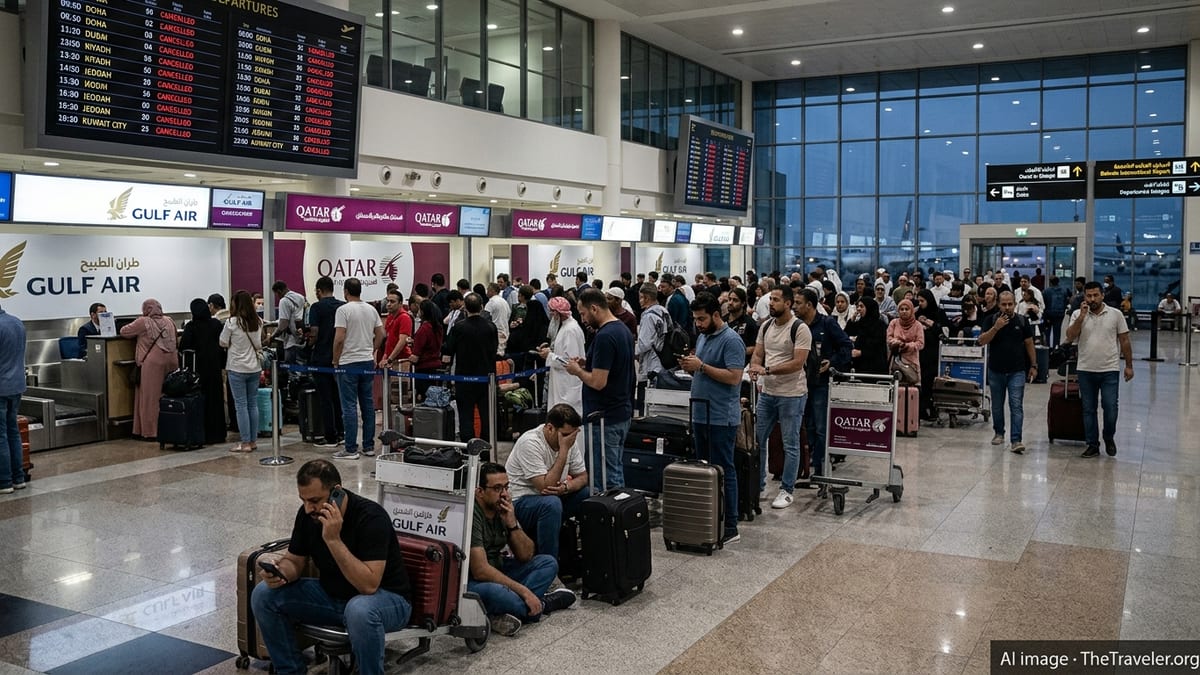
Grounded Operations at Bahrain’s Main Gateway
Publicly available airline and aviation data show that Bahrain’s national carrier, Gulf Air, has been hit particularly hard, with its home base at Bahrain International Airport effectively sidelined amid the ongoing regional security crisis. Recent operational updates indicate that the majority of the airline’s scheduled services through Manama remain suspended, with aircraft repositioned to alternate airports in neighboring Saudi Arabia to keep a minimal network moving.
The latest counts from flight-tracking dashboards and schedule adjustments suggest that Gulf Air has canceled dozens of departures and arrivals touching Bahrain in recent days, targeting high-frequency routes to Dubai, Riyadh, Jeddah and Kuwait City. These cuts, combined with parallel reductions by Qatar Airways on overlapping corridors, make up the estimated 94 affected flights now rippling through the region’s tightly interconnected aviation system.
Passengers who once relied on simple one-stop connections via Bahrain are instead confronting complex, multi‑segment itineraries or forced overland transfers to open airports. Travel forums and consumer reports describe long queues at ticket desks, difficulty reaching call centers and a sharp spike in last‑minute fares on unaffected carriers as demand overwhelms remaining capacity.
While rescue and repatriation flights are gradually appearing on schedules, regular commercial operations through Bahrain remain heavily constrained, with no clear timeline yet visible for a full restoration of Gulf Air’s traditional hub‑and‑spoke model at the airport.
Doha and Qatar Airways Struggle With Prolonged Disruptions
In Doha, Qatar Airways continues to work through the fallout of earlier airspace closures and missile threats that led to widespread cancellations from Hamad International Airport. According to published coverage on the 2026 Iran conflict and its aviation impact, Qatar’s airspace was periodically restricted, forcing the carrier to suspend many of its flagship long‑haul and regional services and rely instead on limited emergency and repatriation flights.
Updated passenger guidance posted by the airline in early March introduced expanded options for those affected by cancellations, including rebooking on alternative routings and, in some cases, rerouting on other carriers. However, travelers documenting their experiences in online communities report that scheduled flights between Doha and cities such as Dubai, Riyadh and Jeddah have repeatedly appeared on timetables before being withdrawn at short notice, compounding uncertainty for anyone planning onward connections.
The resulting patchwork of partial operations and sudden schedule changes has meant that a significant portion of the 94 combined cancellations attributed to Qatar Airways and Gulf Air involves short‑haul Gulf routes that once functioned as reliable shuttle services between major business and pilgrimage centers. For many passengers, the loss of these dense regional links has proved more disruptive than long‑haul cuts, because alternative ground transport is limited and remaining seats on competing airlines are scarce.
As Qatar’s civil aviation authorities gradually reopen narrow operating corridors under heightened security protocols, standard commercial services through Doha are returning in phases, but industry observers note that the network remains far from its pre‑crisis stability.
Shockwaves Across Dubai, Riyadh, Jeddah and Kuwait City
The turbulence at Bahrain and Doha is reverberating through other Gulf megahubs that normally rely on smooth regional traffic flows. In Dubai, recent reports on the 2026 Iran war detail repeated drone and missile incidents around Dubai International Airport, including a mid‑March strike that briefly ignited a fuel facility and forced a temporary halt to flights. Even as local carriers such as Emirates and flydubai restore limited operations, the airport’s role as a flexible diversion point for Bahrain‑ or Doha‑bound travelers has been sharply curtailed.
Saudi Arabia’s main gateways in Riyadh and Jeddah have become crucial pressure valves, absorbing rerouted Gulf Air flights and a surge in passengers seeking alternative paths to Europe, Asia and North America. Aviation tracking data and airline announcements point to additional rotations from Dammam and other Saudi airports set up explicitly to move travelers who would normally transit via Bahrain. This has helped ease some bottlenecks but has also strained airport infrastructure and ground services, especially during peak departure waves.
Kuwait City, already affected by its own airspace concerns linked to the broader regional conflict, has likewise seen intermittent suspensions that intersect with Bahrain‑ and Doha‑related cancellations. With Kuwait’s airport handling fewer international departures than its larger Gulf rivals, any reduction in flights can quickly translate into limited options for residents and expatriates trying to connect onward.
Collectively, these disruptions have transformed what are usually hyper‑efficient regional corridors into a patchwork of opportunistic routes, with travelers forced to piece together journeys that might include a combination of rare direct flights, lengthy layovers and, in some cases, overland transfers between Gulf states.
Stranded Passengers Face Mounting Costs and Complex Rebookings
For individual travelers, the operational statistics translate into days of uncertainty and escalating costs. Accounts posted on travel forums and social platforms describe passengers whose Gulf Air flights from Dubai or other cities via Bahrain were canceled multiple times before they could secure seats on flights departing from Saudi Arabia. Many report paying substantially higher fares on alternative airlines or booking fully refundable backup tickets in the hope of salvaging time‑sensitive trips.
Qatar Airways customers detail similar challenges, particularly those scheduled to connect in Doha for long‑haul journeys to Europe, North America or Australasia. Some travelers report that flights initially flagged as operating were later withdrawn within 24 hours of departure, leaving limited opportunities to rebook onto already full services from regional competitors.
Consumer advocates note that passenger rights frameworks in the Gulf vary by jurisdiction and often differ from compensation regimes in Europe, complicating efforts to obtain refunds or reimbursement for accommodation and incidental expenses. While both Gulf Air and Qatar Airways have published extraordinary disruption policies in response to the ongoing crisis, the on‑the‑ground experience for many travelers remains a patchwork of case‑by‑case decisions influenced by call center capacity, local regulations and rapidly changing operational conditions.
With the regional situation still volatile, travel industry analysts advise that anyone planning journeys through Bahrain, Doha, Dubai, Riyadh, Jeddah or Kuwait City in the coming days should build in extra time, consider flexible tickets and monitor airline communications closely, as further schedule changes remain likely.
Wider Impact on Global Air Routes and the Gulf’s Hub Role
The wave of cancellations at Bahrain International Airport and across the networks of Gulf Air and Qatar Airways forms part of a broader aviation shock to the Middle East. Economic analyses of the 2026 Iran war estimate that thousands of flights a day have been affected by overlapping airspace closures in Bahrain, Qatar, Kuwait and the United Arab Emirates, temporarily dimming the Gulf’s status as a seamless crossroads between continents.
Long‑haul carriers from Europe and Asia have been forced to redesign flight paths to avoid conflict‑adjacent skies, often adding time and fuel costs that erode the efficiency advantages of traditional Gulf routings. Some have suspended services entirely to key hubs such as Dubai and Doha during the most intense periods of disruption, narrowing options further for passengers stranded by Gulf Air and Qatar Airways cancellations.
Regional tourism boards and airport operators are now contending with a sudden drop in transit traffic, hotel stays and retail spending that underpin many Gulf economies. While evacuation and special charter flights provide short‑term relief for stranded visitors, they do little to replace the consistent, high‑volume flows of business travelers and holidaymakers that normally pass through Bahrain and its neighboring hubs.
Industry observers caution that even once security conditions improve and airspace restrictions ease, airlines may take time to rebuild full schedules and restore traveler confidence. For now, the 94 flight cancellations attributed to Gulf Air and Qatar Airways represent only a visible slice of a much larger shock to the region’s role in global aviation, leaving passengers and travel planners to navigate an unusually fragile and unpredictable network.