

More news on this day
Thousands of air travelers across China, Laos, Thailand and India are facing rolling delays and cancellations this week as severe weather, air-traffic control constraints and network knock-on effects combine to snarl key routes across mainland Southeast and South Asia.
Get the latest news straight to your inbox!
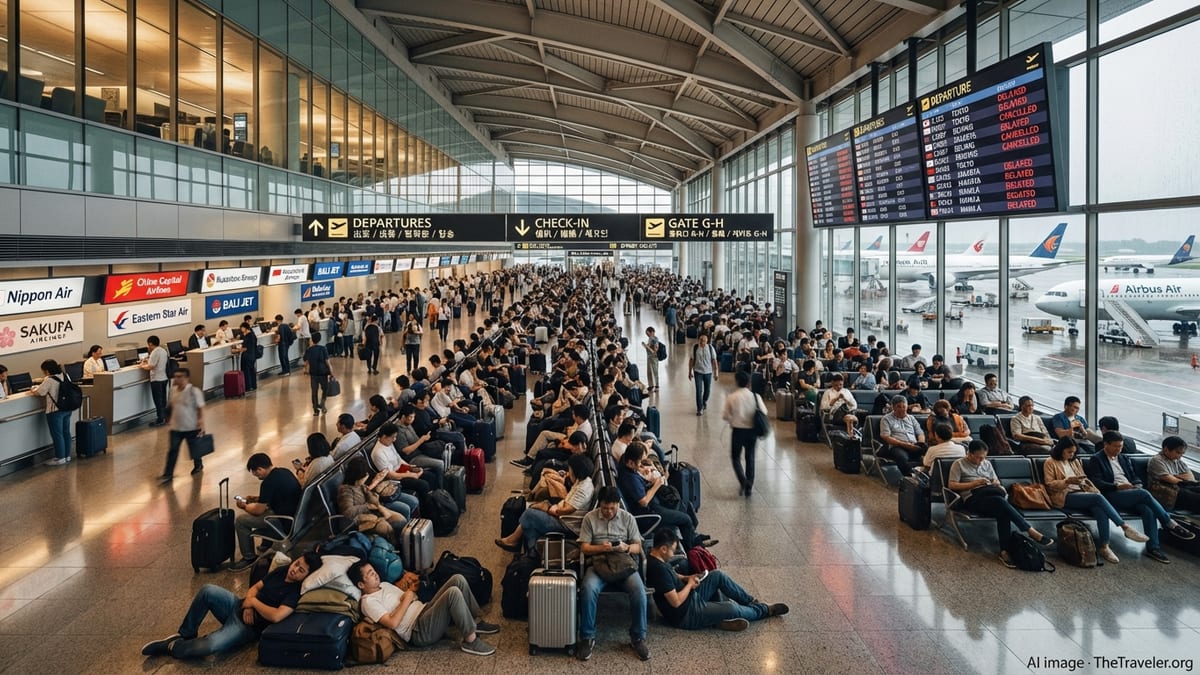
Storm Systems Slam Chinese and Thai Hubs
Publicly available aviation tracking data for early April 2026 shows that a series of storm fronts over eastern and southern China have triggered extensive disruption at major gateways, including Beijing, Shanghai, Shenzhen and Chengdu. Heavy rain, low cloud and thunderstorms around Shanghai Pudong and Beijing Daxing in particular have forced temporary ground stops and reduced departure rates, leading to queues of aircraft and mounting delays.
Recent tallies compiled from airport departure boards indicate that hundreds of flights within China have either been cancelled or significantly delayed over the past several days. Travel and aviation industry coverage points to more than two hundred cancellations and well over a thousand delays affecting carriers such as Air China, China Eastern and China Southern, with the impact radiating onto connecting services across Asia and beyond.
Thailand is experiencing parallel turbulence, though for slightly different reasons. Airports of Thailand has reported more than one hundred affected flights at Bangkok’s Suvarnabhumi and Don Mueang airports over recent days, linked partly to aircraft arriving late from weather hit Chinese cities and partly to schedule adjustments by Middle East and regional carriers. While terminals remain open and operational, many passengers are encountering last minute gate changes, rolling delay estimates and missed onward connections.
The combination of meteorological disruption in China and tight capacity at Bangkok’s hubs is rippling through Southeast Asia’s dense short haul network. This is particularly visible on popular routes connecting Bangkok with southern China, northern Thailand and secondary cities in Laos, where smaller airports have less room in their schedules to absorb incoming delays.
Laos Faces Knock On Disruptions from Regional Gridlock
Although Laos handles far fewer flights than its larger neighbors, the country’s main gateways at Vientiane and Luang Prabang are feeling the effects of the wider regional gridlock. Publicly available schedules show a high dependence on feeder traffic from Bangkok, Kunming, Hanoi and other nearby hubs, which means delays or cancellations upstream quickly translate into long waits and occasional overnight strandings for passengers in Laos.
Reports from regional travel outlets indicate that services operated by Thai, Lao and Vietnamese carriers have been especially vulnerable when aircraft and crew are held up in storm affected Chinese airspace. In several instances, heavily delayed inbound aircraft have arrived in Laos after local night curfews or crew duty limits, forcing airlines to cancel the planned return leg and rebook travelers for the following day.
The limited redundancy built into Laos’s aviation network is amplifying the disruption. Many routes operate with only one or two daily frequencies and rely on a single aircraft rotation. When that rotation is broken by severe weather or an upstream air traffic control restriction, there are few spare planes or alternate flights available to clear the backlog quickly.
Travel agents in the region are therefore encouraging passengers headed to or from Laos to allow additional buffer time in their itineraries, particularly if their journey depends on tight connections in Bangkok or Chinese cities that have been repeatedly affected by storms and congestion since the start of April.
India’s Congested Skies Struggle With Regional Spillover
India is confronting its own wave of delays at major hubs, compounded by the wider Asia Pacific turbulence. Data compiled by aviation analytics firms for the past forty eight hours points to hundreds of late departures and arrivals at Delhi, Mumbai, Kolkata and Chennai, with dozens more reported at second tier airports. Some of this disruption reflects local weather and airport congestion, but a mounting share is being traced to aircraft arriving behind schedule from Southeast and East Asia.
India’s domestic network has only recently begun to stabilize after a high profile operational crisis at one of its largest low cost carriers, where aggressive timetables and new crew duty rules triggered widespread cancellations during the winter season. Although schedules have since been trimmed and regulators report improved on time performance overall, the system remains sensitive to shocks arriving from outside the country’s borders.
In the current wave of disruption, long haul and regional services linking India with China, Thailand and other nearby markets have been the first to show strain. Aircraft that depart late from weather affected hubs in China or Southeast Asia typically arrive in India at or beyond their scheduled turnaround times, forcing airlines to juggle rotations, swap equipment and delay subsequent domestic flights. Publicly available information from airport dashboards in Delhi and Mumbai shows banks of departures pushed back by several hours at peak times.
Industry analysts note that Indian carriers are also managing continued airspace and routing complications on some westbound sectors, stemming from earlier regional tensions and volcanic activity over parts of the Middle East and East Africa. While those issues are separate from the current storm related chaos in East Asia, together they have narrowed operational flexibility and reduced the ability of airlines to recover quickly when new disruptions arise.
Passengers Confront Long Queues, Sparse Information
Across China, Laos, Thailand and India, the human impact of the latest aviation turmoil is visible in crowded terminals, long check in and security lines, and passengers queuing at customer service desks in search of rebooking options. According to published coverage from multiple regional outlets, some travelers have been forced to spend nights on terminal floors as hotels near major airports quickly filled during the worst of the disruption.
Information gaps remain a recurring complaint. While many airlines now push real time updates through mobile apps and text messages, delays driven by cascading network effects can be hard to predict. Departure boards at several major Asian hubs have shown rolling twenty or thirty minute extensions to departure times, only for flights to remain grounded far longer as crews and aircraft fail to arrive in position.
Consumer advocates in the region point out that compensation and care rules differ widely across the four affected countries, and often depend on whether the disruption is classified as weather related, operational or within the airline’s control. In practice, this has led to uneven experiences for passengers who, on the same crowded concourse, may receive meal vouchers or hotel rooms from one carrier while only being offered rebooking on a later flight by another.
Travel insurers are beginning to flag the episode as a reminder of the value of trip interruption and delay coverage on complex itineraries. Policy summaries reviewed by travel media show that some products will reimburse additional accommodation and meal costs after delays of a set number of hours, provided travelers keep receipts and documentation from their airline.
What Travelers Should Expect in the Coming Days
Forecasts from meteorological agencies across East and South Asia indicate that unsettled weather is likely to persist over parts of China and the wider region through the coming days, although individual storm cells are expected to move quickly. Aviation specialists following the situation suggest that airlines will focus on gradually restoring core schedules rather than immediately clearing all backlogs, which means some residual delays are likely even after skies begin to clear.
Airports and carriers in China, Laos, Thailand and India are also reviewing staffing and stand allocation to cope with irregular operations, according to publicly available operational notices and statements. These measures include opening additional check in counters during peak disruption periods, adjusting runway use to handle compressed departure banks and, in some cases, proactively trimming frequencies on the most congested routes.
For travelers with imminent trips through the region, the prevailing advice from travel agencies and airline guidance is to monitor flight status closely on the day of departure, arrive early at the airport and prepare contingency plans for missed connections. Flexible tickets, direct routings where possible and overnight stopovers instead of tight same day transfers are being recommended for those traveling through the most affected hubs.
While the current chaos underscores the vulnerability of Asia’s fast growing aviation market to simultaneous weather and operational shocks, it is also prompting renewed discussion about resilience. Industry observers note that investments in air traffic control modernization, better regional data sharing and more realistic scheduling buffers may become higher priorities as governments and airlines seek to prevent similar multi country disruptions in future peak travel periods.