

More news on this day
Air passengers across Europe faced another bruising travel day on February 22 as 49 flights were grounded and 371 delayed across France, Germany and the United Kingdom, with major carriers British Airways, Air France, Finnair and KLM forced to trim schedules and re-route aircraft amid deteriorating weather and stretched airport operations.
France, Germany and UK Bear the Brunt of Fresh Disruptions
The latest wave of disruption hit some of Europe’s busiest aviation corridors, with cancellations and delays concentrated on short and medium haul routes linking Paris, London, Frankfurt, Munich and key regional airports. Flight tracking data and airport operations reports indicated that weather-related air traffic restrictions and knock-on operational issues combined to push the day’s numbers to 49 outright cancellations and 371 delays across the three countries.
In France, Paris Charles de Gaulle and Orly saw clusters of scrapped and late departures, particularly on morning and late evening rotations where low visibility and gusting winds constrained runway capacity. Services to and from regional hubs such as Lyon, Nice and Toulouse were also affected, compounding pressure on domestic travellers and those using Paris as a connecting gateway for long haul flights.
Germany’s major hubs, led by Frankfurt and Munich, contended with similar challenges as winter systems moved across central Europe, forcing air traffic controllers to space arrivals and departures further apart. This ripple effect left aircraft and crews out of position for subsequent legs, triggering a small but disruptive wave of cancellations on feeder routes into Germany from the UK and neighbouring states.
In the UK, London Heathrow, Gatwick and Manchester reported elevated delay levels through the day as stacking in holding patterns increased and ground handling teams struggled to work around intervals of heavy rain and crosswinds. Many passengers experienced missed connections onto transatlantic and European services, even when their original flights eventually departed.
British Airways, Air France, Finnair and KLM Among Hardest Hit
National carriers British Airways and Air France, along with Nordic operator Finnair and Dutch flag carrier KLM, featured prominently in the day’s disruption statistics as they operate dense schedules through the affected airspace and rely on tightly timed hub banks at London, Paris, Helsinki and Amsterdam. When poor weather and flow restrictions interrupt those banks, even a relatively modest number of cancellations can create outsized consequences for passengers.
British Airways trimmed frequencies on several intra-European rotations from London, with selected departures to German and French business destinations removed from the timetable to free up aircraft and crews for later waves. Some services were consolidated, meaning passengers booked on cancelled flights were moved onto remaining departures where seats were available.
Air France reported cancellations and extended delays on short haul services from Paris to British and German cities, particularly those scheduled in the early morning and late at night when operating windows are tighter. Turnaround times lengthened as aircraft queued for de-icing and slot approvals, while ground operations contended with wet, blustery conditions.
Finnair and KLM, though based further north in Helsinki and Amsterdam, were drawn into the disruption web through their extensive European networks that intersect with French, German and UK airspace. Select feeder services into Paris, London and German hubs were delayed or scrubbed as the airlines adjusted flying programmes and sought to maintain long haul connectivity where possible.
Key Routes and Airports Most Affected
While the disruption was spread across multiple city pairs, several high-density corridors bore the brunt of the cancellations and longest delays. Routes connecting London with Paris, Frankfurt, Munich and Amsterdam saw above-average schedule changes as airlines prioritised flights with high onward-connection volumes and reallocated aircraft accordingly.
In France, heavily trafficked domestic sectors such as Paris to Nice, Toulouse and Marseille were among those affected, particularly where aircraft were inbound from weather-hit airports in the UK or Germany. Travellers connecting through Paris to long haul destinations in North America, Africa and Asia reported tight or missed connections as inbound flights arrived late into already busy transfer banks.
German hubs experienced bottlenecks on services to and from London, Paris and major Scandinavian and Eastern European cities. Short haul flights that typically operate multiple rotations per day were particularly vulnerable; a delay or cancellation early in the sequence often cascaded into subsequent legs, forcing operators to reshuffle aircraft and crew assignments.
In the UK, Heathrow and Gatwick saw disruptions ripple beyond flights operated by the four headline carriers, affecting codeshare and alliance partners that rely on those airports as primary European gateways. Regional airports with thinner schedules, such as Birmingham, Bristol and Edinburgh, also recorded delays when aircraft and crews based at larger hubs were held up.
How Many Passengers Are Affected and What They Are Experiencing
Aviation analysts estimate that the grounding of 49 flights across the three countries likely disrupted travel for several thousand passengers directly, while the 371 delayed services will have affected tens of thousands more through missed connections, extended layovers and late arrivals. Each cancelled flight typically strands between 100 and 250 people, depending on aircraft type and load factor.
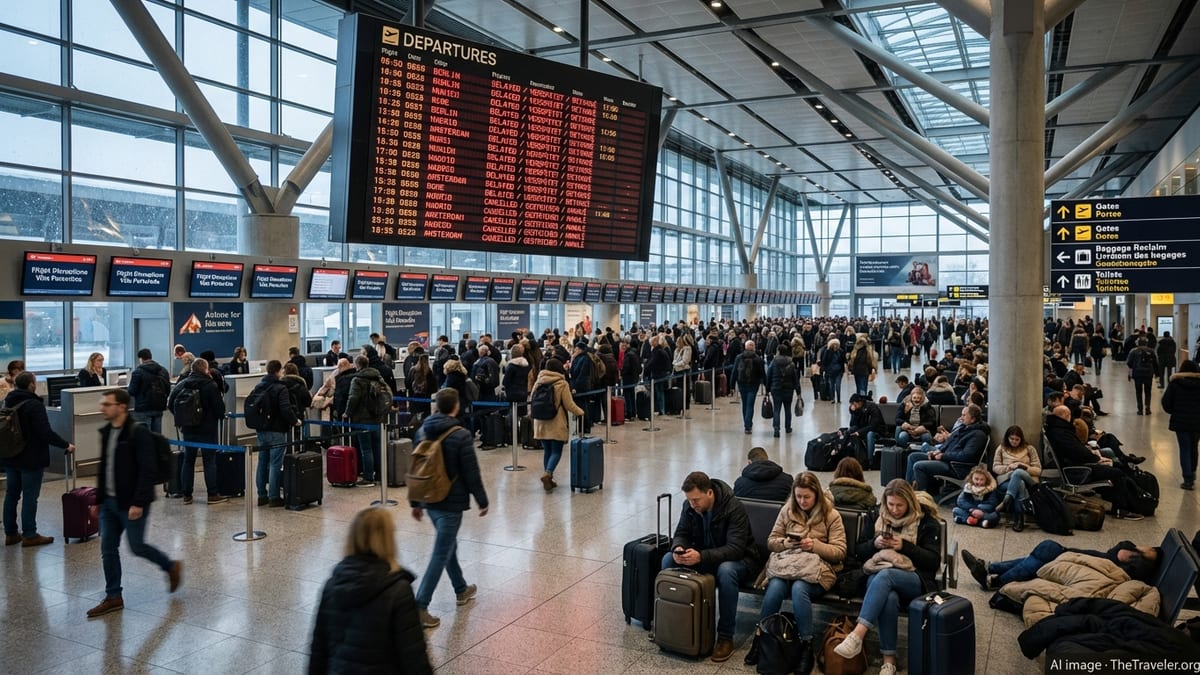
At airports, travellers described long queues at airline customer service desks and transfer counters as they sought rebooking options, hotel vouchers and meal allowances. Screens filled with “delayed” notices at peak times, and many passengers reported spending hours waiting for updated departure times or gate changes as operations teams worked through congested schedules.
Families returning from half-term breaks and business travellers with tightly planned itineraries were among those hardest hit. Some reported being re-routed via secondary hubs in Spain, Italy or the Netherlands in order to reach final destinations in time for meetings or onward connections. Others were forced to overnight in airport hotels when onward flights had already departed or were fully booked.
The impact was felt beyond terminals as well, with rail and coach operators around London, Paris and major German cities experiencing a surge in last-minute demand from stranded passengers seeking alternative ways to complete their journeys.
Weather, Staffing and Capacity Pressures Behind the Disruption
While adverse winter weather provided the trigger for the day’s disruption, industry observers point to a broader backdrop of operational fragility across European aviation. Airports and airlines continue to operate with relatively tight staffing margins in ground handling, maintenance and air traffic control, leaving systems more vulnerable when weather degrades or traffic surges.
In France and Germany, low cloud ceilings, heavy rain and crosswinds prompted air traffic flow management measures, requiring aircraft to accept longer routing, lower speeds and wider spacing on approach. These conditions significantly reduce the number of flights that can safely land or take off within a given time window, forcing airlines to cut frequencies or accept rolling delays.
Carriers also grapple with aircraft and crew rostering constraints when disruption extends across multiple days. A single weather event can cause aircraft to be out of position and crews to exceed legal duty time limits, requiring aircraft substitutions or cancellations while operators work to reset the system. This effect was evident in the way today’s timetable was shaped by earlier weather systems that had already stressed networks in January and February.
Industry groups have repeatedly warned that Europe’s major hubs are operating close to capacity during peak waves, leaving little buffer when conditions deteriorate. Today’s figures underscore how even modestly elevated cancellation numbers can translate into widespread inconvenience when they hit at the wrong point in the daily operating cycle.
What Rights Passengers Have Under EU261 and UK Rules
For travellers caught up in the disruption, one of the most pressing questions is compensation and care. Under European Union regulation EU261 and equivalent UK rules, passengers whose flights are cancelled or significantly delayed may be entitled to assistance, refunds or compensation, depending on circumstances.
When a flight is cancelled, airlines must generally offer a choice between a refund of the unused ticket portion or re-routing at the earliest opportunity under comparable transport conditions. They are also required to provide care in the form of meals, refreshments and hotel accommodation where an overnight stay becomes necessary, as well as transport between the airport and place of accommodation.
Cash compensation, however, depends on the cause of disruption. If cancellations or long delays are due to extraordinary circumstances such as severe weather or air traffic control restrictions beyond the airline’s control, carriers may be exempt from paying compensation, though obligations to provide care and re-routing still apply. Where operational or staffing issues within the airline’s control are a contributing factor, compensation may be claimable.
Passengers are advised to retain boarding passes, booking confirmations and receipts for any out-of-pocket expenses such as meals, ground transport and accommodation. These documents are often required when submitting claims directly to airlines or via specialist claims services and consumer organisations.
Practical Advice for Travellers Caught in the Chaos
Travel experts recommend that affected passengers take a proactive approach when disruption hits. Checking flight status directly with the airline’s app or departure boards before leaving for the airport can help travellers avoid unnecessary journeys if cancellations have already been announced. Where services are delayed but still scheduled to operate, arriving earlier than usual may improve chances of securing alternative options if rebooking becomes necessary.
At the airport, using multiple channels simultaneously can speed up rebooking. While queues at staffed desks may be long, many airlines now enable same-day changes and alternative routing through mobile apps and call centres. Some passengers have had success contacting airlines through social media messaging, where dedicated disruption teams can sometimes process changes more quickly than crowded counters.
Those with flexible plans might consider accepting re-routing via less congested hubs or to nearby alternative airports, particularly in regions of France and Germany with good rail links. For example, travellers heading to London may be offered flights to other UK airports with onward rail connections, while passengers bound for German cities can sometimes be rebooked to nearby hubs and complete journeys by train.
Experts also stress the importance of keeping receipts and noting the names and times of airline staff interactions. This record makes it easier to pursue reimbursement or formal complaints later, especially where passengers believe their rights under EU261 or UK regulations have not been fully respected.
What Comes Next for Europe’s Winter Travel Season
The latest figures of 49 cancellations and 371 delays highlight how sensitive Europe’s air travel system remains to weather and operational strains this winter. With several weeks of potentially unsettled conditions still ahead, airlines and airports are under pressure to fine-tune schedules, strengthen staffing and improve communication with passengers when irregular operations occur.
Carriers such as British Airways, Air France, Finnair and KLM are expected to continue using tactical schedule cuts and aircraft swaps on marginal flights to preserve connectivity on core long haul and trunk routes. Industry analysts say that more conservative scheduling, including longer ground times and slightly lower daily utilisation of aircraft, may help absorb future shocks but could also constrain capacity and keep fares elevated on popular routes.
For passengers planning trips in the coming days, the episode serves as a reminder to build additional margin into connections, particularly when travelling through weather-prone hubs in northern and western Europe. Choosing earlier departures, allowing longer layovers and considering flexible tickets or travel insurance that covers disruption can reduce the risk of missed events and unplanned expenses.
As airlines and regulators scrutinise the latest disruption, attention is likely to focus on whether lessons from previous winters are being fully applied, from investment in de-icing and ground equipment to coordination between airports and air navigation services. Travellers, meanwhile, will be hoping that the worst of this season’s turbulence is now behind them.