

More news on this day
Major disruption across key European hubs in the United Kingdom, France and Switzerland has left passengers stranded after a fresh wave of flight cancellations and delays involving Virgin Atlantic, British Airways, Scandinavian Airlines (SAS) and Air France, according to publicly available flight data and media reports.
Get the latest news straight to your inbox!
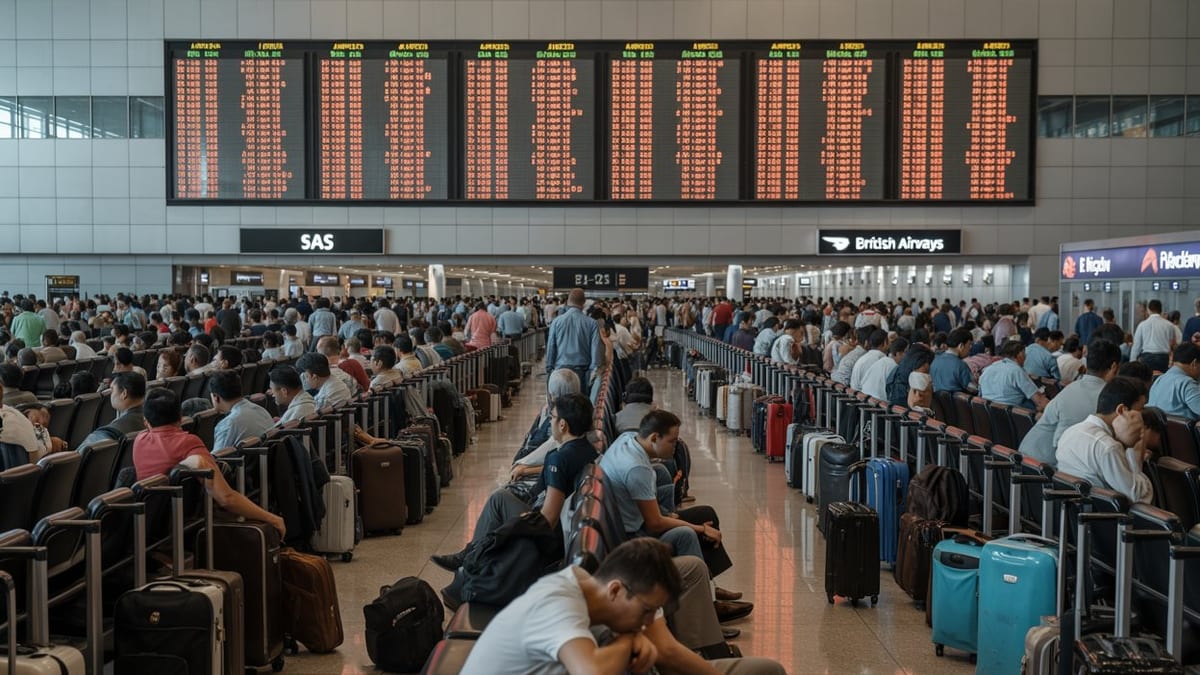
Image by Travel And Tour World
Disruption Spreads Across London, Paris and Zurich
Reports from flight tracking platforms and airport status boards on Sunday indicate widespread disruption across London, Paris and Zurich, with hundreds of services affected and knock-on delays rippling through airline schedules. Data suggests that, in total, around sixteen flights operated by or scheduled for Virgin Atlantic, British Airways, SAS and Air France have been cancelled, while roughly two thousand departures and arrivals across the three metropolitan systems have experienced delays of varying lengths.
At London’s Heathrow and Gatwick airports, the impact has been compounded by already stretched operations in recent weeks, with the UK’s aviation sector under strain from weather events, staffing pressures and broader geopolitical disruptions that are reshaping long-haul networks. British Airways and Virgin Atlantic, both heavily dependent on London as a primary hub, have been forced to trim or retime services as congestion builds.
In Paris, delays at Charles de Gaulle and Orly have interacted with broader route adjustments by Air France related to the Middle East conflict and fuel market volatility. Paris is also absorbing additional traffic that would normally transit through hubs facing more severe constraints, adding to the complexity of day-to-day operations.
Zurich, a key gateway for central Europe and a frequent transfer point for SAS and partner carriers, has reported weather-related throughput issues this month. Strong winds, low cloud and passing frontal systems have periodically reduced capacity, contributing to rolling hold times and missed connections on northbound and intra-European routes.
Multiple Factors Behind the Latest Wave of Delays
Publicly available coverage of recent aviation trends suggests that the present round of disruption is the result of multiple intersecting pressures rather than a single isolated failure. Over recent months, European operators have been contending with volatile jet fuel costs, rerouted flight paths around conflict zones, winter and early spring storms, and tight staffing levels in both airline operations and air traffic control.
Industry-focused reporting has highlighted how airspace closures and restrictions in the Middle East have lengthened journey times on a number of long-haul corridors between Europe and Asia, forcing carriers such as British Airways, Virgin Atlantic and Air France to redesign schedules, add fuel stops or cancel selected frequencies. These changes reduce slack in the system and can make major hubs more vulnerable when even minor technical or weather issues arise closer to home.
At the same time, airports in the UK, France and Switzerland have experienced their own localized shocks in the past year, ranging from infrastructure outages to windstorm damage and snow events. While recent operations at London, Paris and Zurich have largely recovered from those earlier incidents, the latest disruption shows that airlines remain in a delicate balancing act as they attempt to restore capacity to meet strong demand.
Scandinavian Airlines, which relies on a mix of Scandinavian and continental European airports to feed its network, is exposed to any instability at connecting hubs such as Heathrow, Charles de Gaulle and Zurich. Even limited cancellations or extended delays on joint or codeshare services can have outsized effects on onward journeys for passengers relying on tight transfer windows.
Passengers Face Missed Connections and Overnight Stranding
The immediate impact for travelers across London, Paris and Zurich has been a familiar pattern of missed connections, long queues at service desks and crowded terminal areas as passengers seek rebooking options. With thousands of flights across Europe running late on peak travel days, spare seats on alternative services can be scarce, particularly on transatlantic and major intra-European routes.
Travel discussion forums and social media posts from recent weeks illustrate how quickly disruption can strand passengers far from their original destination, particularly those traveling on separate tickets or tight layovers between long-haul and short-haul flights. In hubs such as Heathrow and Charles de Gaulle, delays of even an hour can be enough to break carefully planned itineraries involving Virgin Atlantic, British Airways, SAS or Air France segments.
In Zurich, weather-related flow restrictions and minor technical issues can have similar consequences. Travelers arriving late from London or Paris may find that regional connections into central and eastern Europe have already departed, leaving them reliant on hotel vouchers, overnight stays or complex rail and road alternatives to complete their journeys.
The situation is especially challenging for families, elderly passengers and those with limited flexibility in visas or onward travel bookings. With so many flights across the continent affected, options to reroute via secondary hubs such as Geneva, Lyon or Brussels are not always available on the same day, prolonging uncertainty for those already in transit.
What Passenger Rights Look Like in the UK and Europe
Despite the scale of the disruption, passengers are protected by a well-established framework of air travel rights in both the United Kingdom and the wider European area. In the European Union, Regulation EC 261/2004 sets common rules for compensation and assistance in the event of cancellations, long delays and denied boarding. Under associated agreements, similar protections apply to flights to and from Switzerland.
Following the UK’s departure from the EU, many of these provisions were transposed into British law, creating a parallel regime that continues to govern flights departing from UK airports and services operated by UK-based carriers. While the details differ slightly, both systems require airlines to provide care such as meals and accommodation during extended disruption, and in some cases financial compensation when delays or cancellations are within the carrier’s control.
However, publicly available guidance also notes that extraordinary circumstances such as severe weather, air traffic control strikes or security-related airspace closures may limit entitlement to compensation, even when the practical impact on passengers is substantial. Determining whether a specific delay is compensable can be complex, particularly when multiple factors are involved across different countries and control zones.
Consumer groups and travel advisers often recommend that affected passengers keep detailed records of boarding passes, booking confirmations and receipts for out-of-pocket expenses, and to submit claims directly with operating airlines such as Virgin Atlantic, British Airways, SAS or Air France in the first instance. Where disagreements arise, specialized dispute resolution schemes or national enforcement bodies may provide additional avenues for redress.
Outlook for Spring and Summer Travel in Europe
The latest round of cancellations and delays across London, Paris and Zurich arrives just as airlines are preparing for the busy late spring and summer travel period. Industry commentary in recent weeks has pointed to robust demand for leisure and business travel, even as carriers continue to adjust to higher fuel costs and evolving geopolitical risks.
Analysts suggest that while Europe’s aviation network has demonstrated resilience since the pandemic, it is operating with limited spare capacity. Any combination of storms, air traffic control bottlenecks, technical outages or new airspace restrictions could again trigger waves of disruption similar to those now being reported at major hubs in the UK, France and Switzerland.
For travelers, planning ahead is likely to be crucial. Expert advice commonly emphasizes booking longer connection times, favoring through-tickets on a single booking where possible, and monitoring flight status closely in the 24 hours before departure. Flexible fares or travel insurance with strong disruption coverage may help to mitigate some of the financial risk associated with large-scale operational upheaval.
As Virgin Atlantic, British Airways, SAS and Air France work to stabilize schedules and clear backlogs from the current disruption, attention will turn to whether operational resilience measures put in place since recent crises are sufficient to handle peak summer volumes. The experience of stranded passengers in London, Paris and Zurich this week highlights how quickly minor timetable stresses can evolve into system-wide travel chaos when conditions across Europe converge.