

More news on this day
Thousands of passengers moving between Australia and New Zealand are facing renewed disruption this week, as airports in Melbourne, Sydney, Auckland, Wellington and other key hubs report more than two dozen flight cancellations and hundreds of delays affecting services operated by Qantas, Jetstar, Air New Zealand and other major carriers.
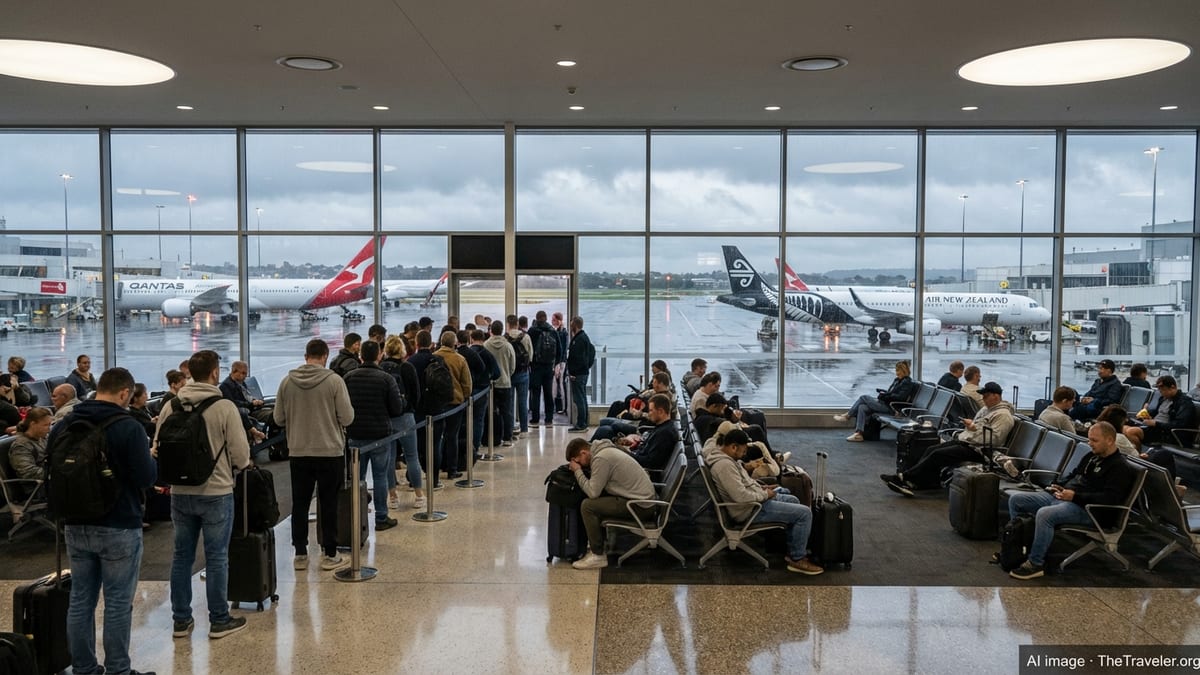
Fresh Wave of Disruptions Across Major Trans-Tasman Hubs
Operational data and airline reports from mid-February 2026 point to a new spike in travel disruption along the busy Australia–New Zealand corridor. Recent tallies show at least 27 flight cancellations and well over 500 delays in a single operational window, hitting Melbourne Tullamarine, Sydney, Brisbane, Auckland, Wellington, Christchurch and several regional airports. While schedule volatility has become an unwelcome feature of post-pandemic travel, the latest figures highlight how exposed key hubs remain to weather shocks, resource constraints and network changes.
Melbourne Tullamarine has again emerged as the epicentre of disruption, recording more than 180 delayed departures and arrivals alongside over a dozen cancellations in one recent reporting period. Sydney followed with close to 150 delays and multiple cancellations, while Brisbane, Auckland, Wellington and Christchurch all reported elevated levels of delayed services. The majority of the affected flights were operated by Qantas, Jetstar, Air New Zealand, Virgin Australia and QantasLink, underscoring how systemic pressures are rippling through multiple airline brands at once.
For travellers, the numbers translate into long queues at check-in and security, crowded departure halls and late-night scrambles for scarce hotel rooms, particularly when cancellations occur late in the evening. With many routes operating close to capacity, even a small cluster of grounded flights can quickly cascade through the network, leaving passengers stranded far from home or facing missed connections onto long-haul services.
Airport managers and airline executives insist that core schedules remain intact and that most flights are operating, if sometimes late. Yet the frequency and scale of disruption events across the Tasman in recent months have prompted growing questions about resilience in one of the world’s most economically and socially important short-haul corridors.
Wellington’s Wild Winds and Weather-Driven Chaos
One of the sharpest recent shocks has come from the weather. On February 15 a deep low-pressure system barrelled across New Zealand’s lower North Island, bringing violent winds, heavy rain and large swells in Cook Strait. In Wellington, gusts measured at close to 200 kilometres per hour forced the suspension of scores of flights, with the capital’s airport warning of major disruption as aircraft struggled to land or take off safely in crosswinds and turbulence.
Local authorities reported power cuts to tens of thousands of homes and businesses, while emergency services dealt with fallen trees and damaged roofs across the region. Ferry services on the vital Wellington–Picton link were halted, compounding the sense of isolation for communities that rely on both air and sea connections. For airlines, the conditions left little room for manoeuvre, with Air New Zealand, Jetstar and Qantas cancelling or significantly delaying services into and out of Wellington and rerouting some aircraft to less affected airports where possible.
The storm followed another battering in January, when destructive winds over Wellington led to about 81 cancellations in a single day at the capital’s airport. Air New Zealand said those conditions triggered widespread disruption across its domestic network, as aircraft and crews were left out of position for subsequent flights. The latest February event has revived concerns that the country’s increasingly volatile climate is making already weather-sensitive airports such as Wellington more vulnerable to frequent shutdowns.
Passengers caught up in the recent storms reported spending long stretches on terminal floors waiting for news of revised departure times, with uncertainty often compounded by shifting forecasts and air traffic control restrictions. For travellers relying on tight domestic-international connections through Auckland, Wellington or Christchurch, a single weather-related delay on a short hop can mean the loss of a long-haul seat, with rebooking options limited during peak periods.
Melbourne and Sydney Grapple With Volume and Knock-on Delays
In Australia, the latest wave of disruption has once again shone a spotlight on Melbourne and Sydney, the country’s two busiest international gateways and the primary launch points for trans-Tasman flights. Recent statistics covering a single day of operations showed Melbourne recording 183 delays and 11 cancellations, while Sydney logged 147 delays and four cancellations, with Qantas, Jetstar, Virgin Australia, Air New Zealand and QantasLink all affected.
Airport operations specialists say such clusters of delays can stem from a mix of factors that build over the course of the day. Early-morning weather restrictions, ground-handling bottlenecks or isolated technical issues can slow turnaround times, forcing aircraft into late departures that then knock on to the next sector and then the next. With many trans-Tasman flights scheduled in tight waves to optimise connections on both sides of the Tasman Sea, a series of minor holdups can quickly evolve into region-wide disruption.
In Melbourne, recent route decisions are also reshaping the operational landscape. Qantas has signalled the end of its Q400 turboprop services from Melbourne to Albury and Wagga Wagga from March 1, a move the airline says will allow it to redeploy aircraft and crew more efficiently within its domestic network. While those changes are framed around long-term reliability and performance, in the short term any adjustment in base locations and aircraft types requires careful coordination to avoid gaps that can worsen disruption when irregular operations occur.
At Sydney Airport, where runway and airspace constraints already make the operation sensitive to even small timetable slippages, the recent flurry of delays has renewed calls from travel industry groups for clearer real-time communication to passengers. With many travellers relying on Sydney for same-day connections to Asia, North America and Europe, domestic and trans-Tasman reliability is increasingly viewed as a critical part of Australia’s international competitiveness.
Airlines Under Pressure: Qantas, Jetstar and Air New Zealand
The latest disruption has arrived at a delicate moment for the region’s major airlines. Qantas is still working to rebuild public trust after a string of high-profile complaints and regulatory fines in recent years, while Air New Zealand continues to balance strong demand with fleet renewal and maintenance windows. Jetstar, the low-cost arm of Qantas, has been expanding aggressively on domestic New Zealand and trans-Tasman routes, creating both new opportunities and fresh operational complexity.
In early February, Qantas began flying its new Airbus A220 aircraft on services between Brisbane and Wellington, replacing older Boeing 737 jets on several weekly rotations. The aircraft promises reduced noise and emissions alongside lower fuel burn, factors that could improve reliability during disruption-prone weather events. Yet the introduction of new types also requires updated training for pilots, cabin crew and engineering staff, and any teething issues can ripple through schedules while networks adjust.
At the same time, QantasLink has announced the closure of three regional crew bases from April, as part of a restructuring that aims to concentrate staff in larger ports where disruption responses can be centrally coordinated. A Senate inquiry has already criticised the handling of those closures, warning that poorly managed change can threaten both employee wellbeing and operational stability. For travellers, the risk is that any gaps in staffing coverage or local expertise could make it harder for airlines to recover quickly when weather or technical issues arise.
Jetstar’s pilot workforce is also in the spotlight, with unions securing approval in early February for the option of protected industrial action if current wage and rostering negotiations fail to progress. While no strike dates have been set, the potential for work stoppages or overtime bans later in the year hangs over the carrier’s ambitious schedule growth in New Zealand and across the Tasman. Even the threat of industrial action can complicate planning for airlines already juggling tight crew rosters and high aircraft utilisation.
Patterns of Repeated Disruption Since Late 2025
Recent turbulence is not an isolated event. Data from late 2025 through early 2026 points to a pattern of repeated disruption episodes affecting flights between Australia and New Zealand. Late last year, staffing shortages and scheduling glitches led to more than a dozen cancellations and hundreds of delays across the corridor over a short period. Subsequent months have seen further peaks, including reports of over 70 cancellations and more than 300 delays across multiple days, followed by a later episode involving more than 140 cancellations and more than 700 delays.
These spikes have tended to coincide with either severe weather, such as strong winds in Wellington or storm systems across eastern Australia, or with peak holiday travel periods when networks are running at full stretch. In some cases, capacity reductions due to aircraft maintenance or delayed deliveries have forced carriers to trim schedules at short notice, leaving less buffer to absorb irregular operations. As a result, what might once have been contained disruption at a single airport now more easily spreads across several hubs.
Travel analysts note that the concentration of trans-Tasman services into a handful of key airports means that any single-day disruption can have lasting after-effects. Aircraft that end the day in the wrong city can create knock-on cancellations the following morning, while crew reaching duty-time limits may be unable to operate later rotations, forcing last-minute reassignments. In an environment where airlines are keen to maximise utilisation to offset higher costs, there is limited slack in the system to recover from shocks.
The cumulative effect is a sense among frequent flyers that disruption is no longer a rare inconvenience but an increasingly common feature of trans-Tasman travel. While on-time performance across the corridor remains respectable by global standards, the visibility of large-scale delay days has prompted calls for more robust contingency planning and greater transparency over the causes of each disruption episode.
Travellers Caught in the Crossfire
For passengers, the human impact of cancellations and long delays can be severe. Families with young children have reported being stuck in terminals late into the night as rolling delays push departure times back in 30-minute increments. Business travellers face missed meetings and extra accommodation costs, while international visitors on tight itineraries may lose precious days from carefully planned trips to Australia and New Zealand.
Consumer advocates say that while many disruption events are outside airline control, such as extreme weather, there is still scope to improve the experience for those affected. Clear communication of the reason for a delay, realistic estimates of revised departure times and early offers of meal vouchers or hotel accommodation where appropriate can go a long way towards maintaining goodwill. When cancellations are known hours in advance, proactive rebooking onto alternative services can help spread demand rather than forcing everyone into a last-minute scramble at the airport.
Some travellers are responding by building greater flexibility into their plans, adding overnight stays before important events or long-haul departures and opting for earlier flights in the day to allow for recovery options if something goes wrong. Others are increasingly relying on travel insurance policies that explicitly cover missed connections, additional accommodation and rebooking fees tied to airline delays and cancellations in the region.
Yet not all passengers have the means to absorb additional costs or time losses. For students, seasonal workers and residents of smaller cities reliant on connecting flights through Melbourne, Sydney, Auckland or Wellington, prolonged disruption can mean missed job opportunities, lost wages or the inability to reach family in emergencies. As disruption episodes accumulate, pressure is building on airlines and regulators to ensure compensation regimes, where applicable, adequately reflect the realities of modern travel across the Tasman.
Industry Response and Prospects for More Resilient Networks
In the face of heightened scrutiny, airlines and airports in Australia and New Zealand are emphasising their efforts to improve resilience. Carriers are investing in newer, more efficient aircraft such as the Airbus A220 and updated narrowbody jets that promise better performance in challenging conditions and lower operating costs. Several airports have stepped up recruitment of ground-handling staff and introduced new technology to speed up baggage processing and aircraft turnarounds.
Operational teams are also refining their approaches to disruption management, using more sophisticated forecasting tools to anticipate weather and congestion hot spots earlier in the planning cycle. By adjusting schedules, proactively swapping aircraft or adding spare capacity on vulnerable routes, airlines hope to reduce the severity of knock-on delays when irregular operations occur. Some have introduced dedicated “recovery” teams tasked with rapidly rebooking passengers and repositioning aircraft and crew when storms or technical issues hit.
Nevertheless, aviation experts caution that there are limits to how much resilience can be built into a network that operates on thin margins and faces rising cost pressures. More generous scheduling buffers, additional spare aircraft and larger reserve crews all come with a price tag that must be balanced against ticket affordability and shareholder expectations. As climate change contributes to more frequent bouts of extreme weather in both Australia and New Zealand, the operational challenges facing airlines are likely to intensify rather than fade.
For now, the Australia–New Zealand travel market remains in high demand, supported by strong tourism flows, business ties and family connections across the Tasman. The way airlines and airports manage the current cycle of disruption will be critical in determining whether that demand can be sustained without a lasting hit to passenger confidence. With more storms on the horizon and labour negotiations still unresolved at some carriers, travellers may need to brace for further bouts of interference before the region’s skies can be described as truly settled again.