

More news on this day
Argentina’s air travel network was thrown into fresh turmoil on March 12 as more than a dozen flights in and out of Buenos Aires were canceled and many more delayed, with low-cost carrier Flybondi, United Airlines, JetSMART, Aerolíneas Argentinas and other operators forced to reshuffle schedules and reroute passengers at the country’s busiest hubs.
Get the latest news straight to your inbox!
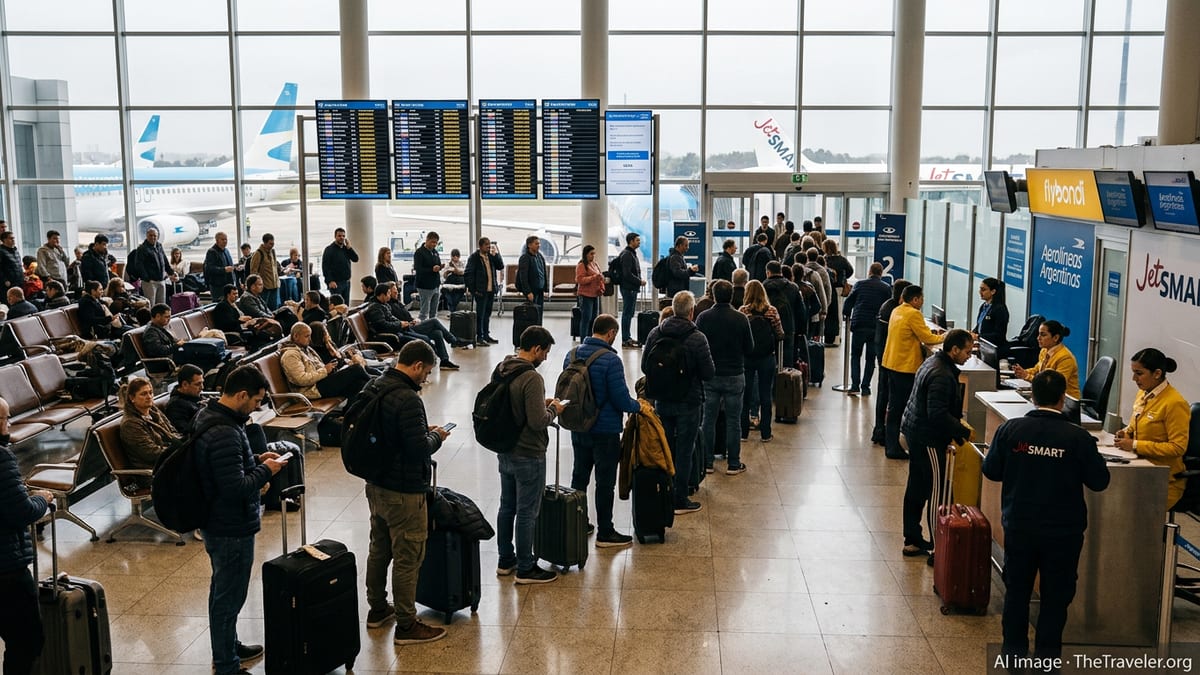
Fresh Wave of Disruptions at Buenos Aires Gateways
The latest round of disruption hit both Aeroparque Jorge Newbery, the city airport that concentrates much of Argentina’s domestic traffic, and Ezeiza’s Ministro Pistarini International Airport, the main gateway for long-haul international services. According to operational data compiled on March 12, at least a dozen flights involving Buenos Aires were canceled across several carriers, with dozens more suffering significant delays that rippled through the day’s schedule.
Flybondi once again featured prominently among the affected airlines, following months in which the budget carrier has drawn scrutiny for an unusually high rate of cancellations and late departures within Argentina’s domestic market. Analysts note that Flybondi has consistently ranked near the top of local cancellation statistics, substantially above full-service rival Aerolíneas Argentinas and low-cost competitor JetSMART, placing additional pressure on airport operations at peak times.
Long-haul connections were also hit. United Airlines, which serves Buenos Aires from major U.S. hubs, reported schedule adjustments and delays linked to the congested operating environment, adding to the difficulties for international travelers trying to make onward connections within South America. Ground handlers at Ezeiza and Aeroparque struggled to clear backlogs as aircraft and crews fell out of rotation, compressing turnarounds once operations resumed.
While the number of cancellations on March 12 was smaller than the mass groundings seen during February’s nationwide general strike, the fresh disruption underscored just how fragile Argentina’s air travel ecosystem remains in early 2026, especially when concentrated at the two Buenos Aires airports that anchor nearly all major domestic and international routes.
Background: A System Under Strain
The turbulence of March 12 comes on the heels of a punishing period for Argentine aviation. On February 19, a 24-hour general strike called by powerful labor confederations brought the country’s air transport system to a near standstill, forcing Aerolíneas Argentinas to scrub more than 250 flights and prompting JetSMART to cancel its entire schedule for the day. Low-cost rivals, including Flybondi, were also forced to ground or reroute aircraft amid shortages of ramp services, fuel and security staff.
Those industrial actions exposed structural weaknesses in how Argentina’s airports and airlines manage disruptions, particularly at Buenos Aires. When ground operations slow or stop at Aeroparque, carriers frequently attempt to shift flights to Ezeiza, which has more independent handling capabilities. But that workaround introduces its own problems, including last-minute airport changes for passengers and capacity bottlenecks on key runways and taxiways.
Data published in recent months by local aviation consultancies and national media shows that underlying reliability metrics have been deteriorating. Flybondi has led domestic rankings for cancellations, accounting for the majority of scrubbed flights in some recent periods, while Aerolíneas Argentinas and JetSMART have also recorded notable, though smaller, shares of total cancellations. Punctuality across the market has suffered accordingly, eroding traveler confidence in planning tight connections or short business trips.
Travel rights advocates say the persistence of delays and cancellations throughout 2025 and into 2026 has created a climate where many Argentine flyers now assume they must leave wide buffers before crucial events or international departures. That expectation, they argue, is a sign that chronic operational problems rather than isolated shocks are driving the current wave of travel turmoil.
Impact on Travelers and Key Routes
The March 12 disruptions were felt most acutely on trunk routes linking Buenos Aires with major provincial capitals such as Córdoba, Mendoza and Bariloche, as well as on regional international legs to neighboring countries. Many of these flights are operated multiple times daily by a mix of Aerolíneas Argentinas, Flybondi and JetSMART, meaning that a single cancellation or long delay can cascade across several rotations as aircraft and crews arrive late or go out of position.
Passengers reported extended waits in terminal halls at both Aeroparque and Ezeiza as departure boards filled with revised times and “canceled” notices. For some domestic travelers, particularly those using ultra-low-cost tickets, rebooking options were limited to later dates or different airports, while others were offered refunds or travel credits that did little to address immediate lodging and ground transport costs.
International passengers connecting through Buenos Aires were especially vulnerable. Delays on inbound flights from regional cities left tight layovers for onward services operated by carriers such as United Airlines and other overseas operators. In some cases, misaligned schedules forced passengers to overnight in the capital while airlines worked to find seats on later departures, raising out-of-pocket expenses and complicating visa and insurance arrangements.
Travel agents and corporate travel managers said they have become more cautious about building itineraries through Buenos Aires, often steering higher-yield customers toward more conservative connection times or alternative hubs in neighboring countries when possible. That shift risks diverting premium demand away from Argentina’s flag and local carriers at a time when they are already under financial and political pressure.
Airlines Respond with Rebooking and Operational Pledges
In statements following the latest wave of cancellations and delays, airlines emphasized efforts to accommodate affected passengers and to stabilize operations. Aerolíneas Argentinas and JetSMART reiterated existing policies allowing travelers on disrupted flights to rebook without additional charges within defined windows, particularly when cancellations are tied to broader operational issues rather than weather or air traffic control restrictions.
Flybondi, facing heightened scrutiny from regulators and consumer groups for its record on punctuality, has pledged to improve reliability metrics through schedule adjustments and better contingency planning. The carrier has been under pressure since regulators demanded concrete steps to reduce cancellations after a spate of weekend disruptions in late 2024 that left thousands of passengers stranded. Industry observers say the company’s performance through the first months of 2026 suggests that chronic issues have yet to be fully resolved.
International carriers such as United Airlines, which must coordinate with local ground handlers and air traffic control while also maintaining long-haul rotations, have highlighted the knock-on effects that even localized disruptions in Buenos Aires can have across global networks. When departure slots are missed or turnarounds extended, aircraft may return late to U.S. hubs, forcing schedule changes for passengers who never set foot in Argentina.
Airport authorities, meanwhile, have cited efforts to streamline communication with airlines and passengers during disruption events, including more timely updates on terminal screens and via mobile channels. However, many travelers affected on March 12 said information in terminals remained patchy and often lagged behind real-world developments at the gate, leaving them unsure whether to stay in line, seek alternatives, or leave the airport entirely.
What Passengers Should Expect in the Coming Weeks
Analysts warn that operational volatility in Argentina’s air sector is unlikely to dissipate quickly. The combination of tense labor relations, tight airline finances, and infrastructure constraints at Buenos Aires airports means that further pockets of disruption are probable as the southern hemisphere moves through the late-summer and early-autumn travel period.
Consumer advocates are urging travelers to build additional buffers into itineraries that pass through Aeroparque or Ezeiza, especially when connecting to long-haul flights or time-sensitive commitments. They also recommend that passengers familiarize themselves with airline rebooking and compensation rules, keep documentation of delays and cancellations, and maintain direct contact with carriers through official apps or call centers in case large numbers of flights are affected simultaneously.
For inbound tourists, particularly those planning multi-destination itineraries across Argentina’s vast interior, the recent turmoil serves as a reminder that domestic connections can be as critical to trip success as international flights. Travel planners suggest prioritizing routes operated by multiple airlines, avoiding last-flight-of-the-day options when possible, and considering at least one buffer day before key events such as cruises, tours or international departures.
While airlines and airport authorities acknowledge the need to restore confidence in Argentina’s aviation system, recent weeks have shown that progress will likely be incremental. Until reliability metrics improve and labor tensions ease, Buenos Aires is set to remain a challenging, if essential, hub for both domestic and international travelers navigating South America.