

More news on this day
Travelers at Detroit Metropolitan Wayne County Airport faced another day of exasperating uncertainty as Delta Air Lines and its regional partners Endeavor Air and SkyWest grounded eight flights and delayed well over 100 more, snarling key connections to cities including Greenville, Alpena, Boston, Burlington and Los Angeles and underscoring how fragile US air travel remains in the heart of winter.
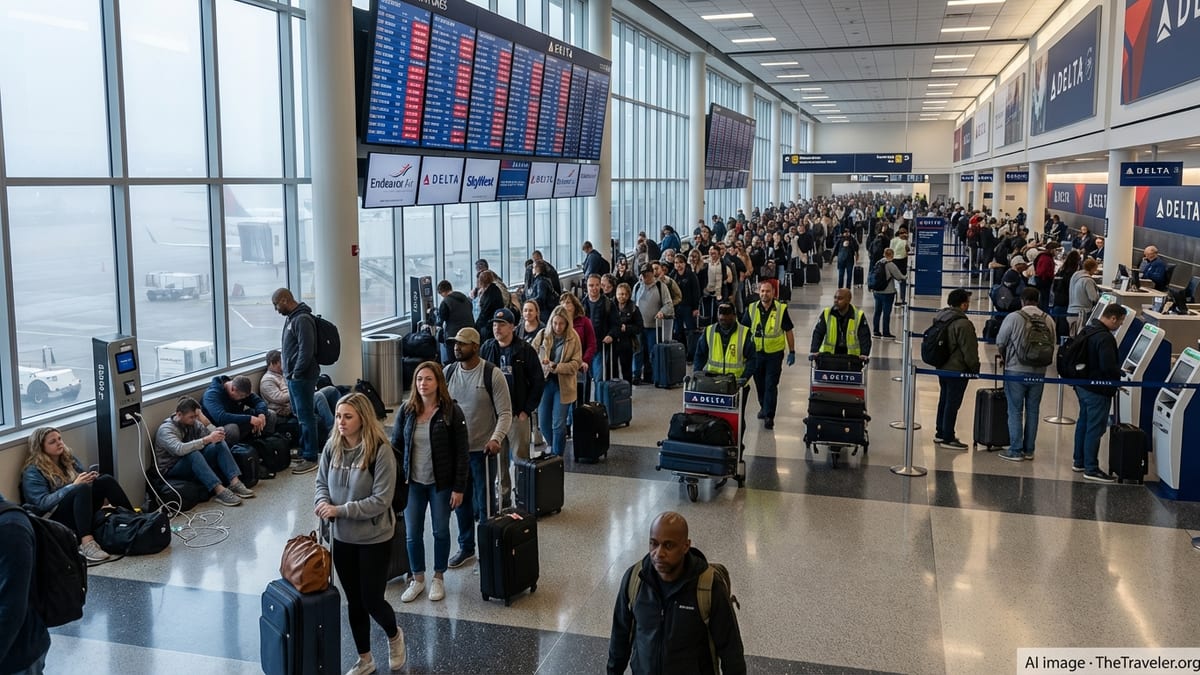
Another Disruptive Day at a Key Delta Hub
The disruption at Detroit Metro unfolded against a backdrop of already elevated nationwide delays, with weather, air traffic constraints and airline scheduling decisions combining to slow operations at some of the country’s busiest hubs. As one of Delta’s largest connecting points, Detroit plays an outsized role in feeding traffic from smaller communities and major coastal cities into the carrier’s domestic and international network.
By midafternoon, operational data showed a pattern of creeping delays radiating outward from Detroit to secondary markets, with departures to regional airports in Michigan and the upper Midwest pushed back repeatedly. That, in turn, put pressure on connections to major business and leisure destinations, from New England to Southern California, leaving passengers scrambling to rebook and reroute.
Airport officials urged travelers to arrive early and brace for extended waits at check in and security, even as real time boards cycled through a familiar pattern of “delayed,” “gate change” and “awaiting crew” messages. For many passengers, the issue was not just whether their flight would leave but whether it would arrive in time to preserve onward connections through Detroit’s tightly optimized banked schedule.
While the number of outright cancellations at Detroit remained modest compared with some recent severe weather events, the sheer volume of delays created a rolling backlog that pushed some departures into late evening, complicating crew scheduling and aircraft rotations for Delta and its regional affiliates.
Smaller Markets Feel the Shockwaves First
Communities such as Greenville and Alpena, which depend on regional jets operated under the Delta Connection banner, were among the first to feel the impact. With relatively few daily departures and limited alternative carriers, even a single grounded aircraft or extended delay can effectively sever a city’s air link for much of the day.
In Greenville, travelers booked on Delta Connection services operated by SkyWest and Endeavor reported multiple schedule revisions, with boarding times repeatedly pushed back as aircraft and crews failed to arrive from Detroit on time. For residents relying on those flights to connect onward to the East Coast or the West Coast, missed connections meant unexpected overnight stays and hastily rearranged plans.
In northern Michigan, Alpena’s lifeline to Detroit is similarly reliant on a small number of regional flights. When one departure was grounded and another significantly delayed, choices for stranded passengers quickly narrowed. Some opted to drive several hours to larger airports in search of open seats, a reminder of how quickly disruptions at a major hub can translate into isolation for smaller communities.
Local officials in affected cities have repeatedly stressed how critical reliable air links are for medical travel, business visits and tourism. Periods of repeated disruption, even when driven by factors beyond a single airline’s control, risk undermining confidence among both residents and visitors.
Major Routes to Boston, Burlington and Los Angeles Snarl
The turbulence extended well beyond regional markets. Detroit’s high demand routes to major coastal cities, including Boston, Burlington and Los Angeles, also saw cascading delays that rippled through the day. These flights are linchpins of Delta’s network, funneling Midwest and Canadian traffic into key business and leisure centers.
Boston, already contending with its own weather related challenges this winter, saw Detroit bound and Detroit originating flights pushed back as air traffic managers sequenced arrivals and departures through congested Northeast airspace. Travelers connecting in Detroit for Boston found themselves watching connection windows shrink from hours to minutes, with some ultimately missing the last feasible departures.
Farther north, Burlington sits at the intersection of regional connectivity and winter weather vulnerability. Flights linking Detroit and Burlington are especially sensitive to runway conditions and deicing requirements, and even minor slowdowns upstream in Detroit can turn into longer ground holds in Vermont as crews work within regulatory duty time limits.
On the other side of the country, Detroit to Los Angeles is a flagship corridor for Delta, feeding both domestic connections and long haul international itineraries from the West Coast. When delays in Detroit stretch into the afternoon and evening, westbound departures begin to depart late, compressing turn times in Los Angeles and threatening early morning schedules the following day.
Delta, Endeavor and SkyWest Grapple With Winter Strains
Delta Air Lines, along with Endeavor Air and SkyWest, sits at the center of this latest episode of travel turmoil partly because of its reliance on a hub and spoke model concentrated at airports such as Detroit. In ordinary conditions, that model allows efficient connections across a vast network. In periods of stress, however, it can amplify the impact of relatively small operational issues.
Winter 2025 to 2026 has already seen several major storms and cold snaps disrupt airline schedules nationwide, with Detroit and other northern hubs frequently affected by snow, strong winds and low visibility. In some cases, airlines have proactively trimmed schedules to preserve reliability, but even reduced timetables can buckle under the combined pressure of weather and air traffic control constraints.
For Endeavor Air and SkyWest, which operate many of Delta’s shorter regional flights, tight crew and aircraft utilization means a delay early in the day can reverberate through multiple subsequent legs. A Detroit to Alpena aircraft arriving late from another city, for instance, can quickly put the entire remainder of its rotation behind schedule.
Industry analysts note that the regional sector remains especially exposed to pilot staffing challenges and cost pressures. While hiring has improved compared with the immediate post pandemic period, reserves remain lean at some carriers, limiting flexibility when irregular operations strike. On a day like this at Detroit, that can translate to extended waits as airlines search for spare crews to operate delayed flights.
Passengers Confront Missed Connections and Limited Options
For passengers caught up in Detroit’s operational tangle, the most immediate pain point is often missed connections. Detroit’s schedule is built around timed “banks” of arrivals feeding outbound waves of departures. When inbound flights from cities such as Greenville, Alpena or Boston arrive late, the carefully planned choreography breaks down.
Travelers reported crowding around gate podiums and customer service desks as they sought rebooking options, only to discover that many later flights were already full or facing their own delays. With only eight outright cancellations tied to the episode, the bulk of the disruption took the form of creeping delays that were more difficult to quantify but no less frustrating.
The cost for travelers goes beyond inconvenience. Some were forced to pay for last minute hotel rooms near Detroit Metro when their rebooked flights departed the following morning, while others lost prepaid nights in vacation rentals or missed crucial business meetings. Travel insurance and credit card trip interruption benefits may offset some of these expenses, but passengers often face a complicated claims process afterward.
Families with young children and elderly travelers were particularly affected, as long hours sitting in crowded gate areas or standing in ticketing lines added a layer of physical strain to the emotional stress. For international passengers transiting Detroit on their way to or from Canada, Europe or Asia, a missed domestic connection could mean a delay of an entire day or more.
Communication, Waivers and What Travelers Can Do
In line with previous disruption events, Delta encouraged customers to use digital tools to monitor their flights and adjust plans. Online rebooking options and app notifications have become increasingly central to how major airlines manage irregular operations, allowing some travelers to secure alternate routings before reaching a human agent at the airport.
When delays reach certain thresholds, airlines commonly issue travel waivers that permit passengers to change flights without additional fees, provided they remain within a defined travel window and route structure. While specific terms vary, such waivers can be crucial for those with flexibility to shift to earlier or later flights, or even to move travel to a different day to avoid the worst of the disruption.
Travel advocates recommend that passengers facing a day like this at Detroit Metro keep boarding passes, receipts and screenshots of delay notifications, which can be useful later when seeking compensation, vouchers or reimbursement of incidental expenses. They also advise checking the status of both origin and destination airports, since conditions at either end can dictate whether a flight is allowed to depart.
For future trips, seasoned travelers increasingly build in longer connection times when routing through weather sensitive hubs during the winter months. Choosing a two or three hour layover instead of a tight turn can provide a buffer when delays start to accumulate, especially on itineraries that depend on a single daily long haul departure from Detroit or Los Angeles.
Broader Strains on the US Winter Air Travel System
The latest bout of disruption at Detroit Metro is part of a broader pattern this winter, as storms, cold snaps and operational challenges have periodically slowed air travel across the United States. Recent systems moving through the Great Lakes and Northeast have triggered hundreds of cancellations and thousands of delays, with ripple effects felt from Florida to the Pacific Northwest.
Nationally, carriers such as Delta, American, United, Southwest and their regional partners have been forced to juggle aircraft and crews amid a flight schedule that is close to pre pandemic volumes. While airlines have invested heavily in technology and operational planning tools, the sheer scale of the network means that localized problems can quickly escalate into regional or national snarls.
Detroit’s role as a connector between smaller Midwestern communities and larger coastal markets makes it especially vulnerable when storms or air traffic restrictions squeeze available capacity. Even when weather in southeastern Michigan is relatively manageable, conditions at outstations or along flight paths can force ground holds, reroutings or speed restrictions that eat into schedules.
For now, travelers passing through Detroit Metro, Greenville, Alpena, Boston, Burlington, Los Angeles and other connected cities remain at the mercy of the system’s ability to recover from each fresh shock. As airlines head into the late winter and early spring travel period, pressure will remain high to demonstrate that they can maintain reliability even as demand grows and the weather remains volatile.