

More news on this day
Hundreds of passengers were left stranded across Europe, the United States and the Middle East on Tuesday as a fresh wave of cancellations and rolling delays on SAS, Iberia, Air Algérie and British Airways disrupted at least 89 flights, snarling connections in the UK, Spain, Norway, Sweden, the Netherlands, and major US hubs from New York and Boston to Washington D.C. and San Juan.
Targeted Cancellations Ripple Across Key Transatlantic and Regional Routes
Data compiled from live flight tracking services and airport operations on February 17 indicates that the four carriers together cut around 20 departures and arrivals while another 69 services operated significantly behind schedule. While the numbers are modest compared with continent wide shutdowns seen during severe storms or strikes, the impact was amplified by the strategic importance of the routes affected, many of them key links between Northern Europe and the eastern United States.
British Airways trimmed services in and out of London Heathrow and Gatwick, with disruptions visible on flights bound for New York, Boston and Washington D.C., as well as short haul sectors feeding those long haul departures. SAS registered cancellations and long delays on services linking Scandinavian hubs such as Oslo and Stockholm with Manchester, Amsterdam and other European gateways, complicating onward connections to the US.
In southern Europe, Iberia scaled back selected departures from Madrid and Barcelona, including flights to the Caribbean gateway of San Juan and to northern European cities where winter weather and air traffic control flow restrictions have been mounting. Air Algérie, meanwhile, scrubbed and delayed several departures between Algiers and European capitals, affecting passengers travelling between North Africa, France, Spain and the UK, as well as those connecting through the carrier’s regional network.
The patchwork of schedule changes reflected a combination of operational constraints rather than a single trigger, aviation analysts said, but the distribution of affected flights meant that even a relatively small number of cancellations produced outsized queues at transfer desks and gate areas.
Passengers Stranded From Heathrow to San Juan
By Tuesday afternoon, departure boards at London Heathrow and Gatwick showed clusters of delayed British Airways and Iberia services to New York’s JFK and Newark airports, Boston Logan and Washington Dulles, with knock on effects for returning transatlantic rotations later in the day. Travellers reported extended waits on board aircraft during de icing and slot holds, followed by abrupt cancellations once crew duty time limits were reached.
At New York, Boston and Washington, arriving passengers on SAS and British Airways services faced missed connections to European cities including Manchester, Oslo, Stockholm, Madrid and Amsterdam. Some were offered hotel vouchers and rerouting via alternative hubs, while others were advised that the next available seats would not be until later in the week because peak winter flights on these routes are already heavily booked.
In San Juan, where Iberia links the Caribbean island to Madrid and beyond, disrupted services left holidaymakers and returning residents lining up at customer service counters to secure new itineraries. The cancellation of even a single long haul departure can strand several hundred passengers, and with limited alternative non stop options to Europe, rebooking often involves complex routings via the mainland United States.
Further east, passengers on Air Algérie flights at European and North African airports reported rolling departure time changes as the airline sought to sequence aircraft and crews amid a day of disrupted rotations. For travellers using Algiers as a stepping stone between African and European cities, missed connections compounded the chaos.
Weather, Congested Skies and Knock On Effects From Recent Disruptions
The latest problems come on the heels of several weeks of turbulent operations across Europe and the Middle East. A run of winter storms, patchy fog and strong crosswinds has repeatedly lowered runway capacity at major hubs in the UK, Norway, Spain and the Netherlands, forcing airlines to thin schedules and accept arrival and departure limits agreed with air traffic control.
Industry data for February shows that airports from London and Madrid to Oslo, Amsterdam and Stockholm have been grappling with elevated levels of delays and targeted cancellations as carriers attempt to protect the integrity of long haul services by trimming short haul feeders when conditions worsen. Analysts say that on days like Tuesday, when weather is marginal rather than extreme, the compounding effect of earlier disruptions can still push fragile schedules over the edge.
In the Middle East, where several dozen flights were cancelled and more than a thousand delayed last week amid heightened security tensions and temporary airspace restrictions, airlines and airports are still working through displaced aircraft and crew. Services operated by European carriers into and out of Gulf and Levant hubs have been vulnerable to knock on delays when aircraft arrive late from previous sectors.
That network complexity has been on full display as SAS, Iberia, Air Algérie and British Airways juggle their fleets across Europe, North America and the Middle East. When one leg in a rotation is cancelled, the aircraft that was scheduled to operate the following sector is suddenly out of position, setting off a chain reaction that can take days to fully unwind.
Scenes of Confusion at European Hubs
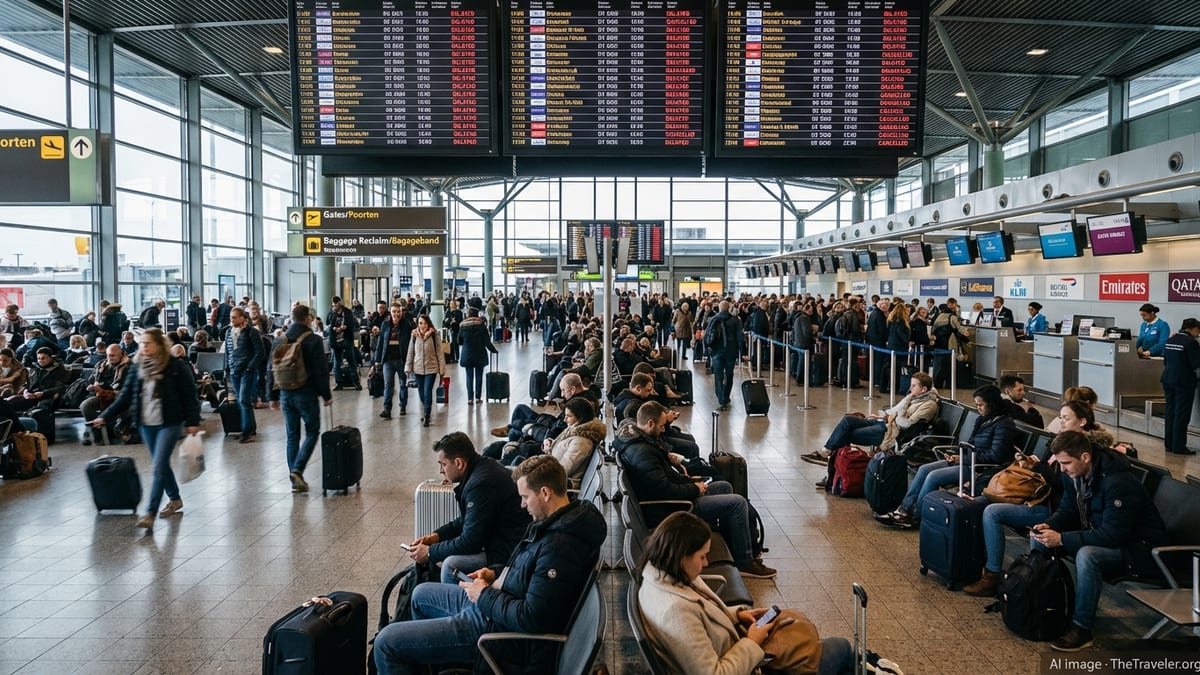
At Heathrow and Manchester in the UK, Arlanda in Sweden and Schiphol in the Netherlands, the human cost of the operational puzzle was clear. Long lines formed at airline service desks as passengers sought rerouting and compensation information, while departure halls filled with travellers sitting on suitcases and recharging phones as they awaited updates.
Ground staff at Scandinavian hubs reported particular pressure on SAS counters, as multiple delayed departures to and from Norway and Sweden converged with northbound flights from continental Europe. With onward connections to smaller regional airports often operating only once or twice a day in winter, some passengers were warned that even a relatively short international delay could translate into overnight stays or extended stopovers.
In Spain, Iberia’s main base at Madrid Barajas experienced a familiar pattern of ripple effects. Holding patterns and flow restrictions over central Spain quickly fed into gate shortages and a shortage of available slots for departing aircraft. Passengers on flights to northern Europe and the Americas reported multiple gate changes and late boarding announcements, followed by either lengthy ground holds or last minute cancellations when crew working hour limits loomed.
Air Algérie’s passengers, particularly those travelling between Algiers and secondary European destinations, encountered a mix of delayed departures and aborted flights, as the airline concentrated scarce resources on maintaining its highest demand routes. For travellers relying on tight self made connections with other carriers, any shift in departure time risked missed onward flights and additional out of pocket costs.
What Affected Passengers Are Being Offered
The four airlines moved on Tuesday to emphasise their rebooking and care policies, with customer notifications pushed through mobile apps, email and airport display systems as schedules were updated. British Airways and Iberia encouraged passengers due to travel in the coming 24 hours to check their flight status before leaving for the airport and, where possible, to rebook online rather than queuing at service desks.
Under European passenger rights rules, travellers whose flights depart from airports in the European Union or the UK, or who are flying into the region on an EU or UK carrier, may be entitled to assistance, refunds or compensation depending on the cause and length of the disruption. Legal experts note that those entitlements vary according to whether the delays stem from factors within the airlines’ control, such as crew rostering or technical issues, or from external causes like severe weather and airspace closures.
SAS and Iberia have been waiving change fees on many of the affected routes, allowing passengers to shift travel to later dates when seat availability permits. Air Algérie has been offering either rerouting via alternative gateways or refunds where schedules have been cut back more aggressively, though availability on popular routes to and from France, Spain and the UK remains tight during the busy winter period.
For stranded transatlantic passengers in New York, Boston, Washington D.C. and San Juan, options can be more limited. Long haul flights typically operate at high load factors in February as leisure travellers take advantage of lower fares outside peak summer periods, leaving fewer spare seats for reaccommodating disrupted customers.
Growing Scrutiny of Airline Resilience and Communication
The latest round of disruption is likely to deepen questions already being asked by regulators and consumer advocates about the resilience of airline schedules and the quality of communication with passengers. After several high profile meltdowns in recent winters, European and US authorities have pressed carriers to ensure that staffing, de icing capacity and aircraft utilization plans are realistic for harsh weather and busy holiday peaks.
Passenger groups say that while Tuesday’s events did not reach the level of a system wide breakdown, they nevertheless highlight how thin the margin for error remains. Travellers at airports in the UK, Spain and Scandinavia reported inconsistencies in how and when information was shared, with some receiving timely app alerts while others only learned of cancellations at the gate.
Industry analysts note that SAS, Iberia, Air Algérie and British Airways are all in various stages of fleet renewal and network adjustment, processes that can introduce short term complexity even as they promise longer term improvements in reliability and efficiency. The phasing in of new aircraft types, the retirement of older jets and the redrawing of route maps require careful coordination across different departments and partner airlines.
For now, though, the most immediate concern for the carriers is clearing the backlog. Restoring aircraft and crews to their planned rotations, particularly on long haul sectors connecting Europe, the US and the Middle East, will be essential to preventing Tuesday’s problems from bleeding into the rest of the week.
Advice for Travellers Facing Ongoing Disruptions
With winter conditions and residual network imbalances likely to continue in the coming days, travel planners are urging passengers booked on SAS, Iberia, Air Algérie and British Airways to build extra time and flexibility into their journeys. That includes avoiding tight self made connections between different tickets, especially when transiting busy hubs such as London, Madrid, Oslo, Stockholm, Amsterdam and Algiers.
Experts recommend that passengers monitor their flight status continually from 24 hours before departure, use airline apps to receive push notifications and, where possible, complete check in early to secure seats on flights that are likely to be oversold once rebookings are added. Those whose trips are time sensitive, such as business travellers or people heading to major events, may wish to explore alternative routings or even rail options within Europe in case of last minute changes.
Travellers already caught up in Tuesday’s wave of cancellations and delays are being encouraged to keep receipts for meals, accommodation and ground transport, which may be necessary when seeking reimbursement or compensation. Consumer advocates also advise passengers to familiarise themselves with applicable passenger rights regimes in both their departure and arrival countries, as rules differ between jurisdictions.
For hundreds of people in terminals from New York and Boston to Oslo, Manchester, Madrid and Algiers, however, the priority on Tuesday remained more basic: finding an available seat, a place to rest and a clear route home amid another day of unpredictable skies.