

More news on this day
Severe travel disruption has swept across three of Europe’s busiest aviation hubs, with more than 156 flights cancelled at major airports serving London, Madrid and Frankfurt, stranding thousands of passengers and triggering long queues, missed connections and mounting frustration across England, Spain and Germany.
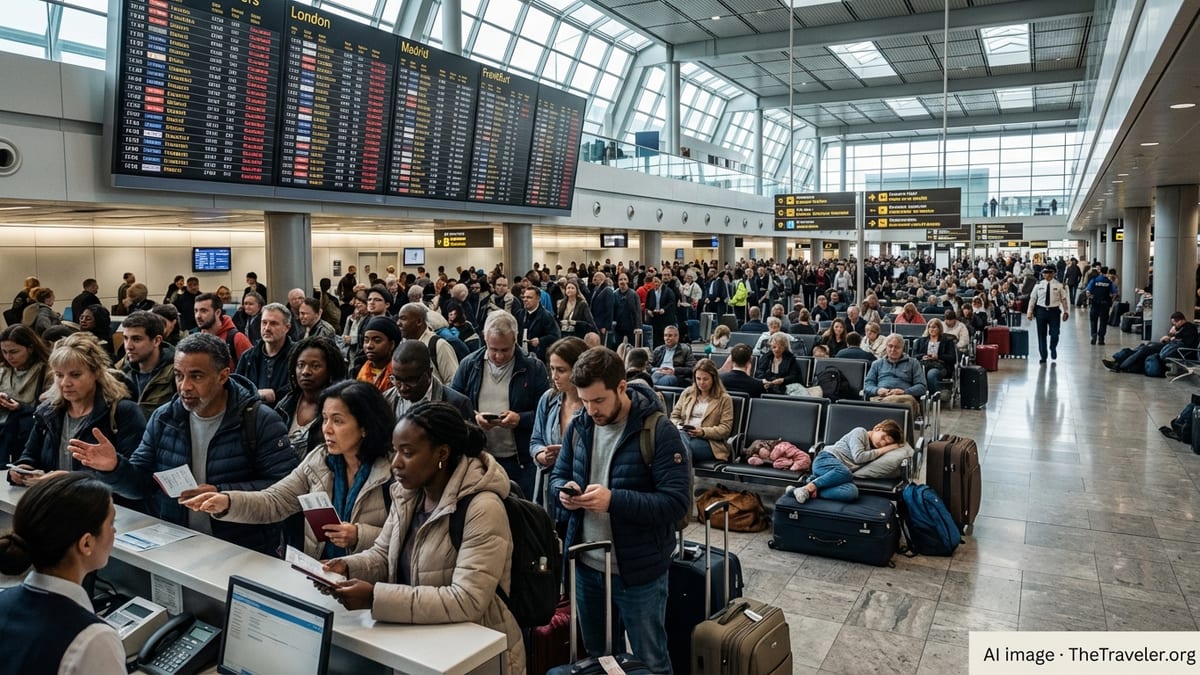
Europe’s Key Hubs Brought to a Standstill
The latest wave of cancellations struck at the heart of Europe’s air network on Tuesday, 17 February 2026, as airports serving London, Madrid and Frankfurt reported more than 156 flights scrubbed from schedules within hours. Aviation data providers and airport authorities confirmed that both short haul and long haul services had been affected, with early-morning waves of departures hit hardest and disruption spreading deep into the day’s operations.
In the United Kingdom, London’s primary international gateways saw dozens of flights grounded as weather-related capacity reductions and residual congestion from earlier winter storms collided with crew and aircraft availability problems. At Madrid–Barajas Adolfo Suárez Airport, Spain’s main hub, a combination of high winds, storm remnants and restricted arrival rates forced airlines to thin out their schedules. Frankfurt Airport, Germany’s largest, reported a similar pattern of cancellations and delays, with operators citing both adverse conditions and the knock-on effects of recent operational strains.
Although exact tallies were still being revised in real time, operational logs indicated that more than 50 flights were cancelled across London’s main airports, at least 45 in Madrid and more than 60 at Frankfurt. With many of these flights operating as feeder services into broader global networks, the impact extended well beyond Europe’s borders, affecting itineraries across North America, the Middle East, Africa and Asia.
Airlines warned that recovery would take time, as aircraft and crew rosters were thrown off balance. Even passengers whose flights still appeared on departure boards were urged to check status updates frequently and to allow significantly more time than usual to navigate congested terminals and rebooking desks.
Storm Systems, Knock-on Delays and Saturated Schedules
The immediate trigger for the latest cancellations lay in a mix of meteorological and operational pressures that have built up across Europe’s skies since late January. Successive winter storms, including the powerful system known as Storm Nils, have repeatedly forced air traffic managers to reduce arrival and departure rates at major hubs, creating backlogs that ripple through the continent’s tightly timed airline schedules.
In the days leading up to Tuesday’s disruption, weather forecasters had warned of lingering bands of heavy cloud, strong crosswinds and low visibility affecting parts of the United Kingdom, Spain and Germany. While modern airliners are certified to operate in challenging conditions, safety-driven spacing between aircraft inevitably increases during adverse weather, reducing the number of flights that can land or take off in any given hour. For hubs such as London, Madrid and Frankfurt, which routinely operate close to capacity, even modest reductions in hourly movements can quickly force airlines to cancel entire rotations.
The cancellations also reflect how thinly stretched many operations remain. Recent weeks have seen large-scale disruption across Europe, with thousands of delays and dozens of cancellations reported daily at multiple airports. By Tuesday, crews and aircraft were still out of position from earlier events, particularly at Lufthansa’s Frankfurt hub and at London’s busiest international gateways. Several airlines confirmed that some cancellations were due to a lack of available aircraft or rested crews rather than the immediate weather at the departure airport.
Industry analysts noted that the current episode fits a broader pattern of vulnerability. Highly optimised schedules, lean staffing models and high utilisation rates leave limited slack in the system when severe weather or industrial action strikes. Once the network is destabilised, recovery can take several days, meaning passengers often feel the effects long after the worst of the storm has passed.
Where the Cancellations Hit Hardest
At London’s main airports, short haul services within Europe bore the brunt of the cancellations. Morning departures to key business destinations such as Frankfurt, Amsterdam, Paris and Dublin were cut, with several airlines consolidating passengers onto fewer flights later in the day. Select long haul services were also affected, particularly transatlantic and Middle Eastern departures that rely on tight aircraft rotations from overnight inbound flights.
Madrid–Barajas reported significant disruption across the Iberia and low-cost carrier networks, with cancellations concentrating on routes to northern and western Europe, where weather-related air traffic restrictions were most pronounced. Some regional services within Spain, including links to Barcelona and Bilbao, were reduced as airlines prioritised the stabilisation of long haul flights to Latin America and North America. Lines at customer service desks in Terminal 4, the main hub facility, stretched across check-in halls as passengers sought to salvage onward journeys.
Frankfurt Airport, a critical hub for Lufthansa and a central node in Europe’s aviation system, experienced one of the heaviest clusters of cancellations. Dozens of intra-European flights were dropped from the morning and early afternoon schedule as the airport operated with reduced capacity due to winter conditions. Several long haul departures, including services to North America, Asia and the Middle East, were delayed or rescheduled as airlines worked to reallocate aircraft and crew. With Frankfurt also serving as a key cargo gateway, logistics operators reported delays in freight movements as hold space on passenger flights evaporated.
The disruption was not limited to passengers flying directly into or out of the three cities. Because London, Madrid and Frankfurt together function as major transfer points for connecting itineraries, cancellations on feeder legs stranded travellers in secondary airports from Lisbon and Athens to Warsaw and Stockholm. Many were forced into overnight stays and lengthy detours as airlines attempted to rebuild broken itineraries via alternative hubs.
Passengers Face Long Queues, Limited Options and Mounting Costs
For passengers on the ground, the numbers translated into long queues, packed terminals and uncertain travel plans. At London’s airports, travellers arriving for early departures found their flights already cancelled or heavily delayed, with some learning of schedule changes only upon reaching check-in. Social media carried images of crowded departure halls and long lines at ticket counters as customers sought rebooking, refunds or hotel vouchers.
Madrid and Frankfurt reported similar scenes. Families returning from school holidays, business travellers aiming to reach key meetings and long haul passengers with tight connections all jostled for assistance. With many services already full in the next 24 to 48 hours, rebooking options proved limited, particularly for those travelling in large groups or on the most popular routes.
Financially, the disruption created a cascade of costs for travellers. While European passenger rights rules provide for compensation in certain cases of delay or cancellation, airlines are not required to pay compensation when extraordinary circumstances such as severe weather are to blame, though they remain obliged to offer care, meals and, where necessary, accommodation. That distinction often leaves passengers confused about what they can claim, even as they face additional expenses for taxis, missed hotel nights or rebooked connecting flights outside the European Union.
Consumer advocates urged passengers to document all additional expenses and to retain boarding passes, booking confirmations and receipts. They also stressed the importance of checking whether travel insurance policies include specific cover for missed connections caused by upstream delays, warning that not all products provide the same level of protection in complex, multi-leg itineraries.
Airlines and Airports Launch Recovery Operations
Airlines operating through London, Madrid and Frankfurt moved quickly to launch recovery plans, with many carriers trimming schedules further in a bid to stabilise operations over the coming days. Several announced that customers booked on affected flights could rebook free of charge to alternative dates or routes, subject to availability, while some long haul passengers were offered rerouting via partner hubs elsewhere in Europe or the Middle East.
Airport operators in all three countries activated contingency measures designed for periods of acute disruption. At London, extra staff were deployed to assist with crowd management and to provide updated information in check-in halls and security lanes. In Madrid, airport authorities opened additional customer service points and coordinated with police and ground handlers to manage flows through immigration and baggage reclaim. Frankfurt’s operator, Fraport, warned passengers to expect continued delays and isolated cancellations as weather conditions and downstream crew shortages continued to affect operations.
Despite these efforts, the recovery was expected to be uneven. High aircraft utilisation means that a flight cancelled on Tuesday can affect aircraft availability for days afterwards, particularly when rotations span multiple continents. With winter still in full force across Europe and North America, aviation planners cautioned that additional weather systems in the coming week could further slow the return to normal schedules.
Industry observers pointed out that airlines have increasingly relied on measures such as dynamic rebooking, mobile notifications and self-service kiosks to keep passengers informed and moving during disruption. However, the scale of the latest wave of cancellations, combined with peak-season load factors, tested the limits of these tools, leaving many travellers still reliant on traditional customer service counters.
Why London, Madrid and Frankfurt Are So Exposed
The concentration of cancellations at London, Madrid and Frankfurt underlined the structural vulnerability of Europe’s largest hub airports. Each operates as a critical gateway for both origin and transfer traffic, running near capacity for much of the day. Slot constraints at London’s busiest international airport, complex runway configurations at Madrid–Barajas and the heavy dependence on hub-and-spoke operations at Frankfurt all magnify the impact of any disruption.
London’s hub is particularly sensitive to air traffic control restrictions and weather-induced capacity cuts. With limited spare runway capacity, any reduction in permitted movements per hour typically forces airlines to cancel entire banks of flights, often targeting shorter routes where passengers can be more easily re-accommodated. A similar dynamic plays out in Frankfurt, where Lufthansa’s tightly orchestrated wave system of arrivals and departures relies on precise timing to feed long haul connections.
Madrid’s role as a bridge between Europe and Latin America adds another complexity. Delays on transatlantic services can cascade into later rotations within Europe and vice versa, making it difficult for airlines to contain disruption within a single region. When adverse conditions hit multiple hubs simultaneously, as they did this week, carriers face tough choices about where to deploy scarce aircraft and crews to minimise overall network damage.
Experts note that climate change is likely to increase pressure on such hubs in the years ahead, with more frequent extreme weather events and temperature-related constraints on aircraft performance. At the same time, demand for air travel across Europe continues to grow, leaving little appetite for underutilised contingency capacity that might otherwise absorb operational shocks.
What Travellers Should Do If They Are Affected
For those caught up in the cancellations at London, Madrid and Frankfurt, travel experts recommend a clear set of priorities. First, passengers should confirm the status of their flight through official airline channels before leaving for the airport. Flight-tracking apps and third-party websites can be useful for early warning, but the airline’s own notifications remain the most authoritative source when cancellations or rebookings occur.
Once a cancellation is confirmed, speed is essential. Many airlines now allow self-service rebooking through mobile apps or airport kiosks, enabling passengers to secure scarce seats on alternative services without waiting in long lines. Travellers are advised to search not only for direct replacements but also for creative routings via secondary hubs, particularly when flying long haul. In some cases, asking to be rerouted via a different city can make the difference between arriving the same day or being forced into an overnight stay.
Passengers should also familiarise themselves with their rights under European regulations, which provide for care and, in certain circumstances, financial compensation. While weather-related cancellations often fall outside compensation rules, airlines must still offer assistance, including meals and accommodation where necessary. Keeping receipts and documenting conversations with airline staff can help if disputes arise later.
Finally, travellers whose journeys are not time-critical may wish to consider deferring their trips entirely when major disruption is underway. Many carriers, particularly during large-scale events, offer flexible change policies that allow passengers to move travel dates without incurring fees. For some, delaying departure by a day or two can avoid the worst of the chaos and reduce the risk of being stranded in transit.
Growing Questions Over Resilience in European Aviation
The fresh wave of cancellations at London, Madrid and Frankfurt has reignited debate over the resilience of Europe’s aviation system. While airlines and airports emphasise that safety must always come first in adverse weather, consumer advocates and industry analysts argue that chronic understaffing, minimal schedule buffers and aging infrastructure have left the network more fragile than it needs to be.
Recent months have seen repeated episodes of large-scale disruption across the continent, from snowstorms affecting UK–US corridors to strikes that have shut down entire German gateways. Each event has exposed familiar fault lines: shortages of air traffic controllers and ground handlers, long-running labour disputes, bottlenecks at security and border control, and limited investment in systems designed to manage crises.
Policy makers in the United Kingdom, Spain, Germany and at the European Union level face renewed pressure to accelerate reforms, including efforts to streamline fragmented airspace management and to boost staffing resilience at key nodes. Proposals range from modernising air traffic control technology to revisiting slot allocation rules that critics say leave too little slack in daily operations.
For now, however, passengers remain acutely exposed to each new shock that hits the system. With winter far from over and further storms possible in the weeks ahead, airlines and airports across England, Spain and Germany are bracing for more turbulence, even as they work to restore stability to some of Europe’s most important aviation gateways.