

More news on this day
Air passengers across Asia faced major disruption today as 57 flights were cancelled and 576 delayed at key hubs including Beijing Daxing, Chengdu Tianfu, Guangzhou Baiyun, Shanghai Hongqiao, Jakarta and Bali, stranding travelers and putting pressure on already stretched airline schedules.
Get the latest news straight to your inbox!
Major Chinese Hubs Struggle With Heavy Operational Strain
Published data for April 7 indicates that Chinese metro airports again bore the brunt of regional disruption, with Beijing Daxing, Chengdu Tianfu, Guangzhou Baiyun and Shanghai Hongqiao all reporting clusters of cancellations alongside high volumes of delayed departures. These hubs handle dense domestic traffic alongside selected international routes, meaning even modest cancellation totals can displace large numbers of passengers.
At Beijing Daxing, cancellations were accompanied by dozens of late-running flights, compounding pressure on departure banks and connection windows. Publicly available statistics and real-time tracking platforms point to a pattern of knock-on delays rather than isolated schedule changes, a sign that congestion in the terminal control area and on the ground may have reduced operational flexibility.
Guangzhou Baiyun and Chengdu Tianfu, two fast-growing bases for major Chinese carriers, also showed a delay-dominant profile. While the number of outright cancellations remained limited, the sheer scale of late operations effectively curtailed capacity, forcing many travelers into missed connections and rebookings on already crowded services.
Shanghai Hongqiao, serving primarily domestic and regional routes, contributed to the disruption as banks of short-haul flights departed behind schedule. Industry analyses of China’s metroplex systems have long highlighted the challenges of coordinating movements among multiple airports serving the same region, and the latest figures suggest that these structural issues continue to expose travelers to cascading delays when conditions tighten.
Ripple Effects Felt in Jakarta and Bali Holiday Traffic
The impact extended well beyond mainland China, with Jakarta and Bali’s Ngurah Rai International Airport also recording disrupted services. These Indonesian gateways are critical links between Southeast Asia, Australia and the wider Asia Pacific network, positioning them as vulnerable nodes when surrounding hubs experience turbulence.
Jakarta’s role as a central transfer point for domestic and international itineraries meant that cancellations at a few key departure times had an outsized effect on onward journeys. Passengers arriving late from Chinese and Northeast Asian hubs frequently found their connecting flights closed, leading to queues at transfer desks and mounting demand for hotel accommodation and meal vouchers.
In Bali, where many routes are leisure-focused and operate at high load factors during peak periods, delayed and cancelled flights created particular difficulties for travelers locked into fixed check-in and tour schedules. Reports from airport monitoring platforms and regional travel media point to extended turnaround times and ground handling bottlenecks, as operators attempted to rotate aircraft and crews through compressed time windows.
Tour operators tracking the situation indicated that even a relatively small number of cancellations can quickly disrupt package holidays when inbound and outbound flights must align with resort turnover patterns and seasonal demand, amplifying the broader impact of schedule changes originating at distant hubs.
Underlying Causes: Weather, Congestion and Network Complexity
Initial assessments from aviation data providers and regional news coverage attribute the disruption to a mix of weather variability, airspace congestion and operational constraints typical of early peak travel periods. Cloud cover and localized storms near several Chinese airports were reported alongside high traffic densities that left little margin for recovery when inbound flights arrived late.
Complex network structures around cities such as Beijing, Shanghai and Guangzhou, where multiple major carriers share capacity across several hubs, can make it difficult to rebalance schedules once delay chains form. Research into metroplex operations in China has repeatedly underscored how closely spaced airports and shared terminal control areas magnify the effects of even minor disruptions on both arrivals and departures.
Operational data for Guangzhou Baiyun, for example, show how quickly on-time performance can deteriorate when morning or early afternoon waves run behind schedule. Reduced spacing between flights, tighter turnaround windows and limited opportunities for rerouting all contribute to growing queues on taxiways and at departure holds, ultimately leading some airlines to cancel rotations to restore network stability.
In Indonesia, heavy utilization of Jakarta and Bali during holiday and business peaks similarly reduces resilience. Operators rely on precise aircraft rotation plans linking Chinese, Southeast Asian and Australian routes, so delays propagating from one region can leave aircraft and crew out of position, forcing last-minute adjustments or cancellations even where local conditions remain relatively stable.
Impact on Travelers and Airlines Across the Region
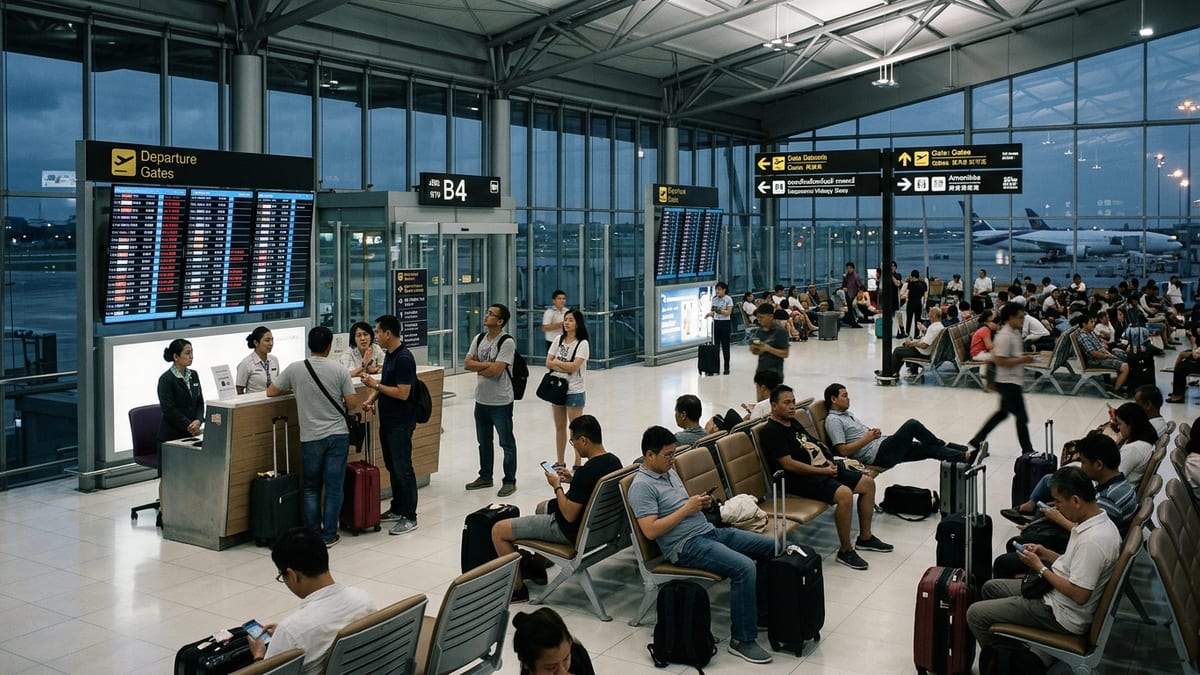
Passengers moving through the affected airports reported extended waits at check-in, security and boarding, as well as crowded transfer zones where multiple delayed flights converged. With 57 cancellations and hundreds of delays registered across these hubs, many travelers faced rebookings onto later services or rerouting through alternative Asian gateways.
For airlines, the pattern of disruption adds to ongoing challenges around fleet utilization and crew management. Delayed rotations can quickly push staff toward duty time limits, increasing the risk of additional cancellations if replacements are not available. Carriers also face higher fuel and handling costs when they operate holding patterns, diversions or last-minute aircraft swaps to maintain parts of their schedules.
Airport operators, meanwhile, must juggle congestion in terminals and airside areas as passengers from multiple delayed flights accumulate. Published guidance from several hubs encourages travelers to monitor their flight status via airline apps and airport displays, arrive early for departures, and be prepared for gate changes when congestion forces real-time adjustments to stands and taxi routes.
Travel insurance providers and passenger rights organizations are also monitoring the evolving disruption patterns, as recurring waves of delays and cancellations raise questions about compensation, duty-of-care obligations and the adequacy of current contingency planning for increasingly busy Asian air corridors.
What Travelers Should Watch in the Coming Days
With air traffic across Asia continuing to rebound, analysts expect congestion-sensitive hubs like Beijing Daxing, Guangzhou Baiyun, Shanghai Hongqiao, Chengdu Tianfu, Jakarta and Bali to remain under pressure during upcoming weekends and holiday peaks. Publicly available trend data indicate that periods of intense disruption often cluster, particularly when weather volatility coincides with high demand.
Travel-focused outlets advise passengers with imminent itineraries through these airports to build in additional connection time where possible and to favor itineraries with protected or same-carrier transfers. Monitoring flight status closely in the 24 hours before departure can provide early warning of schedule changes and increase the chances of securing alternative options before flights sell out.
Industry observers also note that airlines are gradually refining their schedules and recovery strategies in response to repeated disruption episodes across the region. Adjustments to departure waves, improved use of real-time data and more conservative block times on congested routes may help reduce the scale of future delay events, though such changes often take months to filter fully into day-of-operation performance.
For now, the latest figures from Beijing, Chengdu, Guangzhou, Shanghai, Jakarta and Bali underline the reality that Asia’s rapidly growing air networks are still highly vulnerable to bottlenecks. Travelers planning multi-stop journeys through the region are being urged by travel advisors and consumer advocates to treat connection times, schedule buffers and flexible booking conditions as central considerations rather than afterthoughts.