

More news on this day
Travelers across three major global hubs found themselves caught in cascading disruption this weekend, as more than 500 flights in Miami, Delhi and London were delayed, leaving terminals jammed, tempers frayed and airline operations under intense pressure.
Get the latest news straight to your inbox!
Three Hubs, One Day of Global Gridlock
Publicly available flight-tracking dashboards and aviation data services show that delay levels surged across Miami, Delhi and London within a short window, combining into what many passengers experienced as a rolling, borderless travel meltdown. In aggregate, more than 500 flights departing from or arriving at the three hubs registered delays of at least 15 minutes, with knock-on disruption stretching well into the night schedule.
In Miami, tracking data compiled on April 3 indicated more than 260 delayed flights at Miami International Airport as a mix of full-service and low-cost carriers struggled to keep to published timetables. Recent coverage on TheTraveler.org reported elevated delay counts for consecutive days, turning what initially appeared to be an isolated surge into a multi-day pattern of disruption.
Across the Atlantic, London’s airports have faced their own spike in operational strain. Travel and aviation outlets reported that on April 1, English airports including London Heathrow, London Gatwick, London City and Liverpool John Lennon collectively logged more than 400 delays and 20 cancellations, with Heathrow and Gatwick accounting for the majority. While not every one of those delays coincided hour-for-hour with the issues in Miami, the data underlined a period of acute vulnerability in the London system.
Delhi’s Indira Gandhi International Airport has recently experienced repeated episodes of large-scale delays linked to winter fog and technology glitches. Indian news coverage and passenger advisories issued over the 2025–2026 winter season highlighted days when more than 150 flights were disrupted by dense fog and additional waves of late departures followed problems with airport systems. Together with route rerouting pressures tied to regional airspace constraints, the Delhi hub has remained susceptible to rolling delays that contribute to the global total.
Weather, Tech Glitches and Airspace Squeezes Converge
The timing of this latest disruption wave reflects a convergence of factors that analysts say has become characteristic of air travel in 2026. Travel explainers note that airlines and airports are handling record passenger volumes that exceed many pre-2020 benchmarks, leaving little slack when storms, fog or infrastructure problems occur. Even modest weather disturbances can cascade when schedules are already running at near-maximum capacity.
In Delhi, episodes of dense winter fog over recent months repeatedly forced low-visibility operations and temporary suspensions on select runways, with ripple effects into the early spring schedule. Reports on operational advisories described airlines warning passengers to expect rolling delays as visibility fluctuated through the morning and evening peaks, forcing ground stops, diversions and extended holding patterns in the sky.
For London, recent data analyses of Easter-period flying between 2022 and 2025 show that Heathrow and Gatwick consistently rank among the UK’s most delay-prone airports during peak holiday travel, with roughly one in three flights departing late on some spring weekends. A combination of heavy holiday demand, tight runway capacity and Europe-wide air traffic control bottlenecks has created conditions in which relatively small disruptions turn into large queues of late-running aircraft.
Miami’s issues have been tied to a mix of convective weather in the wider region, traffic management initiatives in U.S. airspace and intense spring-break demand. Aviation commentators observing live radar feeds in early April described holding stacks building up near the airport and ground delays stretching turnaround times, especially for carriers operating dense banks of flights to the Caribbean and Latin America.
Passengers Face Long Queues, Missed Connections and Mounting Costs
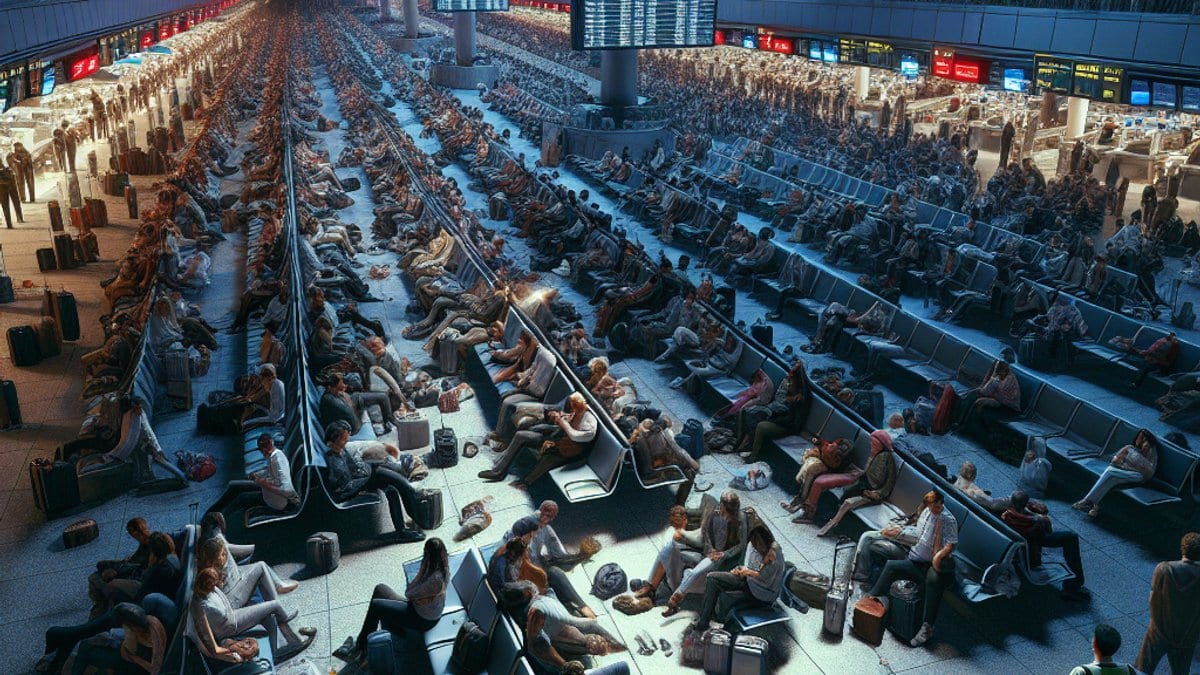
Across all three hubs, the immediate impact of the more than 500 delays was most visible inside the terminals. Photos and eyewitness posts shared on social platforms over the past several days depicted long, slow-moving security and check-in lines in Delhi, crowded departure halls and improvised sleeping areas at London airports, and packed gate zones in Miami as passengers waited for rolling updates on departure boards.
Travel columns and consumer-rights guides published this week describe how even a delay of 60 to 90 minutes at a major hub can translate into missed long-haul connections, especially for itineraries stitched together across multiple airlines. For those stranded overnight, costs quickly mount in the form of last-minute hotel stays, meals, rebooking fees and lost work time, with many travelers uncertain if and when they might receive compensation.
In London, where European consumer-protection rules often give passengers clearer entitlements, commentators note that the cause of delay is crucial. Weather- or air traffic control–related disruptions may qualify as extraordinary circumstances that limit payouts, whereas technical or staffing problems within an airline’s control can trigger compensation obligations. Similar distinctions apply in India and the United States, though the regulatory frameworks differ, leaving many affected passengers combing through airline policies and national rules after the fact.
For travelers in Miami caught in multi-hour queues at airline service desks, publicly available guidance from regulators and consumer advocates stresses the importance of documenting expenses, keeping boarding passes and confirmation emails, and using airline apps to track the official reason codes attached to a delay, which can be decisive in any later claim.
Strained Systems Expose Deeper Structural Weaknesses
Beyond the immediate inconvenience, aviation analysts argue that the latest wave of disruption illustrates how fragile the global airline network remains in 2026. Industry-focused publications and data-driven explainers have pointed to chronic staffing challenges in air traffic control, ground handling and maintenance, as well as infrastructure that has not always kept pace with rapid demand recovery.
Across Europe, Eurocontrol statistics for 2025 highlighted persistent air traffic control capacity issues, including at and around London’s airports, contributing to growing average delay minutes per flight. In India, the combination of rapid growth in domestic traffic, new international services from Delhi and constraints created by temporary regional airspace closures has increased route complexity and reduced scheduling flexibility.
In North America, repeated bouts of severe weather and knock-on congestion since the start of the year have pushed airlines to operate closer to the limits of their fleets and crews. Industry guides note that once the first wave of morning departures goes off-schedule, aircraft and pilots can quickly fall out of position, resulting in a chain reaction of late departures and occasional cancellations that last throughout the day.
Observers say that when these regional fragilities overlap, as they did for Miami, Delhi and London during this latest disruption window, the result is a multi-continent travel snararl that can take days rather than hours to unwind, even after local conditions begin to stabilize.
What Travelers Can Do as Delays Become the New Normal
With data-backed reports indicating that delays have become one of the most common frustrations in global air travel this year, travel advisors are increasingly urging passengers to treat disruption planning as an essential part of trip preparation. Guides published in recent weeks recommend building longer connection buffers, especially when traveling through known congestion hotspots such as Heathrow, Gatwick, Delhi and major U.S. gateways like Miami.
Experts also stress the importance of using airline mobile apps, airport notifications and independent flight-tracking tools to monitor flights from several hours before departure. These tools can give early warning of creeping schedule changes, enabling passengers to adjust ground transportation, rebook onto earlier or later services, or change routing through less congested hubs where fare rules permit.
For those already on itineraries affected by large, multi-airport delay events, consumer advocates suggest prioritizing communication with airlines via multiple channels, including apps and call centers, rather than relying solely on physical service desks during peak disruption. They also recommend that passengers familiarize themselves in advance with local compensation regimes and airline contracts of carriage so that, when delays strike, travelers are better positioned to assert their rights.
As the latest chaos across Miami, Delhi and London demonstrates, delay spikes at a handful of major hubs can now ripple quickly through the global network, turning an ordinary travel day into a grueling test of patience for thousands of passengers worldwide.