

More news on this day
Hundreds of flights across Miami, Delhi and London have been delayed over a series of peak travel days in late March and early April 2026, leaving thousands of passengers stranded in terminals and highlighting how quickly disruption in modern aviation can cascade across continents.
Get the latest news straight to your inbox!
Miami’s Spring Rush Turns Into Prolonged Airport Gridlock
In the United States, Miami International Airport has emerged as one of the major flashpoints of recent disruption. Publicly available flight-tracking data compiled over the Easter period and the first days of April show repeated waves of delays involving more than 400 movements over several days, as storms, tight schedules and heavy holiday traffic converged.
Coverage from national travel outlets and aviation data aggregators indicates that over the Easter holiday alone, roughly 175 flights at Miami were either canceled or significantly delayed, with additional reports two days later pointing to about 260 delayed services across multiple carriers on another particularly difficult day. Taken together, the rolling interruptions meant that well over 400 flights at Miami alone operated behind schedule or not at all within a short span, leaving large numbers of travelers waiting for rebooking and onward connections.
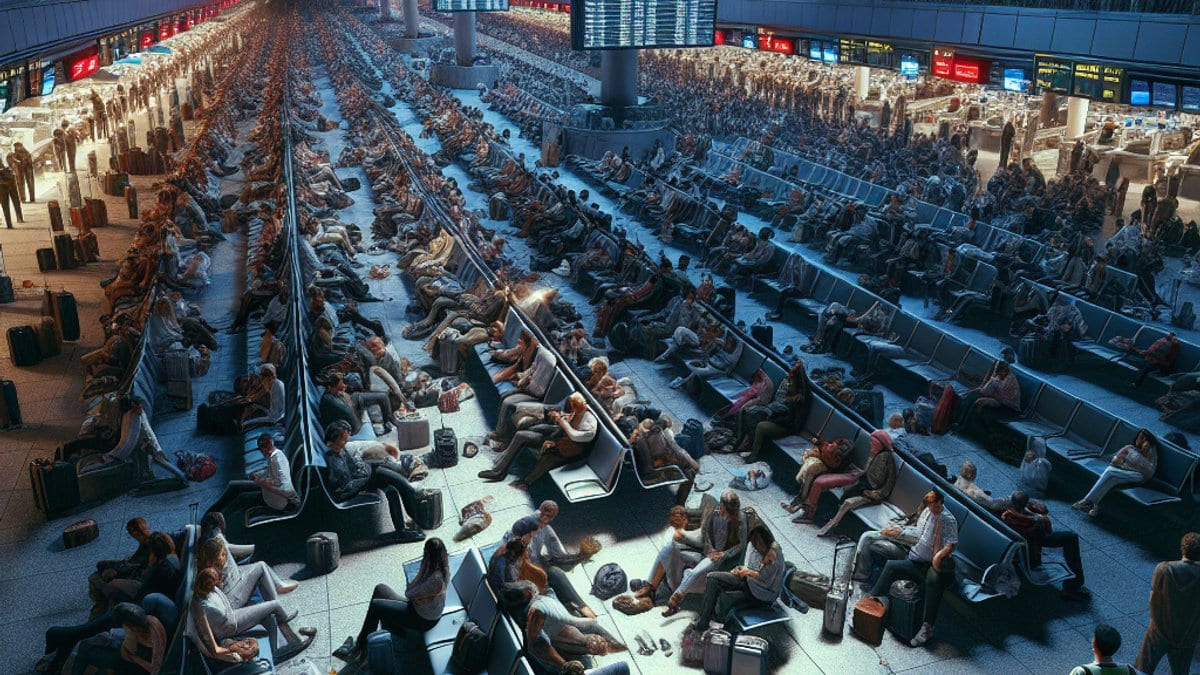
Reports describe crowded concourses, long lines at customer service desks and passengers struggling to piece together multi‑leg itineraries when a single late inbound flight broke connections to Latin America, the Caribbean and other parts of the United States. Observers note that Miami’s role as both an international gateway and a domestic hub magnifies the effect of each delayed departure, as aircraft and crews that arrive late are then unavailable for subsequent rotations.
Industry analysts quoted in recent explainers on U.S. delays suggest that what is unfolding in Miami reflects a broader pattern in 2026, in which robust passenger demand is pushing airport and airline operations close to capacity. When weather or technical issues arise early in the day, there is limited slack in the system, and delays can quickly stretch into hours for travelers across the network.
Delhi’s Tech Glitches and Congestion Feed a Growing Backlog
On the other side of the world, Indira Gandhi International Airport in Delhi has been grappling with its own strain. While there has not been a single headline‑grabbing shutdown in early April 2026, recent history shows how vulnerable the Indian capital’s main hub is to disruption, particularly when technology falters or traffic peaks collide with infrastructure limits.
Indian media coverage from late 2025 and 2025 into 2026 highlights episodes in which faults in air traffic control support systems and messaging platforms forced controllers to manage flights manually, triggering schedule snarls across hundreds of arrivals and departures. One widely reported glitch led to delays affecting more than 800 flights in a single day, with knock‑on effects continuing into subsequent rotations as airlines worked to reposition aircraft and crews.
More routine days have still been marked by heavy congestion. Domestic and international carriers serving Delhi have periodically issued advisories about extended check‑in and security queues and have adjusted their schedules after data system issues, signalling how close the airport often runs to its effective capacity. Passenger accounts circulating in public forums in recent weeks describe lengthy waits, late‑night departures slipping past their scheduled times and significant missed connections on routes linking Delhi to Europe and the Gulf.
When such episodes are viewed collectively, aviation watchers point to a pattern of persistent strain. Even when operations are officially described as normalizing, residual delays frequently continue into following days. This cumulative effect means travelers passing through Delhi in early April can encounter a network still working through earlier disruptions, adding to the tally of delayed flights in the global picture.
London Hubs Struggle Under Holiday Crowds and Weather Systems
In the United Kingdom, London’s major airports have also seen a spate of disruptions as the Easter and early spring travel period brings heavy demand. Recent coverage from travel industry news outlets and data‑focused publications indicates that on a single day in early April 2026, airports across England, including London Heathrow and London Gatwick, recorded more than 400 delayed flights combined, alongside a smaller number of outright cancellations.
Breakdowns of the figures show Heathrow with more than 170 delayed flights and several cancellations, while Gatwick registered delays on well over 100 services. Additional disruption at Manchester, Liverpool, London City and regional airports compounded the strain, pushing the national total of affected flights into the hundreds and leaving large numbers of passengers facing missed connections and extended waits in departure halls.
These recent figures build on a longer‑term pattern in which London’s airports routinely appear near the top of European delay rankings. Data packs and seasonal disruption reports published over the past two years have repeatedly highlighted Gatwick as one of the continent’s most delay‑prone hubs, while Heathrow’s position as the country’s busiest airport gives any operational hiccup an outsize impact on national statistics.
Observers note that the current European windstorm season and unsettled spring weather have periodically forced ground delay programs and holding patterns around the London area. When paired with fully booked holiday flights and tight aircraft utilization, even short‑lived weather systems can generate a backlog that lasts for days and is felt by passengers far from the UK, particularly on long‑haul routes.
A Single Day of Trouble Becomes a Multi‑Day Global Ripple
Across Miami, Delhi and London, aviation analysts emphasize how individual local issues are combining to create a feeling of global instability in air travel. Severe thunderstorms over the eastern United States, intermittent technology problems in busy Asian hubs and stormy weather sweeping across Western Europe are each being handled by different air traffic and airline systems, yet the results for travelers look remarkably similar.
Recent national tallies in the United States show days with more than 3,000 flights delayed across the country, while European data over the last year consistently points to rising average delay minutes per flight. In India, growing passenger numbers and airspace constraints on popular westbound routes have added further pressure, particularly when aircraft and crew scheduling are already stretched.
Because airline networks are highly interconnected, delays in one region quickly translate into missed rotations elsewhere. A Miami flight that leaves several hours late can arrive in South America behind schedule, affecting an overnight departure back to Europe. A late‑running long‑haul service into London may miss its onward slot, tying up a gate and crew needed for another departure. In Delhi, late‑arriving wide‑body aircraft from Europe can compress already busy departure banks to Southeast Asia and Australia.
The effect is that more than 500 delayed flights across these three hubs over a cluster of days do not exist in isolation; they represent a slice of a much larger global picture in which airports and airlines are operating close to the edge of their available capacity.
What the Latest Disruption Wave Signals for 2026 Travel
For passengers, the immediate impact of the current wave of delays is clear: longer lines, uncertainty at the gate and a greater risk of being stranded far from home or final destination. Reports from consumer travel outlets describe travelers in Miami sleeping near departure gates, London passengers scrambling for last‑minute hotel rooms when evening flights are pushed past curfew limits, and Delhi‑bound passengers facing prolonged waits as inbound aircraft miss their scheduled arrival windows.
For the industry, these events add to mounting evidence that resilience remains a central challenge in 2026. Despite investments in new aircraft, expanded terminals and upgraded IT systems, recent statistics show that even modest weather systems, localized glitches or staffing constraints can lead to disproportionately large disruption days, especially at hub airports handling dense banks of connecting flights.
Travel experts writing in recent guidance pieces recommend that passengers build more buffer time into itineraries that rely on connections through congested hubs such as Miami, Delhi and London, particularly during holiday peaks and stormy seasons. They also highlight the value of monitoring real‑time flight data and being prepared with backup options when initial plans unravel.
As spring 2026 progresses, data from these three regions will be closely watched as an indicator of whether the world’s aviation network is adapting to demand or slipping into a prolonged period of chronic delay. For now, the confluence of more than 500 delayed flights across Miami, Delhi and London underscores how quickly routine travel plans can turn into a nightmare when multiple pressure points flare at once.