

Travelers across the United States and the United Kingdom faced fresh disruption today as a wave of delays and cancellations rippled through Newark, Los Angeles, Chicago and London, with at least 76 flights delayed and 11 canceled on services operated by United Airlines, American Airlines and Delta Air Lines.
Major Hubs Struggle As Disruptions Mount
The latest bout of disruption underscores how quickly operations can snarl at some of the world’s busiest hubs. Newark Liberty International, Los Angeles International, Chicago O’Hare and London’s main airports are critical nodes in both domestic and transatlantic networks. When schedules slip at these airports, the impact is often felt far beyond the cities themselves as missed connections and aircraft out of position cascade across the system.
Early operational data from airline and tracking sources indicate that the 76 delayed flights are spread across peak morning and afternoon banks, when carriers attempt to push through dense waves of departures and arrivals. Even relatively modest numbers of cancellations, such as the 11 registered so far, can have an outsized effect when they cut through heavily booked transcontinental and transatlantic services.
United, American and Delta collectively move hundreds of thousands of passengers each day through these four hubs, meaning the current disruption is likely to affect travelers heading to dozens of onward destinations. Many of those passengers have already been rebooked or warned to expect extended travel days as the airlines work through operational backlogs.
Airlines Point to Weather and System Strain
While the precise mix of causes varies by airport, airlines and aviation analysts point to a familiar combination of factors: adverse or shifting weather patterns around key approach corridors, tight air traffic control capacity and aircraft and crew schedules with little slack built in. When conditions deteriorate or traffic slows, even briefly, flights are pushed back into later departure windows, creating ripple effects for aircraft scheduled to make multiple legs throughout the day.
At Newark, where United in particular has faced recurring capacity constraints, reductions in planned schedules over the past year have helped stabilize operations, but they have not eliminated the risk of day to day disruption. Across the Atlantic, London’s airports frequently operate very close to their maximum runway capacity, leaving minimal margin when thunderstorms, low clouds or strong winds force wider spacing between aircraft.
United, American and Delta have all emphasized in recent months that they are investing in better forecasting tools and operational technology to manage disruptions more proactively. Yet the complexity of modern airline networks means that a localized weather cell, a brief ground stop or a staffing shortage in one part of the system can still have knock on effects across multiple hubs, especially during busy travel periods.
Newark and Chicago Feel the Brunt in the U.S.
Newark Liberty and Chicago O’Hare appeared to be bearing the brunt of today’s United States disruptions, according to early snapshots of flight status data. Both airports serve as major connecting hubs for domestic and international itineraries, and both have contended over the past year with heavy traffic volumes intersecting with bouts of severe weather and federal capacity measures.
At Newark, where United operates the majority of departures, reduced schedules implemented in response to chronic congestion have eased some of the worst bottlenecks. Nonetheless, when air traffic controllers impose flow restrictions, queues quickly form for both takeoff and landing. Passengers in the terminal on Tuesday reported long lines at check in and security as airlines attempted to rebook travelers from canceled flights onto already crowded later departures.
Chicago O’Hare, a key connecting hub for both United and American, routinely ranks among the airports with the highest absolute numbers of delays during nationwide weather events. When a line of storms or low ceilings moves through the upper Midwest, aircraft inbound to Chicago may be held on the ground at their origins, setting off a chain of missed connections. Several of today’s delays at O’Hare were linked to aircraft arriving late from elsewhere in the network.
Los Angeles and London Disruptions Hit Long Haul Flyers
At Los Angeles International and London’s major airports, the impact has been particularly acute for long haul passengers. Flights from Los Angeles to East Coast and European destinations, and from London to major U.S. hubs including Chicago and Newark, are often tightly timed to feed onward connections on both sides of the Atlantic. Even a delay of one or two hours can mean travelers arrive too late for their next leg.
Some passengers arriving into London from American and Delta services reported being automatically reprotected onto later transatlantic departures or, in some cases, rerouted through alternative hubs. Those options help preserve overall travel plans but can add many hours to total journey times and increase the likelihood of misplaced baggage as luggage is sorted and retagged under time pressure.
In Los Angeles, the timing of today’s delays has intersected with already heavy midweek traffic, including a mix of business travelers and tourists. With certain flights departing only once per day, particularly to smaller international markets, missed connections can leave passengers facing overnight stays and forced adjustments to hotel and ground transport arrangements at their final destinations.
Passengers Confront Long Lines and Uncertain Timelines
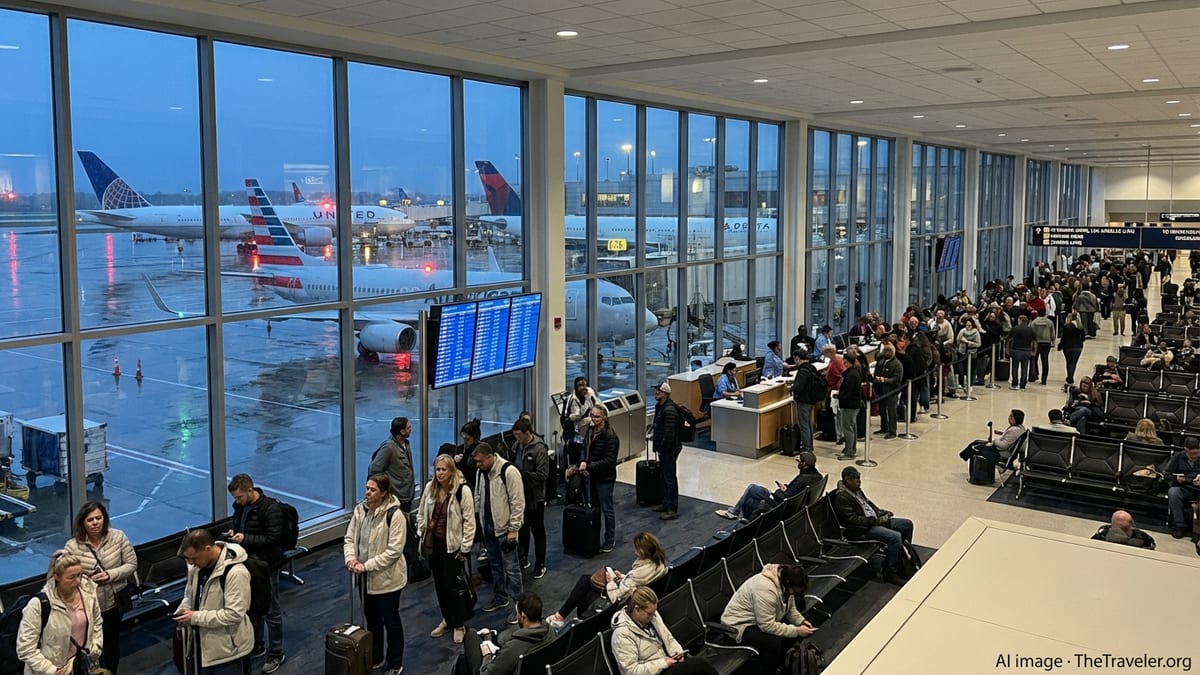
On the ground, the operational statistics translate into a familiar picture of long queues at customer service desks, crowded gate areas and departure boards riddled with red and yellow alerts. At Newark, travelers reported waiting in line for more than an hour to speak with airline agents about rebooking options, while others turned to carrier apps and websites in the hope of securing alternative itineraries before flights filled up.
In Chicago and Los Angeles, some passengers found themselves stuck on aircraft at the gate or on the tarmac while final route decisions and departure slots were confirmed. U.S. Department of Transportation regulations limit how long airlines can keep customers on board without offering the chance to disembark, but even within those limits, extended ground holds can be uncomfortable and stressful, especially for families traveling with small children.
Across the Atlantic in London, travelers described a patchwork of experiences. Some were swiftly rebooked and provided with meal vouchers, while others said they received limited information about the reasons for their delay. Airline and airport staff have urged passengers to monitor official channels closely and to ensure that contact details in their reservations are up to date so automated alerts can reach them quickly.
What Impacted Travelers Can Expect from Airlines
United, American and Delta all maintain published customer service commitments outlining the support they provide during significant disruptions. In general, when a flight is canceled or heavily delayed for reasons within an airline’s control, carriers may offer meal vouchers, hotel accommodation and rebooking at no additional charge. When weather or air traffic control restrictions are the primary cause, the assistance may be more limited, often focusing on placing passengers on the next available flight.
For travelers whose flights are among the 11 canceled so far, rebooking has been the immediate priority. At major hubs, the density of service means many can be accommodated later the same day, although at the cost of longer layovers or red eye departures. In some cases, particularly on transatlantic routes from London, passengers are being shifted to departures 24 hours later, triggering entitlement to overnight accommodation and meals under many airline policies.
In Europe, regulatory frameworks require carriers to provide compensation when delays and cancellations are not caused by extraordinary circumstances. In the United States, rules focus more on transparency and basic protections, with airlines retaining significant discretion over refunds and vouchers in many situations. As today’s disruptions play out across both U.S. and European jurisdictions, impacted travelers are being encouraged to review their rights carefully.
Broader Pattern of Strain on Global Air Travel
While today’s figures of 76 delayed and 11 canceled flights may appear modest in comparison with the thousands of disruptions recorded during major storm systems or large scale technology outages, they fit a broader pattern of intermittent strain in the global air travel system. Over the past two years, a mix of extreme weather, high demand, tight staffing and occasional IT failures has periodically pushed airlines to the edge of their operational capacity.
Industry data from recent seasons has highlighted that even when overall on time performance improves, specific days and specific hubs can experience sharp spikes in disruption. Airports like Newark, Chicago O’Hare, Los Angeles and London Heathrow or Gatwick often sit at the center of these episodes because they handle such high volumes of connecting traffic. Each delay or cancellation there creates more complex knock on consequences than at smaller regional airports.
Aviation analysts note that airlines have adjusted schedules, added spare aircraft and revamped crew planning tools in an effort to build more resilience into their networks. However, with passenger numbers back near or above pre pandemic levels at many major hubs, operational margins remain slim. The events unfolding today serve as another reminder that even incremental disruptions can reverberate widely when the system is running close to full capacity.
Practical Advice for Travelers Facing Disruptions
For travelers caught up in the latest wave of delays and cancellations, early action and clear communication remain the most effective tools. Checking flight status regularly, both through airline apps and airport information screens, can provide crucial minutes of warning that make the difference between securing a last remaining seat on an alternative flight or facing a much longer wait.
Experts continue to recommend booking the earliest feasible departure of the day, especially from disruption prone hubs like Newark and Chicago in the United States and London’s main airports for transatlantic journeys. Morning flights are less exposed to the cumulative knock on delays that tend to build as the day progresses and often have more backup options if something goes wrong.
Passengers are also urged to keep essential items such as medication, chargers and a change of clothes in carry on bags in case bags are delayed or an unexpected overnight stay becomes necessary. With today’s disruptions affecting flights operated by three of the largest U.S. carriers across four critical hubs, many travelers will be drawing on those preparations as they wait for operations to stabilize and for their journeys to finally get underway.