

More news on this day
Hundreds of passengers traveling through Paris Charles de Gaulle and Orly airports have faced disruption after 198 flights were reported delayed and 32 canceled, affecting operations for major European carriers including Air France, easyJet, and British Airways across France and wider European networks.
Get the latest news straight to your inbox!
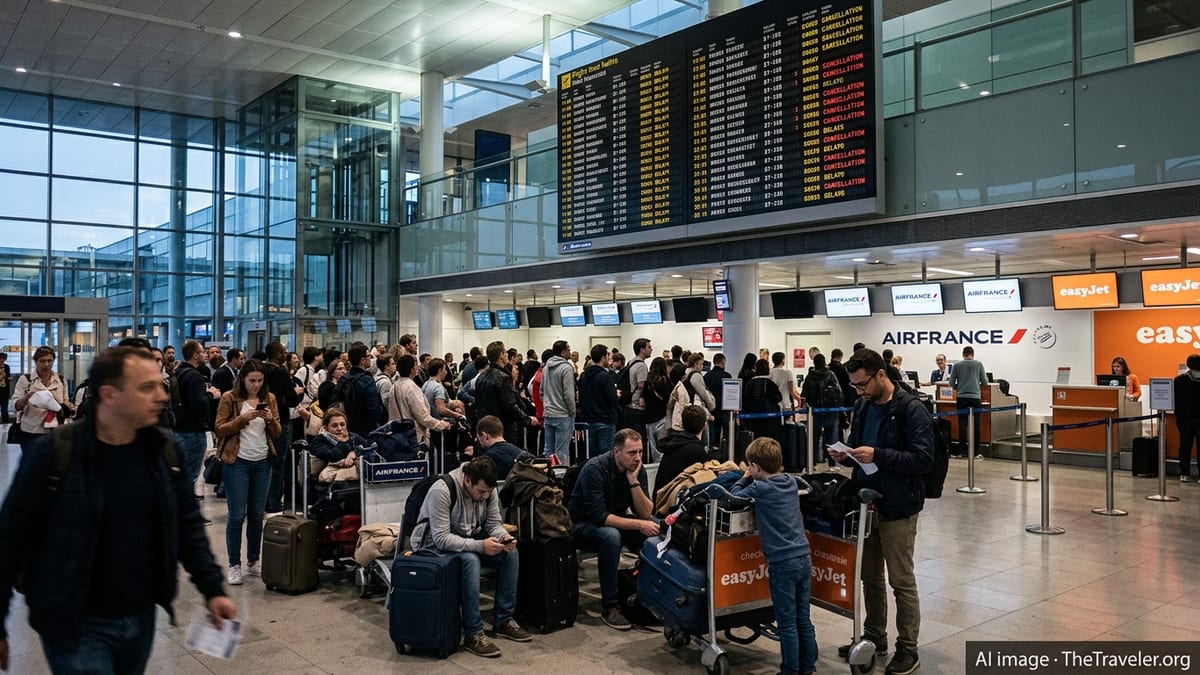
Major Disruptions Across Paris’s Two Main Airports
The latest wave of disruption at Paris Charles de Gaulle and Orly has underscored how vulnerable Europe’s busiest air corridors remain to operational shocks. Publicly available flight tracking and industry data indicate that a combined 198 delayed flights and 32 cancellations have rippled through both airports, stranding and rerouting hundreds of passengers on intra-European and longer-haul journeys.
Paris Charles de Gaulle, one of Europe’s leading hubs and the primary base for Air France, handles tens of millions of passengers annually and is a key transfer point for long-haul and European connections. Orly, traditionally focused on domestic and short- to medium-haul European routes and a key base for low-cost and leisure carriers such as easyJet and Transavia, has seen knock-on effects as schedules were reshuffled and aircraft repositioned between the two airports.
Reports from travel industry outlets and passenger accounts describe crowded departure halls, extended waiting times at check-in and security, and lengthy queues at airline service desks as travelers sought alternative routings, overnight accommodation, or refunds under European passenger-rights rules. With both Paris airports operating close to capacity on many days, relatively modest schedule changes quickly translated into missing connections and cascading delays across multiple destinations.
The concentration of disruption within a relatively short time window magnified the impact. Even where individual delays were under two hours, clustering across peak departure banks at Charles de Gaulle and Orly meant that many passengers missed onward flights or arrived at their destinations significantly later than planned.
Air France, easyJet, and British Airways Among the Most Affected
According to published coverage and schedule data, the disruption has been particularly visible among Air France, easyJet, and British Airways, three of the most prominent operators in and out of the Paris region. Air France, which uses Charles de Gaulle as its principal hub, saw delays ripple through its European network as late-arriving aircraft and crew reassignments affected departures to major cities such as London, Amsterdam, Frankfurt, and Madrid.
EasyJet, which maintains bases at both Charles de Gaulle and Orly for key leisure and city routes, experienced a combination of delayed departures and select cancellations. Industry statistics show that the carrier already operates in a tightly timed, high-frequency network, which can leave little room to absorb sudden operational constraints. When a handful of rotations are canceled or delayed from Paris, subsequent flights to secondary European airports can also be pushed back or combined.
British Airways, whose Paris services connect primarily with London Heathrow and London City, was drawn into the disruption as well. Even relatively minor schedule variations on the Paris–London shuttle can cause travelers to miss onward long-haul departures from the United Kingdom, leading to rebookings, hotel vouchers, and baggage complications. Publicly available timetables for the day of disruption showed late departures in both directions on several British Airways Paris services.
Other European airlines serving the French capital, including low-cost and regional carriers, were indirectly affected when slot times were adjusted and ground-handling resources were stretched. For passengers, this translated into aircraft waiting for parking stands, slower baggage unloading, and boarding delays that extended well beyond the immediate list of canceled flights.
Operational Strain at Europe’s Busiest Hubs
Charles de Gaulle has consistently ranked among Europe’s busiest airports by passenger volume, and Orly remains a crucial gateway for domestic French and Mediterranean traffic. Recent reports on airport performance and punctuality in Europe highlight how even brief interruptions in air traffic control, ground handling, or security screening can lead to measurable spikes in delays, particularly at constrained hubs where runway and terminal capacity are already heavily utilized.
Data from aviation performance reports and past disruption analyses show that Paris’s airports, like other major European hubs, have been wrestling with variable staffing levels, tight turnarounds, and a complex mix of legacy, low-cost, and leisure carriers. While official statistics on average waiting times at border control points suggest that queues are often kept within targeted thresholds, peaks in traffic or unexpected operational bottlenecks can push waiting times higher and erode the buffer built into airline schedules.
When disruption hits at Charles de Gaulle, the effect is magnified by its role as a transfer hub for long-haul services, where missed connections may require complete re-routing rather than simple rebooking on the next hourly departure. At Orly, the impact is felt more acutely on point-to-point leisure routes, where frequency is lower and alternative departures may be hours or even a full day away.
Travel industry observers note that the Paris platform is still adapting to changes in airline strategies, including Air France’s gradual consolidation of most operations at Charles de Gaulle and the growing presence of low-cost carriers at both airports. This evolving mix can complicate ground operations, as different airlines and alliances rely on separate handlers, IT systems, and customer service processes.
Passenger Experience: Long Queues, Missed Connections, and Rebookings
For individual travelers, the most immediate effects of the latest disruption were long queues, uncertainty about departure times, and the risk of missing onward flights. Passenger reports from recent disruption events at Paris’s airports frequently describe crowded terminal corridors, limited seating, and extended waits to speak with airline staff at service counters.
Because Charles de Gaulle functions as a major connecting hub, relatively short outbound delays can cascade into significant missed connections for travelers heading to North America, Africa, Asia, or other parts of Europe. Re-accommodating these passengers often requires rerouting via alternative hubs, leading to overnight stays in Paris or other cities, as well as complications in retrieving and rechecking baggage.
At Orly, where many flights are point-to-point, disruption tends to manifest in long same-day delays or cancellations that leave travelers scrambling for limited alternatives. Leisure passengers bound for Mediterranean destinations or regional European cities can find that the next available departure is not until the following day, particularly outside peak summer seasons.
Public information on recent disruption patterns in France also points to a steady flow of compensation and assistance claims under EU passenger rights rules. Travelers facing cancellations or long delays often seek reimbursement for meals, hotels, and alternative transport, while airlines reference factors such as air traffic control restrictions or weather when assessing eligibility.
What Travelers Should Expect in the Coming Days
Although the immediate wave of disruption at Charles de Gaulle and Orly appears centered on a specific cluster of delayed and canceled flights, travel specialists caution that residual effects can linger for at least 24 to 48 hours. Aircraft and crews may remain out of their planned positions, and some early-morning departures can still be affected as airlines work to restore normal rotations.
Publicly available guidance from aviation and consumer organizations typically recommends that passengers flying to or from Paris in the aftermath of such events check the status of their flights repeatedly on the day of travel, arrive at the airport earlier than usual during known disruption periods, and keep boarding passes, receipts, and written confirmations in case they later pursue compensation or refunds.
Industry analysis suggests that Europe’s major hubs, including Paris, are likely to continue experiencing periodic bouts of disruption tied to a mix of air traffic control constraints, weather, capacity limits, and labor challenges. For airlines like Air France, easyJet, and British Airways, strengthening operational resilience at key airports such as Charles de Gaulle and Orly remains a priority as passenger numbers approach or exceed pre-pandemic levels.
For travelers, the latest disruption across Paris’s airports serves as a reminder to build extra margin into tight connections, consider earlier departures when connecting to long-haul flights, and remain prepared for schedule changes when flying through one of Europe’s busiest aviation gateways.