

More news on this day
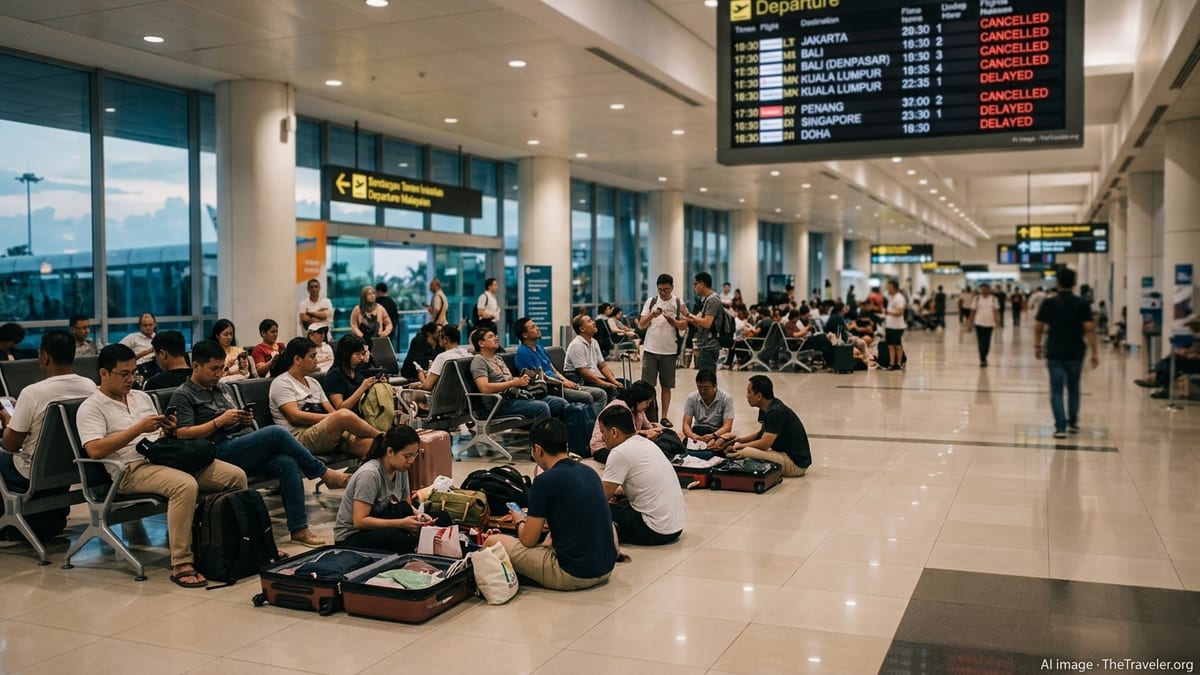
Major travel disruption is unfolding across Southeast Asia as Batik Air, Malaysia Airlines and other regional carriers cancel and consolidate more than 50 flights, leaving passengers stranded in Indonesia and Malaysia and forcing last minute changes on routes linking Jakarta, Bali, Kuala Lumpur, Penang, Singapore, Doha and other long haul hubs.
Get the latest news straight to your inbox!
Wave of Cancellations Hits Key Southeast Asian Gateways
Published schedules and airport operations updates for late March 2026 indicate a sharp spike in cancellations on short and medium haul services in and out of Indonesia and Malaysia, with Batik Air and Malaysia Airlines among the most affected operators. The disruptions are concentrated at major gateways including Jakarta Soekarno Hatta, Bali’s Ngurah Rai, Kuala Lumpur International and Penang, with knock on effects for connecting traffic to Singapore and Doha.
Recent coverage from Bali reports that dozens of international services, including connections to Kuala Lumpur and Singapore, have been removed from the board in a single day, illustrating how quickly conditions can deteriorate for travelers relying on tight regional links. Separate monitoring of airline booking systems and timetable changes shows Malaysia based and Indonesia based carriers trimming frequencies or cancelling rotations outright on certain days, particularly on busy trunk routes such as Jakarta to Kuala Lumpur and Kuala Lumpur to Penang.
While some cancellations are limited to a specific date or time window, others form part of a pattern of rolling adjustments as airlines respond to capacity constraints, volatile demand and operational challenges across their networks. For passengers on multi sector itineraries involving hubs such as Singapore and Doha, even a single cancelled segment can cause missed connections and unplanned stopovers.
Reports from passenger forums and social media suggest that many travelers first became aware of disruptions when checking airport departure boards or receiving same day notifications, a reminder of how quickly airline operations can shift in the current environment.
Batik Air and Malaysia Airlines Under Pressure
Batik Air, which operates separate entities in Malaysia and Indonesia, has been making a series of network adjustments in recent months. Publicly available timetable and press information shows the Malaysia based operation actively reshaping its regional portfolio, including strengthening some links to Indonesia and Singapore while warning that flights into more volatile airspace may be subject to last minute changes. Advisory material issued in late February already signaled the potential for cancellations and schedule revisions on selected routes.
In parallel, Malaysia Airlines continues to fine tune its domestic and regional network. Recent industry and brokerage analyses of seat capacity highlight earlier reductions on some key city pairs such as Kuala Lumpur to Singapore and Kuala Lumpur to Penang, and modest changes on Kuala Lumpur to Jakarta. These underlying cuts mean there is less slack in the system when new operational issues arise, making any further round of short notice cancellations more disruptive for passengers trying to secure alternative seats.
Travelers on both full service and budget brands report experiences of extended delays and repeated retimings on sectors such as Jakarta to Kuala Lumpur and Kuala Lumpur to Bali, even before outright cancellations are applied. Commentary on traveler discussion boards frequently contrasts relatively smooth operations on one day with multi hour delays or sudden cancellations on another, underlining that the situation is highly route and date specific.
According to published industry commentary, both airlines face the same mix of challenges confronting many Asia Pacific carriers in 2026: stretched fleets undergoing maintenance, crew rostering pressures and the need to route aircraft around sensitive airspace or weather affected regions, all of which can cascade into schedule cuts.
Knock On Effects for Routes to Singapore, Doha and Beyond
The immediate impact of the cancellations is being felt on core intra ASEAN sectors, but the disruption is extending far beyond Southeast Asia. Many of the cancelled or consolidated flights feed into long haul services operated either by local flag carriers or by partners such as major Gulf and European airlines, particularly through Singapore and Doha.
Updates circulated by long haul carriers in recent weeks confirm that services from Southeast Asian gateways into the Middle East and on to Europe remain sensitive to the wider geopolitical and airspace situation. When local feeder flights from Jakarta, Bali, Kuala Lumpur or Penang are cancelled, passengers may struggle to reach their onward departure point in time, prompting missed connections, forced overnight stays and complicated rebooking arrangements.
Some airlines have published advance lists of reduced frequencies or selected cancelled flights between Singapore and regional cities such as Jakarta and Penang during March and April 2026. When combined with ad hoc cancellations by Batik Air, Malaysia Airlines and other operators, the net effect is a thinner, less predictable web of connections across the region, especially for itineraries involving two or more changes.
Travel blogs and passenger reports describe cases in which travelers headed for Europe or the Middle East via Singapore or Doha have had to reroute entirely, sometimes shifting to alternative hubs such as Bangkok or Sydney when their original Southeast Asian connections fell through at short notice.
Passengers Stranded and Scrambling for Alternatives
The human impact of the disruptions is visible at airports across the region. Posts from affected travelers describe crowded check in areas and departure halls in Jakarta, Bali and Kuala Lumpur as passengers queue to be rebooked, often competing for a limited number of remaining seats on other airlines or later departures.
In Denpasar, where a cluster of international cancellations was recently reported in a single day, travelers spoke of uncertainty over onward plans, with some visitors to Bali unsure whether they would be able to depart in time to meet visa limits or work commitments. Similar scenes are being described at Kuala Lumpur and Jakarta, where domestic and regional passengers are trying to piece together replacement itineraries at the last minute.
Publicly available information from airlines indicates that those affected by cancellations are generally being offered standard options such as rebooking on the next available flight, holding ticket credits or requesting refunds, subject to fare rules and seat availability. However, tight capacity on popular routes means that replacement flights may depart many hours or even days later than originally planned, particularly for those trying to maintain specific connections to long haul services.
Travel insurance providers and consumer advocates are reminding passengers to retain all receipts related to unexpected accommodation, meals and surface transport, as these may be needed when submitting claims linked to missed connections or extended delays caused by flight cancellations.
What Travelers Should Do Now
Given the fluid situation, aviation analysts and travel experts are advising anyone flying in or out of Indonesia or Malaysia in the coming days and weeks to monitor flight status closely. Airline mobile applications, departure boards and third party tracking tools can provide early indications of retimings or cancellations, although same day changes remain possible.
Passengers booked on itineraries that rely on regional connections through Jakarta, Bali, Kuala Lumpur, Penang, Singapore or Doha are being encouraged in public guidance to build in longer layovers where possible, or to consider routing through alternative hubs if their plans are flexible. Those who have yet to travel may wish to select fares that are more flexible on changes and refunds, even if the upfront cost is higher.
Travel planning resources also recommend confirming any separately booked tickets on different airlines, a common practice among budget conscious travelers in Southeast Asia. When one leg is cancelled, there is often no automatic protection on later segments issued by other carriers, making it especially important to understand each ticket’s conditions and to have contingency funds available for unexpected changes.
With airlines across Southeast Asia continuing to adjust capacity in response to operational pressures and wider regional developments, observers expect further short notice changes on some city pairs through at least the end of March 2026. For now, travelers moving between Jakarta, Bali, Kuala Lumpur, Penang, Singapore, Doha and other connected destinations face an elevated risk of last minute disruption and should prepare accordingly.