

More news on this day
Hundreds of passengers across New Zealand and Australia have had their travel plans thrown into disarray as key airports including Christchurch, Wellington, Melbourne and Sydney report 31 flight cancellations and 594 delays in a single day, affecting services operated by Air New Zealand, Qantas, Delta Air Lines and several other carriers along the busy trans Tasman and domestic corridors.
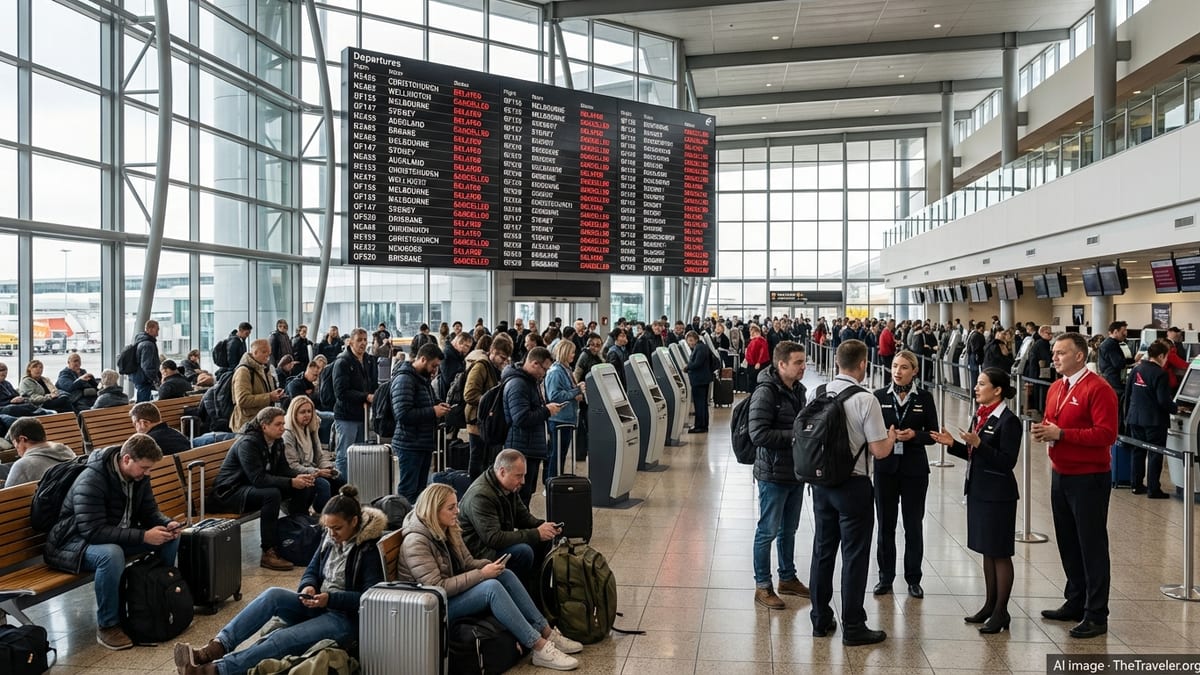
Major Hubs Across Two Countries Struggle With a Difficult Day
The latest wave of disruption swept through some of the region’s most important aviation hubs, snarling departures and arrivals from early morning until late evening. Christchurch and Wellington in New Zealand, together with Melbourne and Sydney in Australia, registered the heaviest operational strain, with rolling delays often compounding as the day progressed.
Operational data from airport boards and airline status pages indicated that dozens of services departed outside their scheduled windows, while a smaller but still significant number were cancelled outright. While the figures fluctuated slightly over the course of the day as flights were rescheduled or reinstated, the tally settled at 31 cancellations and 594 delays across the network, illustrating the scale of the disruption felt by travelers.
For many passengers, the problems were most visible in crowded check in areas, lengthy queues at security and packed gate lounges. Families heading off on long planned holidays, business travelers trying to reach meetings and international passengers connecting to long haul routes all reported extended waits and last minute gate changes as airlines worked to re thread their schedules.
Airports and carriers stressed that the majority of scheduled flights did still operate, but acknowledged that punctuality took a substantial hit. At several hubs, even services that ultimately departed ended up leaving significantly behind schedule after aircraft and crew were repositioned to cover gaps created earlier in the day.
Air New Zealand, Qantas and Delta Among the Worst Affected
Among the airlines most exposed to the disruption were Air New Zealand and Qantas, whose dense schedules across the Tasman Sea and on domestic routes in both countries left them particularly vulnerable when operations began to fray. A mix of short haul and medium haul sectors saw delays stretching from minor setbacks of 20 to 30 minutes through to knock on disruptions of several hours.
Delta Air Lines was also caught up in the turmoil through its long haul services that connect Australasia with North America. Even when Delta operated flights on time out of Sydney, Melbourne or other gateways, connecting passengers who had been relying on delayed regional or trans Tasman services sometimes arrived at the gate too late, triggering a cascade of missed onward journeys and unplanned overnight stays.
Smaller carriers and codeshare partners were not immune. With many itineraries in the region sold under multiple airline brands, passengers often discovered only at the airport that a flight carrying a familiar global airline code was in fact being operated by a local or regional partner that had been forced to adjust its schedule. This made it more difficult for some travelers to track accurate status updates ahead of time.
Airline contact centers and digital channels came under heavy pressure as customers tried to rebook, check in remotely or adjust connections. While apps and websites handled much of the demand, many passengers reported long waits to speak to agents by phone or at airport service desks, particularly when seeking compensation, vouchers or assistance with accommodation.
Christchurch and Wellington Expose Infrastructure and Weather Vulnerabilities
In New Zealand, Christchurch and Wellington underscored their vulnerability to a mix of weather and capacity constraints. Both airports play critical roles in the national network, funnelling domestic travelers into international services and linking regional centers with the main trunk routes to Auckland, Australia and the Pacific.
Wellington’s position on a narrow, windswept stretch of coastline means it is no stranger to disruption when conditions deteriorate. Gusty winds, low cloud and shifting visibility can quickly force airlines to adjust approach patterns, build in additional separation between aircraft or temporarily suspend operations. On the latest day of disruption, marginal conditions at times led to airborne holding patterns and minor diversions, contributing to a build up of delays throughout the schedule.
Christchurch, a key South Island gateway, experienced its own knock on effects as aircraft and crews arriving late from other parts of the network disrupted tightly timed turnarounds. With many services operating with little slack built into daily rotations, any significant delay on an early sector can easily echo through later flights, leaving little room to recover before the end of the operational day.
Travelers transiting through these airports reported a patchwork of experiences. Some domestic connections were held for late arriving passengers where possible, especially on routes with limited remaining capacity that day, while others were asked to rebook onto flights departing several hours later or even the following morning when services were already heavily booked.
Melbourne and Sydney Once Again Bear the Brunt of Disruption
On the Australian side of the Tasman, Melbourne Tullamarine and Sydney Kingsford Smith once again featured prominently in disruption statistics. As two of the country’s busiest airports and key staging posts for international services, any operational difficulties at these hubs tend to reverberate widely throughout domestic and regional networks.
Melbourne, in particular, saw a high concentration of delayed departures and arrivals across a variety of carriers. Tight turnaround windows, peak hour congestion and earlier disruptions on inbound services all contributed to a stacked departure board of flights leaving behind schedule. For many airlines, the challenge was not only getting aircraft airborne but ensuring that crews remained within their permitted duty limits after extended on ground waits.
Sydney faced its own pressures amid slot constraints and heavy traffic volumes. Delays to departures in key morning and evening banks had a disproportionate impact on passengers connecting to and from trans Tasman and long haul services, where fewer alternative options are available later in the day. Even modest schedule slips of under an hour sometimes proved enough to break carefully timed connections.
Airport authorities in both cities deployed additional staff to manage queues and provide information, while urging travelers to arrive early, stay alert to terminal announcements and keep an eye on airline apps for real time updates. Despite those efforts, many passengers expressed frustration at the uncertainty and the difficulty of obtaining clear estimates of revised departure times.
Passengers Confront Long Queues, Missed Connections and Uncertain Plans
For those caught in the middle of the turmoil, the disruption translated into a series of very tangible inconveniences. Families with young children queued for extended periods at check in counters, some sitting on the floor of crowded terminals while waiting for new boarding times. Business travelers scrambled to rearrange meetings and accommodation as estimated departure times shifted repeatedly throughout the day.
Long haul travelers felt the impact particularly acutely when missed connections left them stranded overnight far from their original transit points. Some passengers whose flights were cancelled late in the evening reported difficulty securing hotel rooms near the airport, as nearby properties quickly filled with displaced travelers from multiple airlines all seeking last minute beds.
Social media channels filled with images of packed gate lounges and lines snaking through terminal concourses, alongside posts praising individual staff who went out of their way to assist. Many travelers acknowledged that frontline employees were working under intense pressure, even as they expressed frustration with the broader systems and contingency planning that had allowed disruptions to escalate.
Consumer advocates reiterated calls for clearer communication around passengers’ rights when flights are delayed or cancelled, particularly in relation to meal vouchers, hotel accommodation and rebooking obligations. They also urged airlines to provide more proactive notifications through apps and text messages to reduce unnecessary trips to the airport when disruption becomes unavoidable.
Underlying Pressures: Staffing, Maintenance and Tight Schedules
Behind the headline figures of cancellations and delays lies a complex web of operational pressures. Airlines in both Australia and New Zealand continue to navigate tight staffing levels in certain specialist roles, including pilots, engineers and ground handlers. When rosters are stretched, any unexpected absence, technical issue or short weather disruption can have an outsized effect on the schedule.
Maintenance windows have also become more compressed as carriers push aircraft utilization closer to pre pandemic levels in response to strong demand. While safety standards remain paramount and no airline will dispatch an aircraft that is not fully cleared to fly, unplanned technical issues can trigger cascading delays when there are few spare aircraft available to step in as replacements.
In addition, many carriers operate dense banks of short haul services during peak travel periods, particularly on the east coast of Australia and across the Tasman to New Zealand. When one or two flights in a tightly bunched sequence run late, the knock on effects can ripple across a significant portion of the day’s operation, especially at constrained airports like Sydney where runway slots and ground infrastructure limit flexibility.
Industry analysts note that while some level of disruption is inevitable in any large aviation network, the frequency and scale of recent events suggest that airlines and airports must invest further in resilience. That includes better contingency planning, more flexible crew rostering, stronger data sharing between stakeholders and infrastructure investments to ease chokepoints at busy terminals and airfields.
How Travelers Can Protect Themselves During Volatile Operations
With schedule volatility now a recurring feature of travel across the Australia and New Zealand corridor, passenger advocates are urging travelers to take practical steps to reduce risk. One recurring piece of advice is to build in longer connection windows, especially when linking a regional or domestic leg to an international long haul flight that may only operate once daily.
Flexible booking options, including fares that allow same day changes without heavy penalties, can also provide a critical buffer when disruption strikes. While such tickets may initially appear more expensive, they can save significant costs and stress if schedules unravel on the day of travel. Travel insurance policies that explicitly cover delays, missed connections and accommodation costs are also becoming more important for frequent flyers.
Experts recommend that passengers monitor flight status directly through airline apps or text alerts rather than relying solely on third party booking platforms, as primary carriers tend to update their own systems first. When disruption appears likely, contacting the airline as early as possible can increase the chances of securing an alternative routing before seats on later flights are fully allocated.
For those already at the airport, staying close to the gate, listening carefully to announcements and checking display boards frequently remain essential habits. In rapidly evolving situations, rebooking options, meal vouchers and accommodation support are often prioritized for passengers who are present and able to respond quickly when airlines announce assistance measures.
Calls Grow for Stronger Consumer Protections and Transparency
The latest day of disruption has again fueled debate about whether passengers in Australia and New Zealand enjoy sufficient statutory protections when flights are cancelled or severely delayed. Unlike in some other jurisdictions, compensation and care obligations in these markets are shaped largely by airline policies and contract terms rather than uniform national rules.
Consumer groups argue that this patchwork approach leaves many travelers uncertain about their entitlements, particularly when disruptions involve multiple carriers or codeshare arrangements. They have renewed calls for clearer baseline standards that would guarantee minimum levels of care, such as meals and accommodation, in the event of significant, airline controlled disruption.
Industry representatives counter that the region’s airlines already provide extensive support in many cases and warn that overly rigid regulation could reduce flexibility during major disruption events, ultimately leading to higher fares or reduced capacity. They also point to the complex mix of causes behind delays and cancellations, from weather and air traffic control constraints to operational or technical issues.
For now, passengers are being urged to read fare conditions carefully, retain receipts for any out of pocket expenses incurred due to disruption, and follow up promptly with airlines after travel if they believe they may be entitled to reimbursement or goodwill gestures. As the trans Tasman and domestic air markets continue to recover and grow, the balance between operational resilience, commercial pressures and consumer protection is likely to remain a contentious point of discussion.