

More news on this day
Major disruptions across European skies have left passengers stranded in London, Paris and Zurich after a wave of cancellations and delays involving Virgin Atlantic, British Airways, SAS and Air France, underscoring how vulnerable cross border travel remains to bad weather, air traffic bottlenecks and knock on scheduling problems.
Get the latest news straight to your inbox!
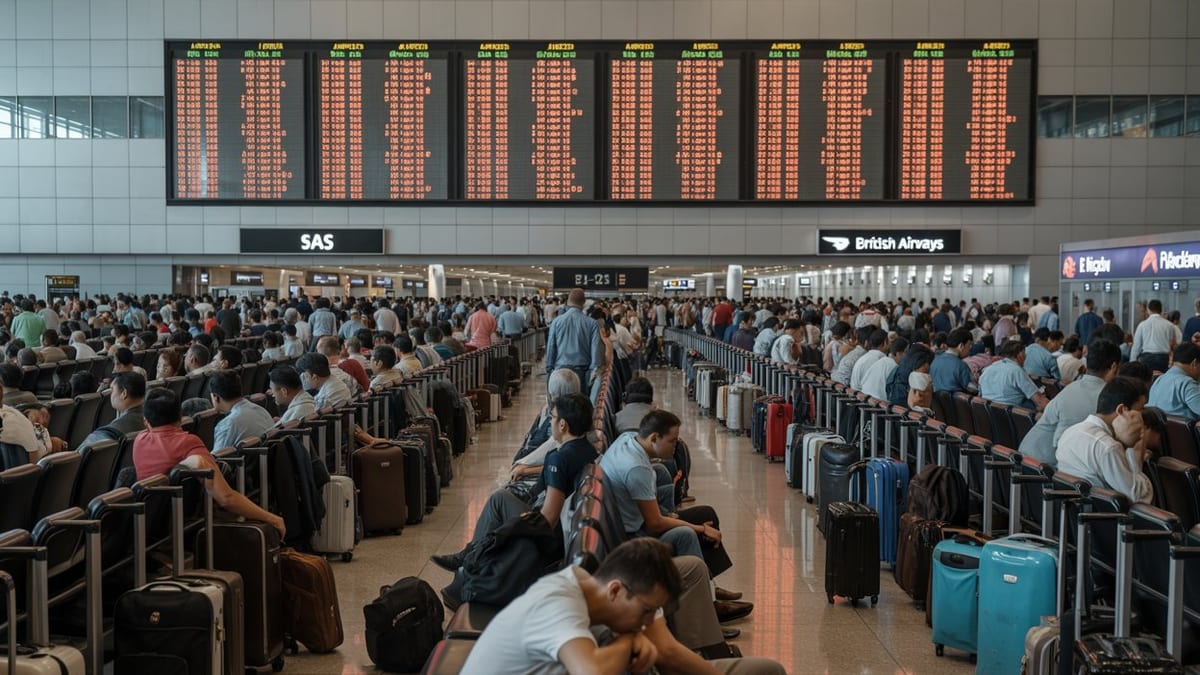
Image by Travel And Tour World
Widespread Cancellations And Thousands Of Delays
Travelers moving through London, Paris and Zurich have faced a combination of outright cancellations and rolling delays affecting short haul and long haul routes. Publicly available flight tracking data for the latest disruption period indicates that at least sixteen flights operated by or scheduled for Virgin Atlantic, British Airways, SAS and Air France were cancelled, with around two thousand services experiencing significant delays as crews and aircraft fell out of position.
At London Heathrow and London Gatwick, British Airways and Virgin Atlantic have been among the most visible carriers affected, with knock on effects for transatlantic departures and feeder connections to continental Europe. In Paris, Air France has cut selected services and warned of longer turnarounds on flights that do operate, while SAS has reported schedule pressures on links between Scandinavia, the UK and Switzerland as aircraft rotate through congested hubs.
In Zurich, delays to inbound aircraft from both the United Kingdom and France have cascaded into late departures toward other European cities and onward intercontinental destinations. Travelers connecting between London, Zurich and Paris have been particularly exposed, as even relatively short delays have been enough to break carefully timed connections.
Weather, Air Traffic Control And Network Knock On Effects
Recent storms moving across western Europe have played a central role in the latest bout of disruption. Strong winds, heavy rain and occasional snowfall over parts of the United Kingdom and France have forced temporary capacity reductions at key airports and restricted the use of certain runways, which in turn has limited the number of movements that can be safely handled each hour.
Over France, air traffic flow management measures have compounded these weather challenges. When traffic capacity in French airspace is reduced, flights are slowed, rerouted or held on the ground, and this can rapidly produce queues that stretch well beyond French borders. Published analyses of previous French airspace restrictions show that even relatively short periods of reduced capacity can generate hundreds of delayed flights and dozens of cancellations at airports across the region.
Once an aircraft misses one slot or is diverted around congested airspace, the ripple effects can extend far beyond the initial problem. Airlines rely on tight aircraft and crew rotations to keep schedules efficient. A delayed arrival into London or Paris late in the day can mean that the aircraft and its crew are no longer in place for the following morning’s departure, leading to proactive cancellations on routes that themselves may be experiencing normal conditions.
Impact On Passengers In London, Paris And Zurich
The result for passengers has been a familiar pattern of long queues at check in areas and ticket desks, crowded departure lounges and a scramble for scarce hotel rooms near airports. Travelers in London have reported flights being retimed multiple times before finally departing, as airlines try to coordinate revised slots with air traffic control and ground handling availability.
In Paris, reduced frequencies on certain Air France services have made it more difficult for passengers to secure same day rebookings when flights are cancelled altogether. Some travelers have turned to alternative routings via secondary hubs in an attempt to bypass the worst affected airports, but high load factors during the spring travel period mean spare seats are limited.
Zurich, though smaller than Heathrow or Charles de Gaulle, has experienced its own bottlenecks. When delayed arrivals from the UK and France bunch together, pressure builds on immigration, baggage systems and transfer security checkpoints. Even passengers whose flights operate close to schedule can miss onward connections if airport infrastructure becomes saturated at peak times.
Airlines Adjust Schedules And Advise Flexible Plans
Virgin Atlantic, British Airways, SAS and Air France have all adjusted their schedules in recent weeks in an effort to build in more resilience. Publicly available timetables show a mix of tactical cancellations, aircraft upgauging on certain departures to consolidate demand, and slightly extended block times on routes known to be vulnerable to air traffic restrictions.
According to published coverage from European aviation analysts, carriers have increasingly moved from ad hoc, last minute cancellations to more structured advance cuts when severe weather or airspace constraints are forecast. By trimming peak time schedules rather than attempting to operate every flight, airlines aim to reduce the risk of long rolling delays that can leave passengers waiting at the airport for many hours.
Travel advisories from airport operators and consumer organizations across the UK, France and Switzerland emphasize the importance of checking flight status frequently before leaving for the airport, allowing extra time for connections and carrying essential items in hand luggage in case baggage deliveries are delayed. For those with non essential journeys, the current pattern of disruption has prompted some to switch to rail or to rebook for later dates when conditions may be more stable.
Passenger Rights Under European And UK Rules
The disruption has once again highlighted the importance of clear information about passenger rights in cases of cancellation and long delay. Under the European Union’s Regulation 261/2004, which has been retained in similar form in the United Kingdom and applied in Switzerland through bilateral agreements, travelers on covered flights may be entitled to care, rerouting or refunds when services do not operate as planned.
These rules generally require airlines to provide meals, refreshments and accommodation when passengers are stranded overnight, along with a choice between rerouting at the earliest opportunity or a refund when a flight is cancelled. Monetary compensation may also be due for long delays or cancellations, although eligibility can depend on factors such as the cause of the disruption and whether it is considered outside the airline’s control.
Consumer advocates note that large scale events involving widespread weather and airspace restrictions can be complex when it comes to determining compensation, but emphasize that the basic duty of care provisions still apply. Travelers caught up in the current wave of cancellations and delays are being encouraged by passenger rights organizations to retain receipts for reasonable expenses and to submit claims directly to the operating carrier once their journeys are complete.