

More news on this day
Spring 2026 is opening with significant turbulence across the United States aviation system, as April begins with mounting flight disruptions at Boston Logan International Airport and several major domestic hubs struggling to recover from a volatile end to March.
Get the latest news straight to your inbox!
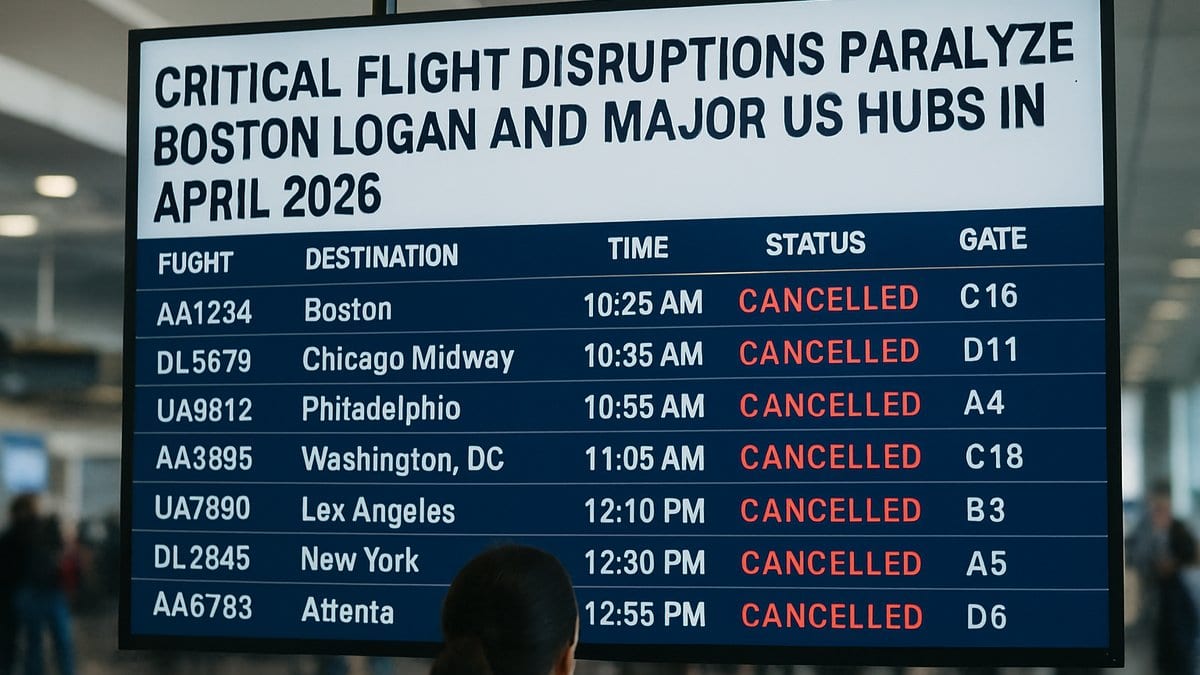
Stormy End to March Sets Up a Turbulent April
The current wave of disruption did not start on the calendar page of April. Severe thunderstorms, rapid snowmelt and flash flooding across large swaths of the country on March 31 generated more than three thousand flight delays and over one hundred cancellations nationwide, according to flight-tracking data cited in recent coverage. The pattern was systemic, touching nearly every major hub and leaving aircraft and crews out of position as the month turned.
Reports indicate that Chicago O’Hare was among the hardest hit, absorbing a substantial share of nationwide delays and cancellations during that late-March storm system. With so much disruption concentrated at a single high-volume hub, ripple effects flowed quickly into connecting airports along the East Coast and across the Sun Belt, setting the stage for persistent schedule volatility in early April.
Publicly available operational summaries show that once large hubs reduce arrival and departure rates because of storms or airspace constraints, it can take many hours for the system to rebalance. That reality is now shaping the early-April travel experience, as airlines work through lingering knock-on effects while confronting fresh bouts of unsettled spring weather.
Forecast discussions and industry analyses suggest that active weather patterns across the central and eastern United States are likely to persist into the first weeks of April. While not every day will see headline-grabbing numbers, the combination of saturated schedules and unstable conditions means recovery from each new round of storms may be slow, especially at already stressed airports.
Boston Logan Feels the Strain of Regional Weather and Network Ripples
Boston Logan, a key gateway for both domestic and transatlantic traffic, is feeling the combined pressure of regional weather and national network disruptions. Flight information dashboards and federal airport-status data for early April show intermittent arrival and departure delays linked to low clouds, gusty winds and congestion in the busy Northeast corridor, particularly on days when nearby hubs such as New York area airports and Washington’s Reagan National experience ground-delay programs.
Historical analyses of weather-related delays rank Boston Logan among the U.S. airports that see frequent operational challenges during periods of active coastal and frontal systems. Recent technical reports on aviation and meteorology highlight how quickly conditions around Boston can deteriorate when Atlantic moisture interacts with passing cold fronts, often forcing air-traffic managers to slow arrival streams or reroute traffic along more circuitous paths.
These constraints are now intersecting with brittle national schedules. When storms or ground stops hit New York or Washington, flights are often diverted, held or rerouted through Boston and other secondary gateways. Planning documents and local meeting materials released by airport authorities in recent years have underscored that disruptions at major neighboring hubs can cause delays and diversions at Logan, even when local weather remains marginally flyable.
Passenger accounts and airline customer advisories in early April point to longer-than-usual time on the ground for some Boston-bound and Boston-originating flights, including extended waits for available gates and deicing or ramp clearance during passing showers. While not every delay is dramatic, the cumulative effect is a perception of a system operating close to its limits as spring travel demand builds.
Major Hubs Across the U.S. Enter April on the Back Foot
Beyond Boston, many of the country’s largest hubs are contending with what aviation observers describe as a rolling series of high-impact days. Ground stops connected to unusual incidents in the Washington region in late March, multiple rounds of severe storms affecting the Northeast, and localized thunderstorms snarling traffic around Houston have all contributed to a fragile operating environment as April begins.
Coverage focused on specific carriers shows how quickly disruptions at one airline’s core hubs can reverberate nationwide. Recent reporting on United Airlines’ network, for example, highlights a single day with more than eight hundred delays and dozens of cancellations centered on the carrier’s principal hubs. When a large share of departures at those airports fall behind schedule, regional spokes and non-hub cities often see inbound and outbound services pushed later into the day or removed entirely.
Similar dynamics are playing out in Texas, where reports from the opening days of April describe hundreds of delays and a smaller but still significant number of cancellations at Dallas, Houston and San Antonio. In those cases, severe weather combined with tight turn times and heavy hub reliance to create extended recovery periods, as airlines worked overnight to reposition aircraft and bring crew schedules back into legal compliance.
Industry data aggregated from recent events suggests that once a hub crosses a certain threshold of delayed flights, the probability of secondary disruption at other hubs rises sharply. That effect is visible in early April statistics, with clusters of delays appearing at airports that share heavy traffic flows or code-share networks, even when they are hundreds of miles apart.
Capacity Cuts, Construction and Safety Concerns Tighten the System
Complicating the weather story are structural constraints that reduce the margin for error in the U.S. aviation network. In late March, coverage by national outlets described a Federal Aviation Administration decision to cut hourly arrival capacity at San Francisco International Airport because of runway construction and safety considerations related to closely spaced parallel runways. The shift from more than fifty arrivals per hour to the mid-thirties is expected to create recurring delays at one of the West Coast’s most important gateways.
While San Francisco is thousands of miles from Boston, network modeling and academic studies on delay propagation show that capacity reductions at a handful of very large hubs can have measurable effects across the entire domestic system. When transcontinental flights depart late from California, connections along the East Coast and in the Midwest often need to be retimed, which can shrink the slack that airlines normally rely on to absorb smaller local disruptions.
Earlier in the year, separate airspace closures in Texas and New Mexico for national-security reasons offered another example of how structural changes can paralyze regional aviation for hours at a time. In that episode, an unexpected temporary flight restriction effectively shut down a major regional airport, with cascading impacts for both passenger travel and cargo schedules.
Safety investigations and policy reviews underway after recent runway and midair incidents are also influencing how traffic managers handle adverse conditions. Public reports and technical findings emphasize a cautious approach when visibility drops or aircraft must operate near active construction zones, which can translate into longer ground holds and lower arrival rates in already busy corridors such as the Northeast.
What Travelers Can Expect Through April 2026
With the busy spring travel period ramping up, publicly available forecasts and airline communications suggest that passengers using Boston Logan and other major hubs should be prepared for intermittent, sometimes severe, disruptions in April 2026. Active weather patterns, reduced capacity at select airports and lingering imbalances from late-March storms are all combining to raise the likelihood of multi-hour delays on peak days.
Consumer guidance from travel and aviation watchdogs stresses the importance of monitoring flight status closely, particularly for itineraries involving connections through disruption-prone hubs such as Chicago, New York, Washington and Houston. Recent high-impact events have shown that schedules can deteriorate quickly once storms form near an airport or a ground stop is issued, narrowing opportunities for rebooking as the day progresses.
Regulatory agencies in the United States maintain public information explaining that passengers are generally entitled to a refund when a flight is canceled and they choose not to travel, including on nonrefundable tickets. Separate rulemaking and enforcement actions in recent years have led some airlines to publish clearer commitments on services such as hotel vouchers or meal assistance during controllable delays, though obligations vary by carrier and by the cause of disruption.
For now, Boston Logan stands as one of several high-visibility barometers of the system’s health. If weather cooperates and major hubs avoid unexpected shutdowns, operational data suggests that airlines can gradually work through existing backlogs. If storms, capacity cuts or technical problems reappear in quick succession, April 2026 may be remembered by travelers as another month when the U.S. air travel system struggled to keep pace with demand.