

More news on this day
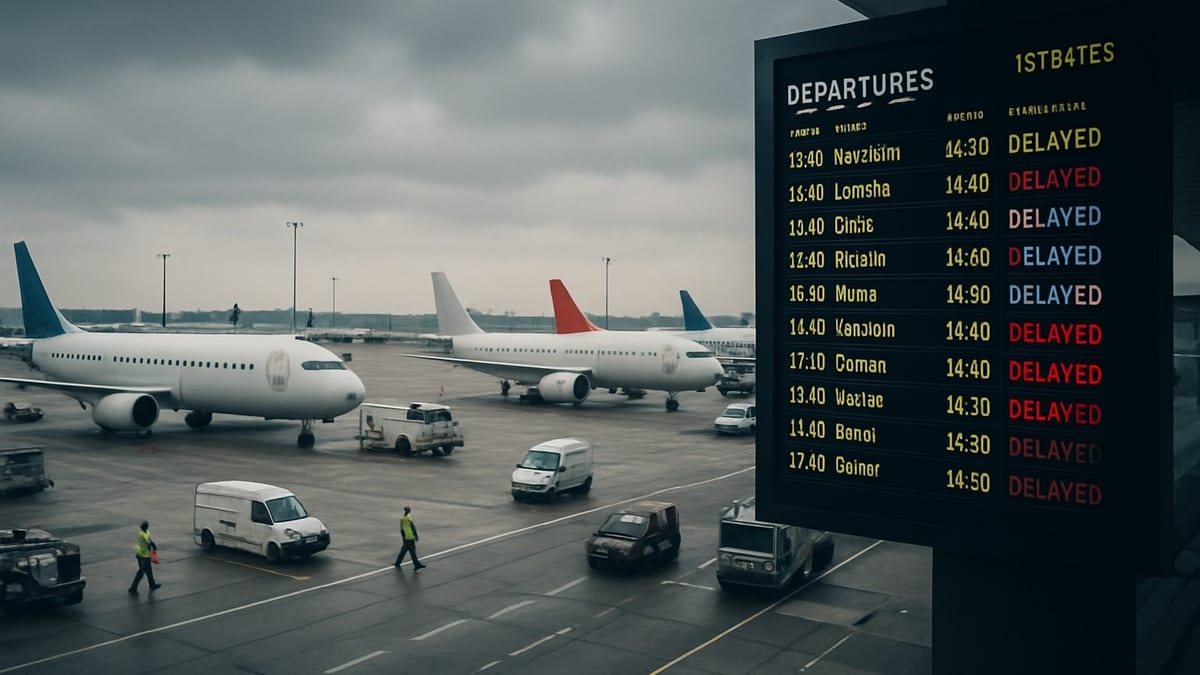
Flight operations at Atlanta’s Hartsfield-Jackson International Airport were severely disrupted today, as at least 73 departures and arrivals were cancelled and hundreds more delayed, causing widespread travel chaos at the world’s busiest hub.
Get the latest news straight to your inbox!
Storm Systems Trigger Fresh Wave of Disruptions
Reports from aviation data trackers and industry outlets indicate that a band of storm systems sweeping across the Southeast and Midwest has played a central role in the latest round of flight chaos affecting Hartsfield-Jackson. Thunderstorms and low clouds in the Atlanta area led to periodic airspace restrictions, limiting the number of arrivals and departures that could safely move through the region at any given time.
As air traffic managers slowed the rate of aircraft allowed into and out of Atlanta, airlines were forced to thin their schedules. Published coverage notes that carriers serving the hub collectively cancelled 73 flights and delayed more than 300, with knock-on effects on routes reaching major domestic cities such as New York, Chicago, Miami and Orlando, as well as several transatlantic services.
The timing of the disruption is particularly sensitive because it follows a series of recent weather-driven interruptions across the United States. Data from travel-industry reports this week show that Atlanta has repeatedly appeared among the top U.S. airports for cancellations and delays, underscoring how exposed the region’s primary hub is to fast-changing storm patterns and summer-style convection.
While the latest disruption falls short of the mass shutdowns seen during major winter storms or large-scale technology failures, the concentration of cancellations at a single hub, paired with hundreds of late departures, has been enough to upend travel plans for thousands of passengers within a single day.
Major Airlines Feel the Strain on Key Routes
According to aviation and travel trade coverage, several large carriers have been particularly affected by the operational squeeze in Atlanta. Delta Air Lines, which uses Hartsfield-Jackson as its primary global hub, appears to have taken a significant share of the cancellations as it rebalanced banked connections and attempted to protect longer-haul services. International partners and competitors, including Air France and other transatlantic operators, were also listed among those cancelling or delaying departures.
Publicly available flight-status data further show that large U.S. domestic carriers such as Southwest and American Airlines experienced disruptions on routes linking Atlanta with major business and leisure destinations. Some services were cancelled outright, while others operated with extended delays as crews and aircraft rotated through congested airspace and saturated gate areas.
For network planners, the choice of which flights to cancel is often guided by aircraft positioning, crew duty-time limits and the need to preserve connections on high-demand routes. As a result, some regional services and off-peak departures from Atlanta appeared more vulnerable to cancellation, while heavily booked trunk routes were more likely to operate, even if significantly delayed.
The current episode adds to a broader pattern in which U.S. carriers have been managing tight schedules amid recurring storms, intermittent air-traffic-control constraints and lingering staffing challenges. From a traveler perspective, the practical outcome is the same: longer queues, busier customer-service desks and greater uncertainty about when disrupted itineraries will be restored.
Hub Status Amplifies National and International Impact
Hartsfield-Jackson’s role as the world’s busiest airport by passenger traffic means that any operational stress at the facility quickly ripples across airline networks far beyond Georgia. Industry analyses frequently highlight Atlanta as one of the most connected hubs in North America, with a dense web of short- and medium-haul flights that funnel travelers into long-haul services.
When cancellations accumulate at a hub of this scale, the impact is not limited to travelers starting or ending their journeys in Atlanta. Passengers connecting between smaller U.S. cities can miss onward flights, while international travelers heading to or from Europe and other regions may face missed connections, unplanned overnight stays or rebookings via alternative airports.
Recent months have already demonstrated how vulnerable large hubs can be when multiple stressors converge. Earlier in the year, strong winter storms led to hundreds of cancellations at Atlanta, and last year’s technology outages at a major U.S. carrier produced several days of cascading operational disruption with Hartsfield-Jackson at the center. The latest run of 73 cancellations, while modest by comparison, reinforces the structural reality that bottlenecks at mega-hubs can quickly influence travel conditions nationwide.
For airlines, the reliance on hub-and-spoke networks in Atlanta offers powerful efficiencies in normal conditions but can magnify problems when weather or other constraints limit capacity. As each disrupted bank of flights ripples through subsequent departure waves, aircraft and crews can end up out of position, prolonging recovery even after storms move away.
Travelers Confront Long Lines and Limited Options
Passengers passing through Hartsfield-Jackson during the latest disruption have encountered a familiar mix of crowded departure halls, lengthy customer-service queues and tight competition for remaining seats. Local media coverage in recent weeks has already documented extended security wait times at Atlanta, with some travelers advised to arrive three hours or more before departure. The addition of widespread cancellations and delays further compounds those pressures inside the terminal.
With many flights fully booked at the start of a busy spring travel period, rebooking options for same-day travel can be limited. Travelers whose flights are cancelled may be shifted onto later departures or alternate routings, and in some cases may be offered vouchers or travel credits if they accept significant schedule changes. Those relying on domestic connections, such as one-stop itineraries between smaller regional airports, can face particular challenges if the final legs of their journeys operate only a few times per day.
Accommodation around Atlanta is another friction point when disruptions stretch into overnight hours. Large-scale cancellations in the past have quickly filled nearby hotels, leaving some passengers to remain in the terminal. Although the present wave of 73 cancellations is smaller than those seen during major storms or technology outages, the hub’s sheer scale means that even a fraction of disrupted flights can translate into hundreds of stranded travelers seeking last-minute lodging.
Consumer advocates and travel publications consistently emphasize the value of proactive planning in such situations, encouraging passengers to monitor flight status closely, keep airline apps updated and respond quickly when rebooking options appear. In a constrained environment, those who act early often secure the most favorable alternatives.
Growing Scrutiny on Resilience and Passenger Information
The latest operational turbulence in Atlanta has also renewed attention on how U.S. airlines and airports communicate with travelers when conditions deteriorate. Transportation analysts point to earlier episodes at Hartsfield-Jackson, including severe winter weather and major IT incidents, as reminders that timely, transparent information is critical to managing passenger expectations.
Regulators and consumer groups have been pushing for clearer disclosures around passenger rights during significant disruptions, particularly when cancellations are not directly attributable to weather. While the current Atlanta episode is closely tied to storm systems and airspace management, it comes amid a broader policy conversation in the United States about compensation, rebooking obligations and the responsibilities of airlines when operations falter.
At the same time, airport-focused initiatives, such as the publication of real-time security wait times and expanded wayfinding tools, are intended to help travelers navigate crowded facilities more effectively during high-stress periods. Hartsfield-Jackson has been part of this trend, with digital tools and on-site signage designed to guide passengers between checkpoints, concourses and rebooking counters.
As severe weather patterns, infrastructure constraints and high travel demand continue to intersect, industry observers expect that hubs such as Atlanta will remain on the front line of operational risk. The current tally of 73 cancellations serves as another data point in an ongoing debate about how much buffer and redundancy the modern air travel system should build in to protect passengers from the next bout of flight chaos.