

More news on this day
Passengers across Brazil faced long queues, missed connections and crowded terminals today as at least 158 flight delays and 20 cancellations swept through major airports in São Paulo, Rio de Janeiro, Brasília, Recife and other key hubs, disrupting operations at LATAM, Gol, Azul, Avianca and several smaller carriers.
Major Hubs Buckle Under Mounting Disruptions
The latest wave of disruption hit Brazil’s busiest air corridors during one of the highest-demand periods of the year, as morning and early afternoon banks of flights began slipping behind schedule. At São Paulo–Guarulhos and Congonhas airports, ripple effects from earlier operational bottlenecks quickly cascaded into double-digit delays, leaving departure boards dominated by revised departure times.
In Rio de Janeiro, both Galeão and Santos Dumont saw knock-on impacts as aircraft and crews arrived late from already delayed rotations elsewhere in the network. Similar scenes were reported in Brasília and Recife, where a mix of congested airspace, slot restrictions and late inbound aircraft squeezed turnaround times and forced airlines to reshuffle schedules.
Operational data compiled by local aviation trackers and airport monitors indicated that no single carrier was solely responsible. Instead, Brazil’s three largest domestic airlines, LATAM, Gol and Azul, were each grappling with tight fleet utilization and limited slack in their schedules, amplifying the effect of every late arrival or technical check. Avianca, which operates key international routes to and from São Paulo, was also drawn into the disruption as delays mounted on shared airport infrastructure.
By mid-afternoon, the combined total of at least 158 delayed flights and 20 outright cancellations had already stranded or significantly inconvenienced thousands of travelers, with officials warning that recovery operations could extend into the late-night waves and early departures the following morning.
LATAM, Gol, Azul and Avianca Struggle to Stabilize Operations
LATAM Brasil, the country’s largest airline by market share, reported widespread delays on trunk routes linking São Paulo, Rio de Janeiro, Brasília, Belo Horizonte and northeastern capitals. Industry analysts noted that the carrier has been running tight turnarounds on its Airbus narrowbody fleet to meet resurgent post-pandemic demand, leaving little margin when weather, congestion or minor technical checks intervene.
Gol Linhas Aéreas, which relies heavily on high-frequency shuttles and point-to-point domestic services, faced particular challenges at São Paulo–Congonhas and Rio’s Santos Dumont. These downtown airports have strict slot and runway constraints, so even modest schedule deviations can force airlines to cancel or consolidate flights rather than risk extended curfew or slot infringements, further frustrating passengers already caught in long check-in and security queues.
Azul, with its strong presence in Belo Horizonte, Campinas and a dense network into secondary and regional cities, saw disruption cascade beyond the main hubs. When aircraft and crews were delayed out of São Paulo and Rio, knock-on effects were quickly felt on connecting services to mid-sized markets such as Vitória, Curitiba and Goiânia, underscoring how tightly interconnected Brazil’s domestic network has become.
On the international front, Avianca and other foreign carriers operating from Guarulhos were forced to adjust boarding times, rebook connecting itineraries and reposition aircraft. Late-arriving inbound flights from Bogotá, other South American capitals and Europe meant some passengers missed onward domestic connections, swelling rebooking lines at transfer counters and information desks.
Passengers Face Long Queues, Confusion and Mounting Costs
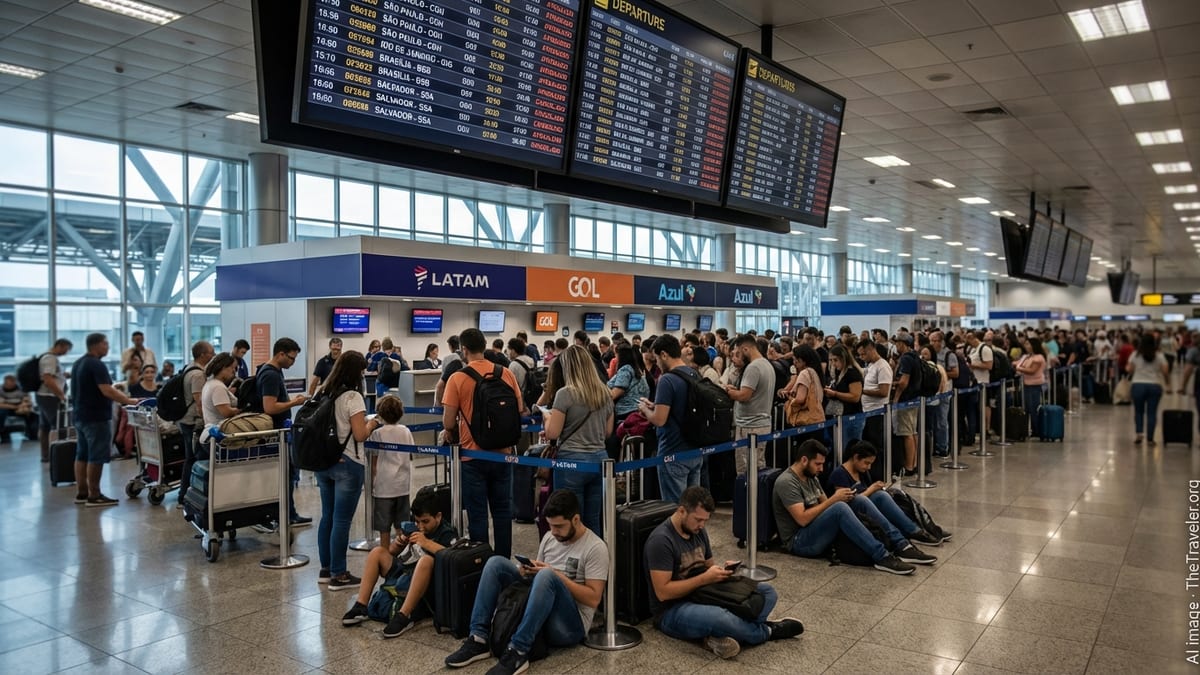
Inside terminals, the human impact of the disruptions was visible in snaking check-in lines, floor-bound passengers resting beside their luggage and crowded food courts as travelers waited out rolling delays. Families returning from holidays, business travelers heading to key meetings and students connecting to university towns were among those caught up in the chaos.
Social media posts from São Paulo, Rio de Janeiro, Brasília and Recife showed passengers expressing frustration over limited information, conflicting announcements and difficulty accessing airline call centers. Some reported being advised to manage rebooking exclusively through mobile apps, only to find that alternative same-day options were fully booked or prohibitively expensive.
Travel agents and consumer associations noted that additional costs were mounting for many affected passengers, including last-minute hotel stays, airport transfers, meals and reissued tickets on competing airlines. For travelers on complex itineraries that combined domestic and international legs, even a short delay at a Brazilian hub could mean losing nonrefundable segments of trips booked through foreign carriers or online platforms.
At several airports, local staff attempted to ease pressure by handing out meal vouchers and arranging limited hotel accommodation for those facing overnight disruptions. However, with Brazil’s aviation sector still recovering from pandemic-era financial stress, airlines remain cautious about offering extensive discretionary compensation beyond what is strictly required by current regulations.
Regulatory Debate Intensifies as Disruptions Become Routine
The latest episode of travel chaos comes as Brazilian regulators and courts grapple with how to balance consumer protection with the financial realities facing airlines. The country has seen a sharp increase in legal disputes over cancellations, delays and baggage issues in recent years, putting additional strain on carriers that argue the current framework encourages litigation and raises operating costs.
The national civil aviation authority has been discussing updates to its rules on passenger assistance and airline liability, seeking to clarify when carriers must provide meals, accommodation and rebooking, and under what circumstances they can invoke force majeure to limit compensation. Industry groups insist that clearer criteria would help reduce uncertainty and support more sustainable pricing, while consumer advocates warn that any rollback of protections could leave travelers more vulnerable during exactly the type of large-scale disruption witnessed today.
Legal specialists point out that even when disruptions stem from factors such as adverse weather or air traffic control restrictions, airlines are still responsible for practical support at the airport, including communication, rebooking and basic welfare for stranded passengers. The recurring scenes of overcrowded terminals and confused travelers have fueled calls for stricter enforcement of existing standards, better contingency planning and more robust staffing at customer service points.
Parliamentary discussions on broader aviation safety and conduct issues, including unruly passengers and operational resilience, have also highlighted how vulnerable Brazil’s air transport system can be when multiple stress factors converge. The current wave of delays and cancellations is expected to feed into those debates, increasing pressure on both policymakers and the industry to deliver visible improvements.
What Travelers Can Do as Brazil’s Skies Remain Unsettled
With airlines and airports still working to clear backlogs, travel experts advised passengers flying over the next 24 to 48 hours to build extra time into their plans and monitor flight status closely. Same-day connections, particularly those involving separate tickets or mixed domestic and international carriers, are seen as especially risky while operations remain fragile.
Specialists recommend checking in online as early as possible, keeping airline apps installed and notifications enabled, and verifying gate information directly on terminal screens to avoid missed announcements in crowded waiting areas. Travelers are also encouraged to keep receipts for any unexpected expenses such as meals, transport or emergency accommodation, in case they seek reimbursement later under Brazilian consumer law or through travel insurance.
For those yet to book, observers suggest favoring nonstop routes where available and avoiding very tight layovers at major hubs until schedules stabilize. As Brazil’s aviation sector continues to operate on thin margins with little buffer capacity, even relatively minor operational shocks can quickly escalate into nationwide disruption, as the latest tally of 158 delayed flights and 20 cancellations has once again made clear.