

More news on this day
Travellers across Brazil are facing major disruption after at least 86 delays and 42 cancellations involving LATAM, Gol and Azul services were recorded in São Paulo, Rio de Janeiro and Brasília, snarling domestic connections and leaving passengers stranded in terminals and on tarmacs.
Get the latest news straight to your inbox!
Operational Snag Ripples Through Brazil’s Busiest Corridors
The latest wave of disruption hit on 9 and 10 April 2026, when operational data and local media coverage began to show a sharp spike in late and cancelled departures on Brazil’s most heavily used business routes. Flights linking São Paulo with Rio de Janeiro and Brasília registered a disproportionate share of the problems, with LATAM, Gol and Azul all affected to varying degrees.
Publicly available flight-tracking snapshots indicated that short-haul shuttles between São Paulo’s Congonhas and Guarulhos airports and Rio’s Santos Dumont and Galeão terminals were among the hardest hit. A cluster of cancellations on morning and early afternoon services quickly cascaded into missed onward connections, particularly for travellers using São Paulo and Brasília as transfer hubs to reach secondary cities.
In Brasília, delays on inbound aircraft from the São Paulo area contributed to a growing backlog throughout the day, as aircraft and crew rotations slipped out of their planned sequence. Airlines attempted to consolidate some lightly booked flights and reallocate equipment, but this provided little immediate relief for those already facing extended waits at the gate.
While precise attributions vary by carrier and route, the combined figure of 86 delayed flights and 42 outright cancellations across the three cities underscores the fragility of Brazil’s high-frequency shuttle network when a disruption strikes at peak time.
Technical Issues in São Paulo Trigger Wider Network Disruption
Reports from Brazilian media outlets and official aviation notices point to a temporary interruption of airspace operations over the São Paulo region on the morning of 9 April as a key catalyst. A technical problem affecting local traffic management led to a short closure of departures and arrivals, forcing aircraft to hold, divert or delay pushback while systems were reset and capacity gradually restored.
Once the pause was lifted, airlines confronted an immediate bottleneck of aircraft vying for departure and arrival slots at Congonhas and Guarulhos. Even a closure lasting less than an hour translated into knock-on effects that stretched across most of the day, as congestion built up both in the air and on the ground. Turnaround times lengthened, gates and remote stands became scarce and crews began to bump up against legal duty-time limits.
Public statements from Azul and Gol about their São Paulo operations indicated multiple cancellations, diversions and partial suspensions into key airports while the disruption was unfolding. Latam’s schedules on core routes such as São Paulo to Rio de Janeiro and São Paulo to Brasília also showed elevated delay levels, reflecting the shared dependency of all three carriers on São Paulo’s constrained airspace and runway capacity.
Because São Paulo sits at the centre of Brazil’s domestic grid, the initial technical glitch had consequences well beyond the city itself. Flights bound for Rio de Janeiro and Brasília departed late or were cancelled outright, and subsequent rotations to other regions of the country began the day already off-schedule.
Passengers Confront Long Queues, Missed Connections and Limited Options
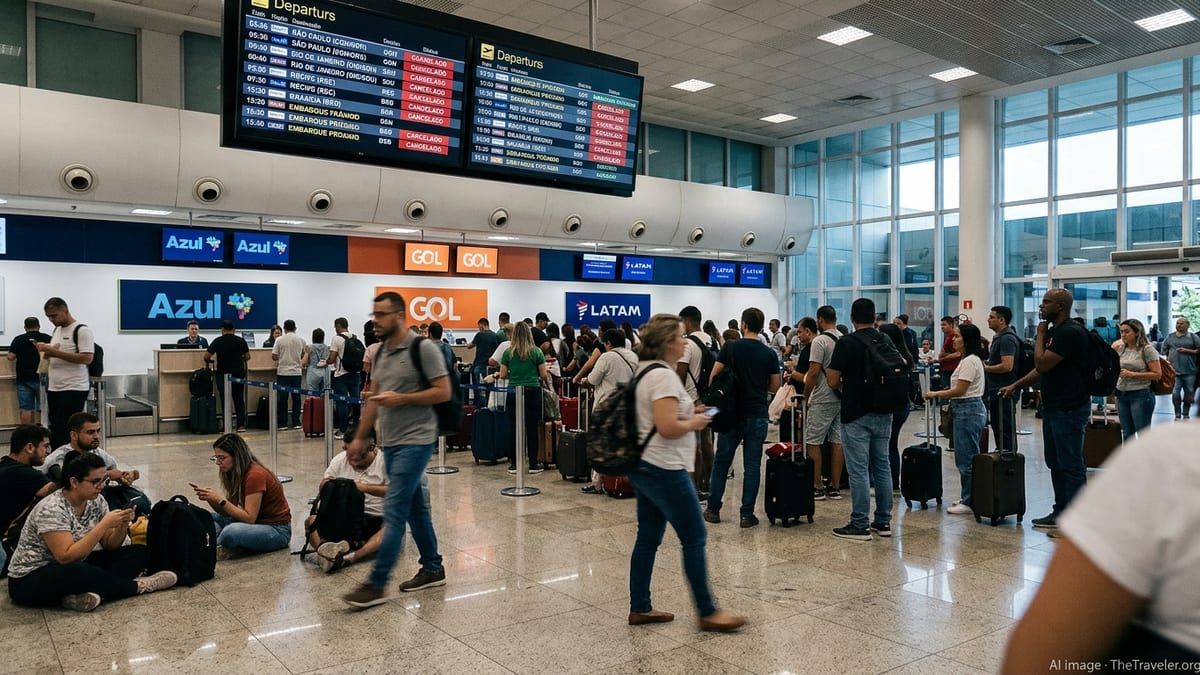
For travellers booked with LATAM, Gol and Azul, the statistics have translated into hours of uncertainty. Images and accounts circulating through Brazilian news outlets and social media channels show crowded check-in halls, long queues at customer service desks and departure boards filled with red and yellow status updates.
Many passengers on the São Paulo to Rio de Janeiro shuttle, a route typically marketed as a reliable “air bridge” for business travellers, reported missed meetings and same-day return trips becoming impossible to complete. Those connecting in São Paulo or Brasília for flights to Brazil’s northeast or interior states were among the worst affected, as limited remaining seat availability made same-day rerouting difficult.
With aircraft and crews out of position, some services were combined or rescheduled, further complicating the travel plans of those relying on tight connections. Families and international travellers arriving from long-haul routes into São Paulo and Rio de Janeiro faced additional stress when onward domestic legs were delayed or cancelled, leaving them to arrange last-minute accommodation or overnight stays in already busy airport hotels.
Consumer advocates in Brazil have reiterated that passengers hit by long delays or cancellations may be entitled to assistance such as meals, communication support and lodging in certain circumstances, but accessing that support in real time can be challenging when disruption is widespread and ground staff are overwhelmed.
Airlines Work to Restore Schedules but Backlog Persists
By late 10 April, publicly accessible operational data suggested that LATAM, Gol and Azul were gradually restoring their planned schedules, with a larger proportion of flights departing within normal delay thresholds. However, the residual backlog from earlier cancellations continued to weigh on the system, as displaced travellers sought available seats on already busy routes.
Airlines encouraged customers through their digital channels to check flight status before heading to the airport and to use apps or websites to rebook when eligible. These tools often update faster than airport information screens and can reduce the need to queue at physical service counters, especially during large-scale disruption events.
Even so, some short-haul sectors remained vulnerable to further knock-on delays as aircraft arrived late from other parts of the network. In practice, this meant that a technical issue centred on São Paulo created instability well into the evening on flights involving Brasília and both of Rio de Janeiro’s principal airports.
Industry observers noted that the episode highlights how reliant Brazil’s domestic air transport system is on a small number of highly saturated metropolitan hubs. When a technical or weather-related constraint emerges in one of these locations, the impact on punctuality across multiple airlines and cities can be immediate and severe.
What Travellers Can Do During Ongoing Irregular Operations
Travel specialists advise that during periods of irregular operations, such as the current disruption involving LATAM, Gol and Azul in São Paulo, Rio de Janeiro and Brasília, passengers should monitor airline notifications closely and allow additional time at the airport. Same-day rebooking often depends on acting quickly when new options are released into reservation systems.
Passengers are also encouraged to keep boarding passes and receipts for expenses incurred during extended delays, as these documents can be important when seeking reimbursements or asserting rights under Brazilian aviation consumer rules. While compensation frameworks differ depending on the cause of disruption, documentation helps support any later claim.
For upcoming trips on Brazil’s densest corridors, flexible planning can help mitigate risk. Choosing slightly off-peak departure times, avoiding very tight connections in São Paulo or Brasília and building in contingency for important meetings or events can reduce the impact if similar disruption flares up again.
With the country’s main carriers now working to stabilise operations, attention is turning to how infrastructure managers and airlines can reduce the likelihood that a short technical interruption in a single airspace sector will once again leave dozens of flights delayed or cancelled and passengers stranded across three of Brazil’s most important cities.