

More news on this day
Travellers across Canada are facing another day of severe disruption as 135 new flight delays and 19 cancellations tied to Air Canada, Air Inuit and Jazz ripple through major hubs in Toronto, Montreal and Ottawa, while the remote northern community of Umiujaq sees already limited air links abruptly reduced.
Fresh Wave of Disruptions Across Canadian Skies
Data compiled on March 3 shows a concentrated burst of operational problems for three key Canadian carriers, with Air Canada, Air Inuit and Jazz collectively responsible for the bulk of 135 delays and 19 cancellations nationwide. While the total number of cancelled flights appears modest compared with past storm-related meltdowns, the pattern of disruption is enough to upend connections, strand travellers and stretch airport resources across the country.
At the same time, broader pressures continue to weigh on airline schedules. Carriers are still juggling winter weather issues and crew rotations while adjusting to international route suspensions linked to conflict in the Middle East. For domestic passengers, this translates into thinner schedule buffers and fewer spare aircraft available when something goes wrong, making each delay or cancellation more likely to cascade through the network.
The latest figures come on the heels of several bruising weeks for Canadian aviation, where repeated bouts of rough weather and global geopolitical tension have exposed how tightly wound airline operations have become. Travellers are increasingly finding that even relatively small numbers of cancellations can trigger widespread knock-on effects for both short-haul and long-haul journeys.
Toronto, Montreal and Ottawa Bear the Brunt
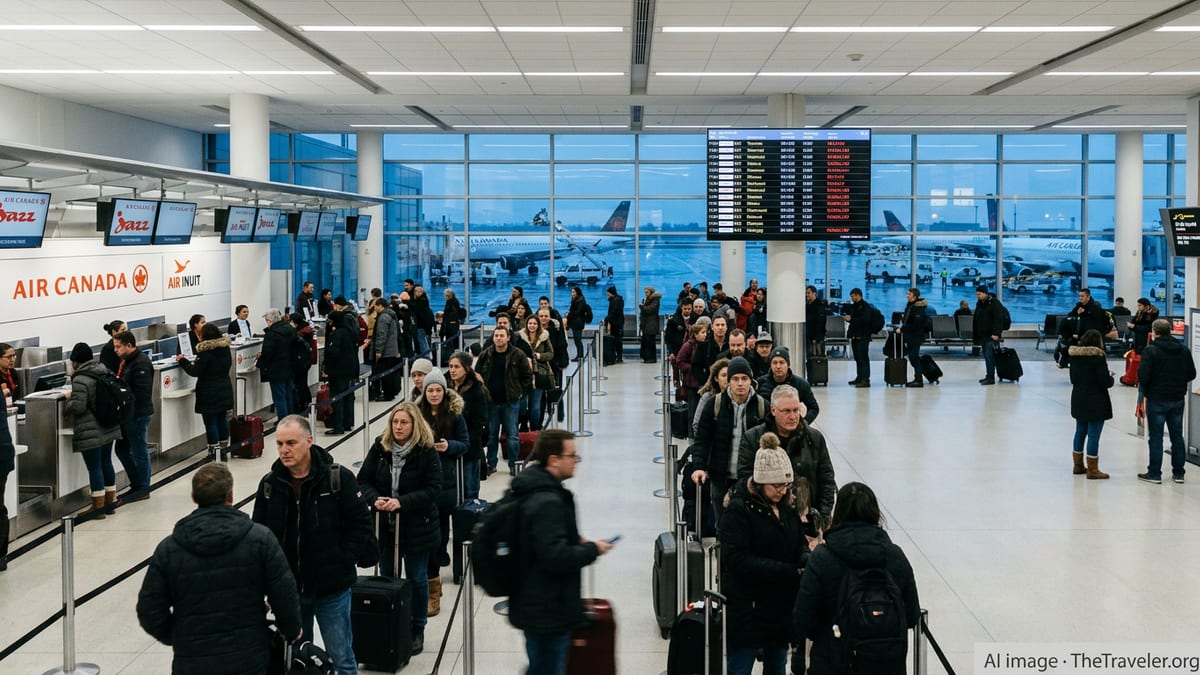
Toronto Pearson, Canada’s busiest airport, is once again at the centre of the disruption. Dozens of delayed departures and arrivals, along with a cluster of cancellations, have pushed gate areas, security lines and customer-service counters to capacity. For passengers connecting through Toronto to regional destinations, a delay of even an hour can mean missed onward flights and unplanned overnight stays.
Montreal–Pierre Elliott Trudeau International Airport has also reported a notable number of delays and a handful of cancellations tied to the three carriers. While the totals there are lower than at Toronto Pearson, Montreal plays a key role for both transatlantic services and eastern Canada connections. Late arriving aircraft from earlier legs can easily throw off carefully timed schedules, particularly for evening bank departures.
In Ottawa, Canada’s capital-city airport is experiencing a more moderate but still disruptive level of operational strain. With fewer daily frequencies than the very largest hubs, even a small cluster of delayed or cancelled flights can represent a significant share of daily movements. Business travellers and government officials shuttling between the capital and other Canadian cities are reporting tight connections, last-minute gate changes and crowded rebooking desks as the latest wave of delays works its way through the timetable.
Umiujaq Highlights the Fragility of Remote Air Links
The effects of today’s flight problems are being felt especially acutely in Umiujaq, a small community in Nunavik that relies heavily on regional carriers such as Air Inuit for essential connectivity. There, two cancellations amid an otherwise delay-free schedule are enough to sharply curtail mobility for the day, effectively erasing key links to the rest of Quebec.
Unlike major hubs, where passengers can often be rebooked on later departures or alternative airlines, travellers in and out of Umiujaq face far fewer options. Many routes operate only once or twice daily, and in some cases only a few times a week. When a flight is scratched, residents and essential workers can be left waiting an extra day or longer, with downstream impacts on medical appointments, school travel and supply chains.
The situation in Umiujaq underscores how national statistics on delays and cancellations can mask very different realities on the ground. In remote and northern regions, each cancelled flight carries outsized consequences. Communities that already grapple with high travel costs and limited infrastructure see their lifeline services squeezed further whenever airline operations come under strain.
Air Canada, Air Inuit and Jazz Under Operational Pressure
Within the current disruption, Air Canada remains the most heavily affected carrier by raw numbers, logging the largest share of delays along with several outright cancellations. As the country’s dominant airline, its aircraft and crews anchor a web of domestic, transborder and long-haul routes. When international operations are disrupted, the ripple effects inevitably reach the domestic network, eroding punctuality on shorter Canadian sectors.
Regional operators Air Inuit and Jazz, which feed traffic into larger hubs and serve smaller centres, are also contending with a high proportion of delayed flights relative to their size, plus a number of cancellations. For these carriers, a single aircraft held up by weather, airport congestion or late-arriving passengers can throw off rotations across multiple communities, particularly in Quebec and Atlantic Canada.
The latest operational headaches arrive just as Air Canada is already adjusting its long-haul schedule to reflect the temporary suspension of flights to Tel Aviv and Dubai amid ongoing conflict in the Middle East. That suspension, in place until at least March 22, has required the airline to redeploy aircraft and crews, leaving less flexibility to mop up irregular operations elsewhere. While the resulting domestic disruption is indirect, it illustrates how international crises can reverberate through Canada’s internal air network.
Frustrated Passengers Navigate Long Lines and Uncertain Plans
For those caught in the middle of today’s disruption, the experience often begins with a status change on a mobile app or departure board and quickly escalates into a scramble to salvage travel plans. At Toronto and Montreal, passengers report extended waits at customer-service counters as staff work to secure scarce seats on later flights, while phone and chat lines have been heavily used by travellers trying to rebook remotely.
Families returning from winter breaks, business travellers with tightly timed meetings and students transiting between smaller communities and major cities are among those most affected. Some have been offered meal vouchers or hotel accommodation where delays stretch into overnight territory, but many others are opting to adjust their plans independently, booking nearby hotels or alternative transport at personal expense in hopes of keeping itineraries intact.
Airports are urging passengers to arrive early, keep a close eye on flight-status updates and use airline digital tools for rebooking whenever possible, in order to ease pressure on in-person service points. With 135 delays and 19 cancellations recorded across this latest data set alone, industry observers note that Canada’s air-travel system remains highly vulnerable to any additional shocks in the days ahead.