

More news on this day
Colombia is grappling with a fresh wave of air travel disruption after state-owned Satena and U.S. low-cost carrier Spirit Airlines canceled or suspended a cluster of key flights connecting Bogotá, Medellín, Cali, Orlando and several regional destinations, leaving passengers stranded and prompting renewed questions about capacity, safety and consumer protections on some of the country’s busiest and most strategic routes.
Get the latest news straight to your inbox!
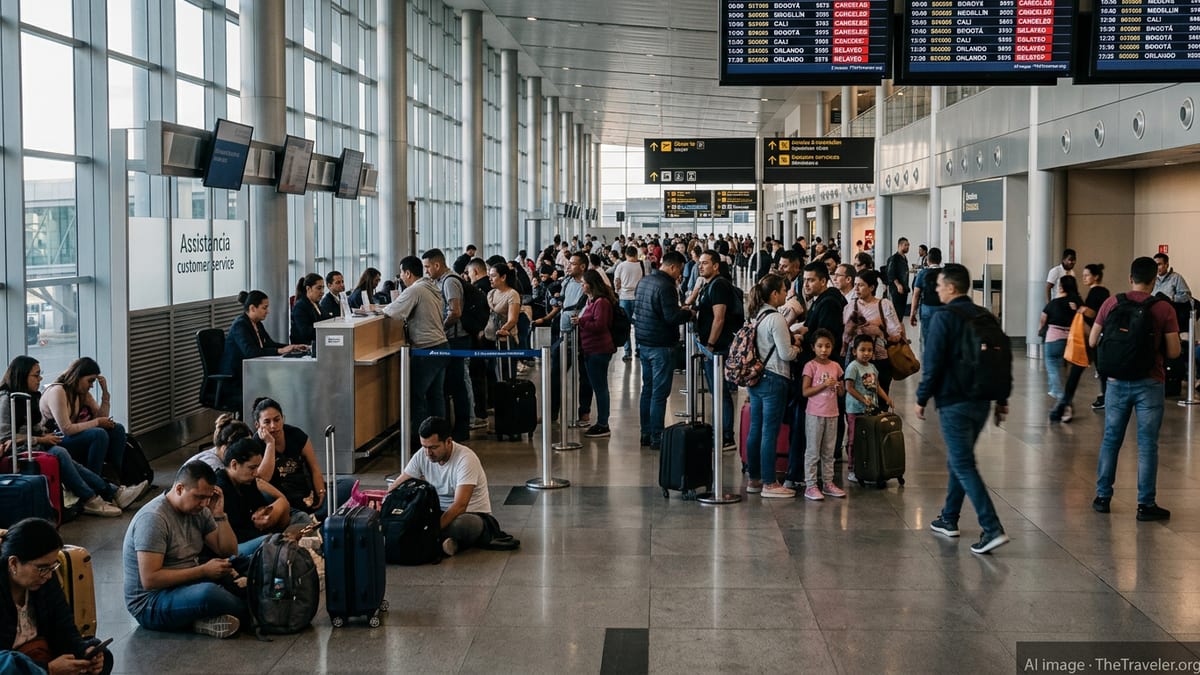
Targeted Cancellations Hit Major Colombian Hubs
The latest disruption involves a mix of outright flight cancellations and temporary suspensions that are rippling through Colombia’s three main air hubs: Bogotá, Medellín and Cali. According to recent operational reports and local media briefings, Satena has halted selected services on secondary routes that feed into these cities, while Spirit has trimmed or canceled multiple frequencies on Colombia–United States corridors, particularly those linking to Orlando.
The reductions come on top of a difficult start to the year for Colombian aviation. In February, several airports including Bogotá and Cali already logged dozens of delays and a series of cancellations affecting carriers such as Avianca, Latam Colombia, Spirit and Satena, leaving hundreds of travelers facing missed connections or overnight stays in terminals. The new wave of cuts has compounded the strain on these networks, particularly for price-sensitive passengers who rely on low-cost and regional operators to move between provincial cities and major hubs.
While the headline impact centers on Bogotá, Medellín and Cali, the fallout reaches beyond Colombia’s biggest metropolitan areas. Travelers connecting from smaller cities and remote communities, many of which depend almost exclusively on Satena for air access, are facing longer itineraries, scarce seats on alternative carriers and higher last-minute fares as they scramble to rebook.
Airport officials and industry analysts say operational resilience remains fragile, with carriers still juggling tight aircraft utilization, maintenance requirements and the commercial pressures of reconfiguring route maps for 2026. That balance has left little slack in the system when one or two key flights are pulled from the schedule.
Satena Pulls Back on Select Regional Links
Satena, the state-owned airline tasked with connecting Colombia’s most remote regions, has confirmed a series of targeted suspensions on routes that funnel traffic into major cities. The most recent high-profile move was the temporary halt of flights to Pizarro in Chocó, following safety concerns at the aerodrome that included people and objects on the runway and deficiencies in basic infrastructure such as perimeter fencing and wind indicators. Authorities framed the step as a precautionary measure, but it has effectively cut a direct air bridge for that coastal community and forced detours through other Pacific and inland airports.
At the same time, Satena is still recalibrating its broader network after the crash of Flight 8849 on January 28, 2026, on the Cúcuta–Ocaña route, a tragedy that has intensified scrutiny of regional operations. Although investigators have yet to publish their final conclusions, Satena’s management has pledged to prioritize safety and operational integrity as it reviews marginal routes and aircraft deployment across the country.
In practice, that has translated into short-notice cancellations on a handful of low-volume services that previously linked smaller cities into Bogotá, Medellín and Cali. Passengers booked on these flights have reported same-day notifications, limited re-accommodation options and difficulty reaching call centers during peak disruption periods. For many travelers in Colombia’s periphery, where road journeys can still take a full day or more, the loss of a single Satena frequency can mean postponing medical appointments, missing business meetings or being forced to pay for far more expensive itineraries on larger carriers.
Paradoxically, Satena is also pressing ahead with expansion on some higher-demand routes, including new and reinforced connections out of Medellín to the Caribbean region. That mix of growth in stronger markets and retrenchment from more challenging destinations underscores the delicate balance the airline is trying to strike between its public-service mandate and financial sustainability.
Spirit’s Cuts Reshape Colombia–Orlando and U.S. Links
Across the Caribbean Sea, Spirit Airlines continues to pare back its international footprint as part of a sweeping restructuring under Chapter 11. The carrier has already announced plans to exit several cities in early 2026 and is trimming underperforming or operationally complex routes across Latin America. Colombia, which for years has been a cornerstone of Spirit’s low-cost international network, has been caught up in this retrenchment.
The most immediate impact for Colombian and U.S.-based travelers is on links involving Orlando, one of Spirit’s key U.S. gateways for leisure traffic to South America. Recent schedule adjustments have reduced frequencies and, on some days, eliminated nonstops that previously connected Orlando with major Colombian cities such as Bogotá and Medellín. Travel agents report that in certain weeks, itineraries that once relied on a single, direct Spirit flight now involve at least one connection or a switch to a legacy carrier at significantly higher fares.
Passengers have taken to social media and consumer forums to complain about cancellations communicated weeks or even months in advance, often accompanied by offers of flight credits instead of automatic cash refunds. While U.S. regulations entitle customers to reimbursement when an airline cancels a flight and the passenger chooses not to travel, many travelers say they are still being steered toward vouchers and rebookings rather than clear instructions about their right to a refund.
For Colombian tourism operators, especially those marketing multi-destination packages that combine Orlando theme parks with stays in cities like Bogotá, Medellín and Cali, the uncertainty around Spirit’s schedule has complicated sales. Some agencies are now advising clients to build in extra flexibility or consider flying on other carriers, even if that means higher initial prices, to reduce the risk of being stranded midway through their trip.
Travelers Left Stranded and Searching for Alternatives
The convergence of Satena’s regional suspensions and Spirit’s cross-border cuts has had a tangible impact on travelers on both sides of the equator. In Colombian terminals, scenes of frustrated passengers queuing at check-in counters and service desks have become more common, particularly following clusters of cancellations linked to weather, infrastructure issues or aircraft rotation problems.
Stranded passengers interviewed by local broadcasters and online travel outlets describe a familiar pattern: an initial text or email advising of a cancellation, followed by long waits to speak with airline staff, and then limited options to rebook within a reasonable timeframe. On busy corridors linking Bogotá, Medellín and Cali, same-day alternatives may exist, but seats can disappear quickly and walk-up fares can soar, placing a heavy financial burden on travelers who booked far in advance to secure low prices.
On international routes such as Colombia–Orlando, the stakes can be even higher. Families traveling with children for long-planned vacations, students on tight budgets and migrant workers commuting between homes and job sites all face the possibility of multi-day delays when flights are pulled from the schedule. In some recent cases, travelers reported being offered re-accommodation several days later or in some instances being advised to make their own arrangements and seek reimbursement afterward, a process that can be time-consuming and uncertain.
Consumer advocates in Colombia and the United States say the situation highlights the importance of understanding passenger rights in both jurisdictions, particularly when itineraries involve a mix of domestic and international segments and different regulatory frameworks. They also warn that travelers should brace for continued volatility in 2026 as airlines across the region fine-tune their networks in response to fuel costs, currency fluctuations and ongoing financial restructuring efforts.
What Passengers Need to Know Before Flying
For those planning trips involving Bogotá, Medellín, Cali or Orlando in the coming weeks, travel experts recommend taking a more cautious and proactive approach than in previous years. That starts with checking flight status repeatedly in the days leading up to departure, not just once when the booking is made. Because both Satena and Spirit have made adjustments on relatively short notice, the risk of schedule changes remains elevated.
Travel advisors also suggest considering slightly longer connection times when building itineraries that rely on regional feeders into major hubs. With Satena recalibrating its operations on thin routes and other domestic carriers facing heavy demand, a tight connection in Bogotá or Medellín can quickly become a missed international departure if an inbound segment is delayed or canceled. Where possible, some agents are steering clients toward through-tickets on a single airline or alliance partner to simplify rebooking options if problems arise.
On the financial side, passengers are being urged to review the fine print on nonrefundable fares and ancillary purchases such as seat selection and baggage, as these extras are not always refunded automatically when a flight is canceled. Paying with a credit card that offers built-in trip interruption or delay coverage can provide an extra layer of protection, particularly for those traveling from North America to Colombia, where accommodation and rebooking costs can add up quickly during disruptions.
Finally, given the evolving situation at key airports and within airline networks, flexibility may be the most valuable asset for travelers in 2026. Being willing to shift dates by a day or two, depart from an alternate airport, or accept a different routing can make the difference between being stranded and reaching one’s destination when cancellations cascade through the system.