

More news on this day
Air travel in and out of Egypt lurched into fresh turmoil this week as more than 75 flights at Cairo International Airport were cancelled or severely disrupted, with EgyptAir, Emirates, Qatar Airways and Gulf Air among the hardest hit amid widening airspace closures across the Middle East.
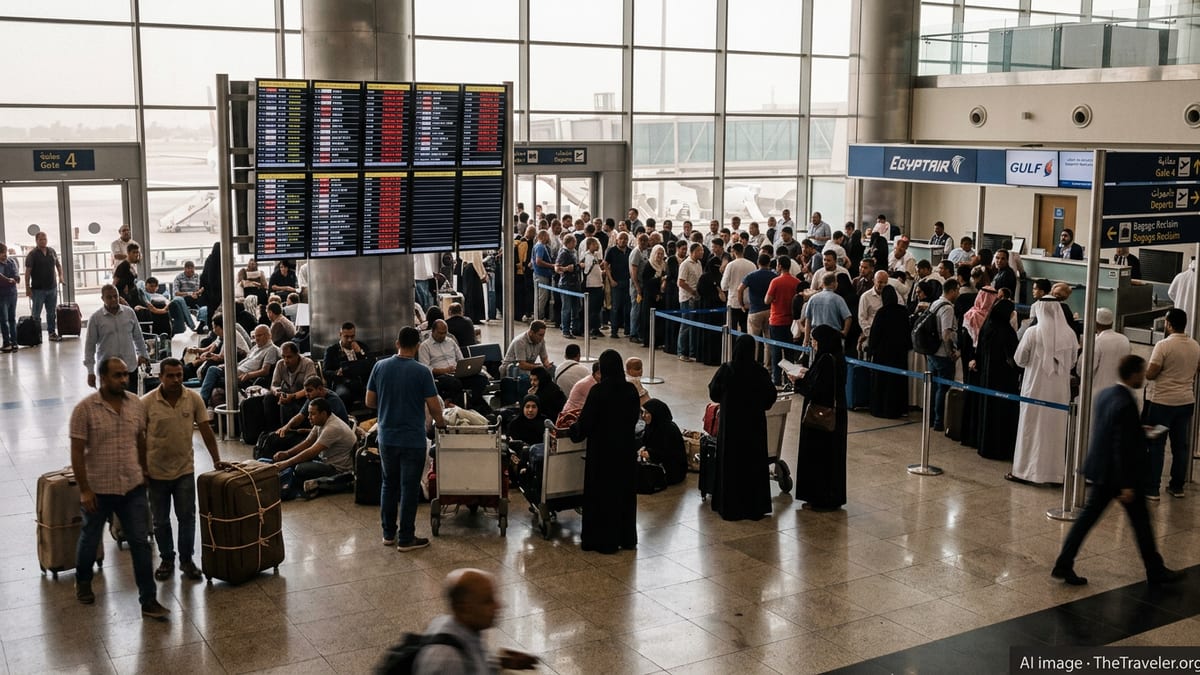
Wave of Cancellations Hits Cairo’s Key Regional Links
Operational data from Egyptian airports on March 2 showed at least 67 cancellations at Cairo International alone, with additional disruptions in Hurghada, Sharm El Sheikh and Alexandria pushing the nationwide tally well past 75 affected flights in a single day. EgyptAir recorded the highest overall disruption volume, while Emirates, Qatar Airways, Gulf Air and other Gulf carriers saw an unusually high ratio of outright cancellations on routes that typically run at or near capacity.
The heaviest impact has fallen on Cairo’s high-demand connections to Dubai, Abu Dhabi, Sharjah, Doha, Kuwait, Dammam, Bahrain, Erbil, Baghdad, Amman and Beirut. These links form the backbone of regional business and labour traffic between Egypt and the Gulf, as well as key onward connections for long-haul journeys between Europe, Africa and Asia. With those hubs now constrained by airspace closures, Cairo’s role has abruptly shifted from a through-traffic gateway to a terminal point for thousands of stranded travellers.
Industry analytics from Cirium and regional aviation trackers indicate that Emirates, Qatar Airways and Gulf Air have each cancelled dozens of services across the wider region since February 28, when coordinated United States and Israeli strikes on Iran triggered sweeping airspace shutdowns. At Cairo, that broader disruption is translating directly into empty departure boards, long lines at ticket desks and mounting frustration among passengers who have seen their journeys unraveled with little warning.
Officials at Cairo International Airport say they remain technically open and able to receive flights, but acknowledge that the cascading effect of neighbouring closures has sharply reduced the number of operational services. With key Gulf hubs and their surrounding airspace largely inaccessible, many flights that would normally pass through or terminate in Egypt are being cancelled outright rather than rerouted on costly, fuel-intensive detours.
EgyptAir Extends Suspensions on 11 High-Profile Routes
Egypt’s flag carrier has moved from short-term delays to open-ended suspensions on a long list of regional destinations. Over the weekend, EgyptAir confirmed that all flights from Cairo to Dubai, Abu Dhabi, Sharjah, Beirut, Doha, Amman, Dammam, Bahrain, Baghdad, Erbil and Kuwait are halted until further notice, citing what it described as rapid regional developments and the ongoing closure of neighbouring airspace.
The airline’s Integrated Operations Control Center has been placed in what executives describe as emergency mode, tracking missile activity, air defence operations and real-time aviation advisories across the Gulf, Levant and Iraq. While Egypt’s own skies remain open, EgyptAir says it cannot safely operate services that must overfly conflict-adjacent corridors or depend on hubs in countries that have closed their airspace entirely.
In an effort to soften the blow for affected customers, EgyptAir is offering fee-free rebooking and refunds for passengers originally scheduled to travel on the suspended routes. Travellers can shift their journeys to later dates or opt for full ticket refunds without penalty for itineraries through mid-March, subject to seat availability and original ticket conditions. The carrier is urging customers not to head to the airport without checked flight status, warning that same-day reaccommodation options remain extremely limited.
Despite these measures, EgyptAir executives privately concede that the scale and duration of the suspensions will depend entirely on how quickly regional airspace can be deemed secure again. With Egypt also preparing to receive an influx of diverted flights and potential evacuation services from neighbouring states, capacity on remaining domestic and international routes is expected to remain tight for days, if not weeks.
Gulf Carriers Ground Operations as Regional Hubs Go Dark
The chaos in Egypt is closely tied to the paralysis gripping Gulf mega-hubs that normally funnel hundreds of thousands of passengers through the region every day. Emirates has cancelled a large share of its global schedule after Dubai International Airport temporarily suspended all flights and surrounding airspace was closed. Qatar Airways has announced that its operations remain temporarily suspended while Qatari airspace is shut, with a further update promised once regulators deem conditions safe enough for at least limited resumptions.
Gulf Air, based in Bahrain, has also axed a significant proportion of its operations amid Bahrain’s airspace restrictions. For Egypt-bound travellers, that means popular one-stop itineraries from Asia, Europe and North America to Cairo via Manama, Doha or Dubai have simply disappeared from sale, leaving few viable alternatives. Analysts note that Gulf Air’s cancellation rate has surged into double digits, reflecting the severe squeeze on its ability to use traditional east–west corridors.
According to aviation analysts, the three major Gulf super-connectors Emirates, Qatar Airways and Etihad collectively handle around 90,000 transiting passengers per day in normal times. With those hubs now effectively offline, shockwaves are rippling through global schedules. For Egypt, which relies heavily on those carriers for inbound tourism, labour remittances and business travel, the knock-on effects are particularly acute.
Data compiled since the first wave of strikes indicates that thousands of flights across the wider Middle East have been cancelled or diverted, making this the most disruptive aviation event the region has seen since the height of the pandemic. Even routes that do not touch the Gulf directly are being rerouted around closed zones, adding hours to flight times and further complicating crew and aircraft rotations.
Passengers Stranded From Dubai and Doha to Riyadh and Beirut
On the ground at Cairo International, the human toll of the crisis is visible in crowded terminal halls, rollaway cots and improvised queuing systems at airline desks. Many stranded passengers had begun journeys days earlier from cities such as Dubai, Doha, Riyadh and Beirut, only to find their connecting legs to or from Cairo abruptly cancelled.
Egyptian workers returning from Gulf jobs, families travelling for school holidays, and transit passengers heading onward to Europe and Africa have all been caught in the disruption. Some were diverted into Egypt when their original Gulf destination closed to arrivals, while others became stuck in Cairo waiting for a connection that never departed. As airlines try to rebook travellers on the handful of remaining services via alternate hubs such as Istanbul or European gateways, seats are selling out quickly and prices on unaffected routes are rising.
Local tourism operators report a wave of last-minute hotel bookings from waylaid travellers, especially in Cairo and resort cities on the Red Sea, where onward flights to Europe have remained more stable. However, the sudden influx is straining capacity, with some hotels reporting near full occupancy driven not by new tourists but by passengers trapped in transit limbo.
At Egypt’s secondary airports, including Hurghada, Sharm El Sheikh and Alexandria, the pattern is similar but on a smaller scale: a cluster of cancellations and long delays, a fraying patchwork of remaining services, and passengers desperately refreshing airline apps in hopes of a status change. Some travellers have chosen to abandon air plans altogether, turning instead to long-distance buses or private cars to reach neighbouring countries where alternative flights may still be operating.
What Travellers Need to Know Right Now
Aviation experts stress that this is a fast-evolving security crisis rather than a conventional weather or staffing disruption, and that travellers should prepare for rolling schedule changes rather than a quick return to normal timetables. For anyone with upcoming trips involving Cairo and major Gulf or Levant hubs, the most important step is to maintain close, direct contact with the operating airline and to avoid relying solely on third-party booking platforms for updates.
Passengers are being urged to confirm that their flight is operating before leaving for the airport, to allow extra time for security and check in, and to have flexible backup plans in case of last-minute cancellations. Travel insurers are starting to receive a surge of claims linked to missed connections and extended hotel stays, though coverage terms vary widely and may exclude disruptions tied to acts of war or political instability.
Industry analysts say the speed at which flights can resume between Egypt and Gulf hubs such as Dubai, Doha and Riyadh will hinge on both military developments and the ability of civil aviation authorities to certify airspace as safe. Even once formal restrictions are lifted, airlines will face a complex restart phase as they reposition aircraft and crews scattered across multiple continents and work through a backlog of displaced passengers.
For now, travellers with nonessential plans in and out of Egypt are being quietly advised by many agents to consider postponing their trips, while those already on the move should brace for extended journeys, last-minute reroutings and the possibility of extended stays in Cairo or other Egyptian cities as the regional air travel map is redrawn in real time.