

More news on this day
More than 1,100 flights across Europe have been disrupted this week, with Germany, France and Portugal among the hardest hit as strikes, staffing constraints and new border checks combine to slow the continent’s already stretched aviation network.
Get the latest news straight to your inbox!
Strikes and Staffing Constraints Squeeze German Airports
Germany is again at the center of Europe’s aviation disruption, with a fresh round of walkouts and long-running staffing issues converging on one of the region’s busiest air travel hubs. Publicly available schedules and tracking data for 9 and 10 April indicate hundreds of delayed and cancelled services clustered around Frankfurt and Munich, as well as knock-on delays at secondary airports served by Lufthansa and its regional partners.
Reports indicate that a one day strike by cabin crew at Lufthansa and Lufthansa CityLine has forced airlines to consolidate services, retime departures and park aircraft out of position. Even flights that ultimately departed have often done so hours behind schedule, contributing significantly to the tally of more than 1,100 delayed services across the wider European network.
These immediate disruptions sit on top of structural challenges flagged in recent industry analyses, which show Germany’s air navigation service provider among the continent’s larger contributors to air traffic flow management delay. Capacity and staffing constraints in German airspace continue to limit the number of aircraft that can be handled safely each hour, meaning that any operational shock, such as industrial action or adverse weather, quickly cascades into widespread lateness.
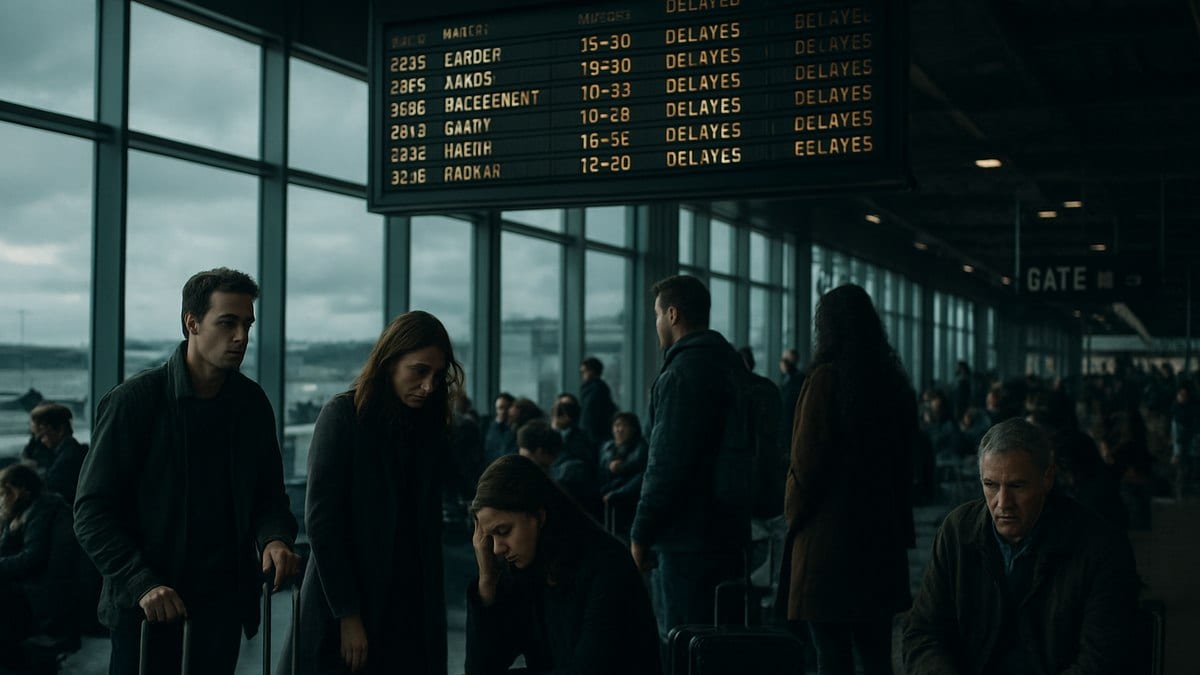
For passengers, the practical impact is visible in crowded terminal departure areas, long queues at rebooking desks and tight or missed connections on onward flights to other parts of Europe and beyond. Airlines have urged travelers to check the status of their flights before heading to the airport and to allow extra time inside terminals, particularly at peak times in the early morning and late afternoon.
France Grapples With Air Traffic Bottlenecks
France, which manages some of Europe’s busiest and most complex airspace, has also emerged as a major contributor to the latest wave of delays. Recent overviews of network performance show French air traffic control capacity and staffing issues generating a significant share of en route holdups, with ripple effects that extend far beyond the country’s borders.
When flow restrictions are applied in French airspace, flights traversing key corridors between northern and southern Europe are often forced into longer routings or delayed takeoff slots. This has proved particularly disruptive during periods of unsettled weather and high seasonal demand, when aircraft already have less margin in their schedules to absorb additional waiting time on the ground or in holding patterns.
According to published coverage of Europe wide disruption in early April, delays attributed to French and neighboring control centers have contributed to late arrivals at airports across Germany and Portugal as well as within France itself. Airlines have had to juggle aircraft rotations, sometimes prioritizing longer haul sectors over shorter regional hops in order to minimize the number of passengers stranded overnight.
The situation underscores the importance of cross border coordination within Europe’s single aviation market. Industry groups have renewed calls for deeper reform of air traffic management systems, arguing that fragmented national approaches make it harder to respond efficiently when demand spikes or when storms push traffic flows into narrower corridors.
Portugal Faces Heavy Queues Under New Border Rules
Portugal has been contending with its own set of challenges, particularly at major gateways such as Lisbon, Porto and Faro. In the run up to and immediate aftermath of the Easter holiday period, local media and passenger rights organizations have highlighted long queues at passport control for non EU travelers, with reports of waits stretching towards two hours at times.
The introduction and phased ramp up of new biometric entry checks for visitors from outside the bloc has added complexity to border processing. Business travel outlets and regional news coverage note that, as of 10 April, new entry requirements across much of the European Union are being fully enforced, raising concerns that even modest technical issues or staffing shortfalls could translate into multi hour lines at peak times.
While many of these delays occur after passengers land, the strain on terminal capacity has begun to intersect with flight operations. Airlines and ground handlers need more time to process arriving passengers and turn aircraft around for their next departures, which can push back schedules and contribute to departure delays from Portuguese airports to destinations in France, Germany and elsewhere.
Industry data also indicate that Portugal has ranked among the less punctual markets in Europe in recent seasons, with a relatively high share of flights arriving late or subject to disruption. The latest wave of operational pressure appears likely to keep punctuality metrics under strain as the spring and summer travel season approaches.
Network Ripple Effects Across Europe’s Skies
The breadth of the current disruption illustrates how tightly woven Europe’s aviation system has become. Analysis of network wide data from recent days shows that delays originating in a few key hubs can quickly spread to affect airlines and airports far from the initial problem, as aircraft and crews fall out of sync with finely balanced rotations.
Coverage of a separate disruption event on 9 April, when more than 1,600 delays were logged across several European countries, highlights how backlogs in one national market, such as the United Kingdom or Italy, can compound pre existing issues in France, Germany and Portugal. When flights arrive late into a congested hub, they may miss available departure slots through constrained airspace, forcing further schedule adjustments.
Weather has also played a background role in the difficult start to the year. A series of winter storms since January has periodically disrupted operations in France and Germany in particular, complicating efforts to restore normal patterns of traffic even on days when conditions are calmer. Each bout of severe conditions leaves aircraft and crew resources scattered, requiring days of careful planning to reassemble.
In practice, this means that individual travelers often experience the cumulative effect of many small delays rather than one dramatic incident. A short hold at departure for air traffic control, a slightly longer taxi time, or extra minutes at the gate waiting for a stand to become free can add up across a journey, tipping connections into riskier territory and contributing to missed flights and overnight stays.
What Travelers Can Expect in the Coming Days
With industrial action in Germany scheduled over a defined period and new border procedures coming into force more broadly across the European Union, industry observers suggest that disruption is likely to remain elevated at least through the current week. Airlines have been trimming schedules, consolidating lightly booked flights and deploying larger aircraft on key routes in an effort to create buffers in their operations.
Passenger rights organizations point out that European Union rules on delays and cancellations continue to apply, even when disruption stems from air traffic control restrictions or staffing shortages. Travelers whose flights arrive several hours late may be entitled to care at the airport and, in some circumstances, financial compensation, depending on the cause of the delay and the distance traveled.
For those planning trips involving Germany, France or Portugal in the near term, publicly available advice emphasizes the importance of leaving extra time for security and border checks and being prepared for possible schedule changes. Early morning departures and flights later in the evening can be particularly vulnerable if aircraft arrive late from previous rotations.
Airports and airlines are monitoring conditions closely as the spring travel season builds. The pattern of more than 1,100 delays concentrated across major European markets serves as a reminder of how sensitive the system remains to both local disruptions and network wide pressures, setting the stage for a challenging summer unless capacity, staffing and technology keep pace with returning demand.