

More news on this day
German travelers are facing a new wave of disruption this week as more than 30 flights from airlines including Qatar Airways, Lufthansa, British Airways and KLM are cancelled across Munich, Berlin, Dusseldorf and Hamburg, hitting key routes to Doha, Tel Aviv, London, Amsterdam, Riyadh, Paris and other hubs just as the busy spring travel period begins.
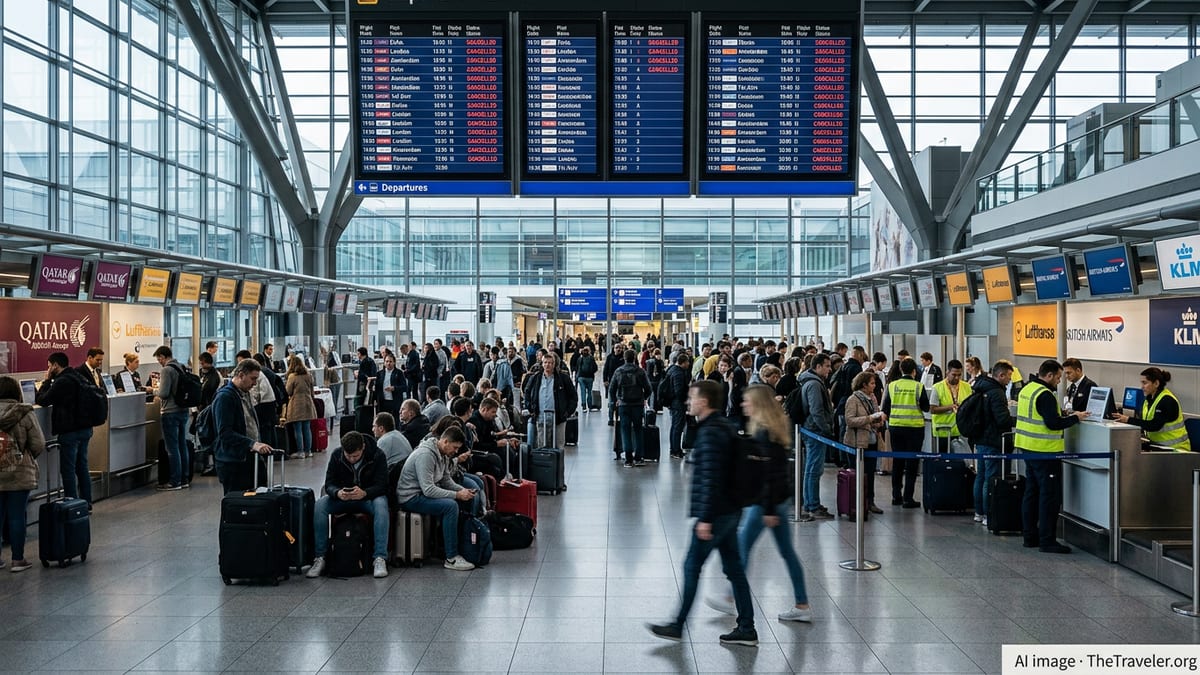
Middle East Airspace Turmoil Reaches German Hubs
The latest cancellations in Germany are the local face of a much wider crisis triggered by ongoing airspace closures and security concerns across parts of the Middle East. Gulf carriers such as Qatar Airways have been operating sharply reduced schedules since late February, when airspace restrictions forced the suspension or rerouting of thousands of services linking Europe with Asia and Africa.
Qatar Airways confirmed this week that it is operating a limited network to and from Doha, prioritising essential trunk routes and consolidating frequencies where possible. That strategy is rippling through its German operations, with flights between Doha and Munich, Berlin, Dusseldorf and Hamburg among those most affected as the airline attempts to preserve long-haul connectivity with fewer available corridors.
Other international airlines serving Germany, including KLM, British Airways and Air France, have also adjusted flight plans to avoid sensitive airspace and reassigned aircraft to less exposed routes. While many services are still operating, the combination of longer routings, crew duty-time constraints and aircraft rotation challenges is resulting in selective cancellations at short notice, particularly on secondary city pairs.
For passengers, that means that even flights not directly overflying the Middle East can be swept up in the disruption, as aircraft and crews scheduled to operate German services are delayed or displaced elsewhere in the network.
Key Routes to Doha, Tel Aviv, London and Amsterdam Hit
Among the cancelled flights in Germany are multiple departures linking major cities with some of Europe and the Middle East’s most important hubs. Services from Munich and Berlin to Doha, a critical connection point for long-haul journeys to Asia, Africa and Australia, have seen targeted cuts as Qatar Airways scales back its timetable and consolidates passengers onto remaining departures.
Connections to Tel Aviv from German airports have been under pressure for months amid ongoing regional instability, and the latest round of cancellations adds further uncertainty. Capacity reductions on Tel Aviv routes are being implemented by both European and Gulf carriers, leaving fewer options for travelers who depend on Germany as a gateway.
Intra-European links are also feeling the strain. British Airways and KLM are among carriers trimming frequencies between German airports and their home hubs at London Heathrow and Amsterdam Schiphol, respectively, after days of wider European disruption and network reshuffles. At least some of the more than 30 cancellations recorded across Munich, Berlin, Dusseldorf and Hamburg involve short-haul sectors to London, Amsterdam and Paris that feed long-haul flights further afield.
Although Germany’s largest hubs at Frankfurt and Munich still retain the majority of their scheduled departures, the pattern of cancellations underscores how quickly shocks in one region can cascade into reduced service on what would normally be routine cross-border routes.
Lufthansa Adjusts Middle East Operations as Pressure Mounts
Germany’s flag carrier Lufthansa has not escaped the turbulence. The airline has already suspended or reduced several services to the Middle East in recent weeks, adjusting its schedule to destinations such as Tehran and other Gulf and Levant points in response to both demand shifts and overflight restrictions. Industry updates point to further refinements in its March timetable, with the group seeking to protect core European and North Atlantic services while scaling back in more volatile markets.
While Lufthansa’s mainline German operations have so far avoided the kind of mass cancellations seen during past strike actions, some Germany–Middle East and connecting flights are being cut or retimed, contributing to the tally of disrupted departures at Munich, Berlin, Dusseldorf and Hamburg. In some cases, passengers originally booked on Lufthansa metal to cities like Riyadh or onward Asian destinations are being rebooked via alternative partners or routings.
Smaller schedule changes, such as the removal of individual daily frequencies or the consolidation of lightly booked flights, can translate into very visible impacts for passengers on specific days. Travelers booked via German hubs may find their original Lufthansa flight number cancelled but be offered an alternative connection via another European hub or on a joint venture partner.
The airline is also navigating broader competitive and regulatory pressures at home, with policymakers scrutinising market share and regional connectivity just as operational resilience is being tested by the Middle East crisis and fluctuating demand.
Knock-On Effects for Travelers Across Europe
The German cancellations come on top of several days of heavy disruption across Europe, with data from industry trackers and passenger rights organisations showing hundreds of flights cancelled and thousands delayed in recent days. Large hubs in the United Kingdom, France, the Netherlands, Spain and Scandinavia have reported queues, missed connections and overnight strandings affecting a mix of low-cost and full-service carriers.
For Germany-based travelers or those transiting through its airports, the result is a patchwork of last-minute changes that can be difficult to anticipate. A single grounded aircraft in Doha or Tel Aviv can lead to a cancelled feeder flight from Hamburg or Dusseldorf the following morning, while extended routings around closed airspace can push crews beyond their legal duty limits, forcing airlines to trim later rotations.
Airlines are responding with a combination of flexible rebooking policies, ad hoc wet leases of additional aircraft where possible and tighter control over advanced inventory to avoid overselling vulnerable flights. Still, the interconnected nature of the network means that even passengers with apparently straightforward itineraries within Europe are being urged to monitor their flight status closely on the day of departure.
Experts note that while the total number of cancelled flights in Germany remains a small fraction of overall daily operations, the concentration of cancellations on long-haul feeders and popular business routes magnifies the disruption for affected travelers.
What Passengers Flying From Germany Should Do Now
With conditions evolving by the day, industry analysts and consumer advocates are advising passengers departing from Germany in the coming week to build extra time into their journeys and prepare contingency plans. Those booked on Qatar Airways, Lufthansa, British Airways, KLM or other major carriers with connections through Doha, Tel Aviv, London, Amsterdam, Riyadh or Paris are being encouraged to check their booking status repeatedly in the 24 hours before departure.
Travellers whose flights are cancelled are typically being offered a choice between rerouting at the earliest opportunity, shifting their trip to a later date or requesting a refund, depending on the airline and ticket type. Under European passenger protection rules, those departing from EU airports may be entitled to assistance such as meals, hotel accommodation where necessary, and in some cases financial compensation when cancellations are not caused by extraordinary circumstances.
Airline call centres and digital channels are under heavy pressure, with some customers reporting long waits to secure alternative options. In many cases, however, carriers are proactively rebooking passengers onto replacement flights and notifying them via app or email, reducing the need to queue at airport counters.
For now, German airports remain open and operational, but the combination of volatile airspace conditions, stretched airline resources and complex international routings means further schedule changes are likely in the days ahead. Passengers are being urged to stay flexible, keep documentation of any additional costs and be ready for itineraries that may include longer routings or unexpected overnight stops as airlines work to stabilise their networks.