

More news on this day
Hundreds of travelers moving through Japan were forced to scrap or rewrite their plans this weekend as a cluster of cancellations and hours-long delays involving United Airlines and ANA Wings disrupted operations at Narita International Airport near Tokyo and Naha Airport in Okinawa, intensifying a broader pattern of flight instability across the country and wider Asia-Pacific region.
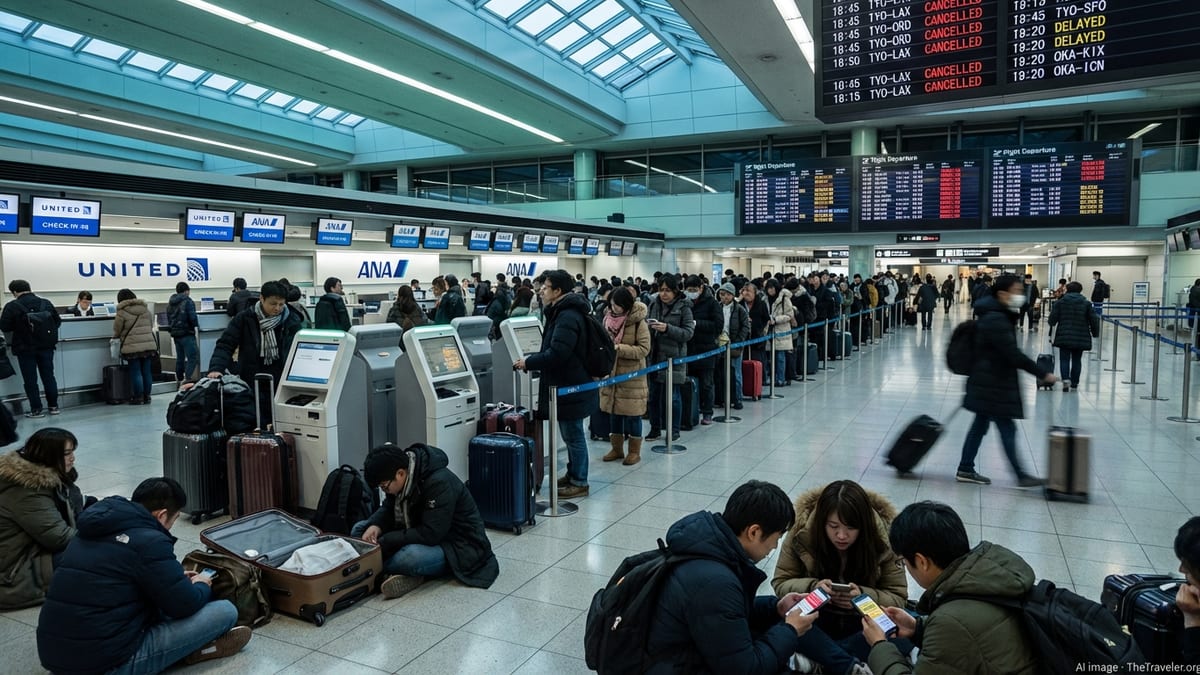
A Fresh Wave of Disruptions at Japan’s Key Gateways
The latest disruption centered on five cancellations linked to United Airlines and regional carrier ANA Wings, alongside numerous delays that quickly backed up departure and arrival banks at Narita and Naha. The two airports serve as vital hubs for both international and domestic routes, meaning localized problems there can rapidly affect connections throughout Japan and across Asia.
Operational data and airline status boards on Saturday showed irregular operations concentrated on Japan routes, adding to a wider pattern of cancellations and delays that has recently touched carriers including All Nippon Airways, Japan Airlines, Jetstar Japan and several regional operators. While United’s mainline schedule focuses on transpacific links into Narita, ANA Wings feeds dense domestic and short-haul traffic into and out of Naha, making both airlines key players in the day’s disruption.
The knock-on effects stretched beyond the five flights that never left the ground. Misaligned aircraft rotations, delayed inbound crews and weather-related congestion compounded the situation, leaving passengers facing missed connections, late-night arrivals and, in some cases, unexpected overnight stays.
For travelers, the timing was especially challenging. February is a shoulder period for tourism, but it is also a busy time for domestic travel and business itineraries across Japan, and recent bouts of adverse winter weather have already tested the resilience of airline schedules into Tokyo and other major cities.
How Five Cancellations Rippled Through Narita and Naha
Although five cancellations may sound modest in isolation at two large airports, the specific flights involved and their positions within the day’s schedule amplified their impact. At Narita, long-haul and regional arrivals tend to be tightly banked to facilitate onward connections, so a single United cancellation can strand connecting passengers heading deeper into Asia or back to North America.
At Naha, where ANA Wings is a core domestic and regional operator, scrubbed departures to secondary islands or mainland cities can leave travelers with few immediate alternatives. Frequencies on some of these routes are limited, and aircraft utilization is high, so re-accommodation options are often later in the day or pushed to the next morning, especially when multiple services are already running behind schedule.
Disruptions also interfere with crew scheduling. Flight crews who time out because of duty limits can force subsequent cancellations or aircraft swaps, further complicating recovery. With staffing still relatively tight across parts of the industry after the pandemic era, several Japanese and international airlines have been operating without substantial spare capacity to absorb sudden schedule shocks.
Airport operations staff at both Narita and Naha spent much of the day reshuffling gate assignments, revising stand plans and coordinating with airline control centers. That behind-the-scenes work, while largely invisible to passengers, slows the system and lengthens turnaround times, making punctual departures more difficult even for flights that are otherwise ready to go.
Weather, Congestion and Crewing: A Volatile Mix
The cancellations and delays arrived against a backdrop of volatile winter weather patterns across Japan and East Asia, which have been driving intermittent disruptions for several weeks. Snow and high winds affecting Tokyo-area airspace in early February prompted waivers and schedule adjustments on some international services, while low cloud ceilings and gusty conditions have periodically reduced arrival and departure rates at major hubs.
Such conditions put additional pressure on carriers like United operating long-haul flights into Narita, where arrival slots are tightly controlled and recovery options for delayed aircraft are limited by nighttime curfews and air traffic flow management. Even modest schedule changes can trigger rolling delays through the day when aircraft must be kept within operational and maintenance windows.
For ANA Wings, whose turboprop and narrowbody fleet links regional cities and islands with Naha and other mainland hubs, localized weather around Okinawa and the Ryukyu chain can force diversions or extended holds. That in turn can push crews toward or beyond duty time limits, prompting cancellations or forcing aircraft to remain out of position for subsequent legs.
Industry analysts note that Japan’s domestic market, although far smaller than at its pre-pandemic peak, is once again running at high utilization during peak periods. Airlines have been cautious about adding excess capacity, which helps maintain yields but leaves relatively little slack in the system when weather or operational issues arise, increasing the risk that a limited set of cancellations can ripple across the network.
Passengers Face Missed Connections and Overnight Stays
For travelers affected at Narita and Naha, the immediate consequences were familiar but no less disruptive. Passengers on United flights into Narita who were relying on same-day onward travel to other Japanese cities or to other Asian hubs discovered that rebooking options were scarce, particularly for itineraries connecting to separate tickets on partner or non-partner carriers.
Some were offered routings through alternative gateways or rebooked on next-day departures, while others accepted partial refunds or travel credits and opted to cut short or reconfigure their trips. Long queues formed at transfer desks and airline service counters in the late afternoon and evening peaks, with wait times stretching as staff worked through complex rebooking scenarios and negotiated with partner airlines for available seats.
In Naha, where ANA Wings cancellations and delays centered on domestic and regional services, passengers bound for smaller islands or remote communities often had even fewer choices. Certain destinations see only a handful of daily flights, and hotel capacity on those islands can be limited; missing an evening departure can mean losing an entire day of a short vacation or being forced to pay out-of-pocket for last-minute accommodation on Okinawa’s main island.
Business travelers and those connecting to onward international flights from other Japanese airports also felt the strain. Some faced the prospect of losing nonrefundable hotel bookings or event tickets, while others were left to coordinate with employers and travel managers to rework tight itineraries at short notice.
United and ANA Wings Response and Customer Support
Both United and ANA Wings moved to implement standard disruption protocols, including rebooking affected travelers on later services where seats were available and offering meal vouchers or hotel accommodations in cases that met each carrier’s eligibility rules. Customer communications flowed through a mix of mobile app notifications, airport display boards, email alerts and announcements in terminal areas.
United has increasingly encouraged passengers to use its mobile app and website to self-manage disruptions, allowing customers to select alternative flights or reroute via different hubs where inventory exists. In practice, however, travelers whose itineraries include other airlines or separate tickets often still need to speak with an agent, especially when they are seeking to preserve complex connection patterns or seat assignments.
ANA Wings, as a regional affiliate within the All Nippon Airways group, channels much of its disruption handling through ANA’s broader customer service infrastructure. Passengers with through-tickets on ANA and ANA Wings generally have more straightforward rebooking options, while those with fragmented itineraries involving low-cost or foreign carriers can find themselves in protracted discussions over responsibilities and costs.
Despite the airlines’ efforts, many travelers described a familiar sense of uncertainty in the terminal, as evolving weather forecasts, shifting crew availability and air traffic control constraints made it difficult for carriers to provide firm assurances on exact departure times. Some flights initially posted with short delays were updated repeatedly as the operational picture evolved, further fraying passengers’ nerves.
Strain on Japan’s Wider Air Network
The Narita and Naha disruptions did not occur in isolation. In recent weeks, multiple Japanese airports including Tokyo, Osaka, Fukuoka, Sapporo, Sendai and Kagoshima have seen waves of cancellations and delays affecting a variety of carriers. These incidents have ranged from modest operational issues to days with dozens of scrapped flights and several hundred late departures and arrivals across the country.
Airlines such as ANA, Japan Airlines, Jetstar Japan, Air Do, Japan Transocean Air, Japan Air Commuter and others have all reported irregular operations tied to factors including weather, technical checks, airspace congestion and crew availability. In one cluster of events, more than 50 flights were cancelled and over 300 delayed across Asia, including at Japanese hubs, underscoring how quickly schedule problems can spill across borders in a tightly interconnected region.
For Japan’s tourism sector, the timing is sensitive. The country has been working to rebuild international visitor numbers and to support domestic tourism campaigns, with Okinawa and other resort destinations relying heavily on predictable air service. Frequent small-scale disruptions may not draw the same headlines as major storms or structural crises, but they can steadily erode confidence among travelers planning tight, multi-city itineraries.
Local businesses around major airports also feel the effects. Airport hotels, transit operators and nearby restaurants often see uneven demand spikes when cancellations force travelers to stay overnight or to wait out long delays between flights, placing additional strain on services that may already be operating with lean staffing.
What Affected Travelers Can Do Now
For passengers directly impacted by the most recent disruptions at Narita and Naha, priorities center on confirming new itineraries, tracking checked baggage and documenting expenses. Airlines typically ask travelers to retain receipts for hotels, meals and ground transportation when seeking reimbursements or goodwill compensation, though the policies differ depending on the official cause of the disruption and local regulations.
Travel experts recommend that passengers monitor airline apps and departure boards closely, as flights that appear to be operating normally several hours before departure can still face late changes in volatile conditions. Those with onward connections, particularly on separate tickets, are advised to build in generous buffers when planning transits through congestion-prone hubs such as Narita.
Frequent flyers also emphasize the value of understanding each carrier’s disruption policy before travel begins. Knowing whether an airline will provide hotel accommodations, how it prioritizes rebooking and what options exist for refunds or credits can help travelers make faster, more informed decisions when they are offered alternative arrangements at the airport.
In some cases, especially for leisure trips with flexible dates, it may be wiser to accept a full or partial refund and rebook travel for a later period rather than attempting to salvage a heavily compromised itinerary in the midst of a busy travel day.
Pressure Mounts for More Resilient Operations
The recurring flight disruptions in Japan, including the latest set of cancellations and delays involving United and ANA Wings, are feeding a growing conversation about how airlines and airports can build more resilience into their operations as travel demand continues to recover. Industry observers point to several levers, ranging from modestly increasing spare aircraft and crew capacity to refining schedule design so that hubs are less vulnerable to cascading delays.
Investments in digital tools are also playing a larger role. Carriers are rolling out more sophisticated forecasting and disruption management systems that can help predict where bottlenecks will form and how best to preemptively adjust schedules, while airports are deploying upgraded airfield management and passenger flow technologies to keep operations moving when conditions deteriorate.
At the same time, analysts caution that there are limits to how much redundancy airlines can cost-effectively build into their networks, particularly in markets still recovering financially from the pandemic. For now, travelers through Narita, Naha and other Japanese hubs are likely to continue experiencing bouts of irregular operations when weather, congestion and crewing issues intersect, even as carriers and authorities work to smooth out the worst of the volatility.
For passengers, the latest episode serves as another reminder that flexibility, advance preparation and a clear understanding of airline policies remain essential tools when navigating long-haul and multi-leg journeys through some of Asia’s busiest airports.