

More news on this day
Travelers heading in and out of London on Tuesday, 17 February 2026, are facing another day of disruption as American Airlines, Iberia, and British Airways cancel four flights and delay many more across the UK’s busiest airports, snarling transatlantic and European travel plans at the height of winter demand.
Four Cancellations Trigger Fresh Turmoil at London Hubs
Operational data from London’s major airports on Tuesday points to a fresh round of disruption for passengers booked on American Airlines, Iberia, and British Airways. Across the three carriers, four flights have been cancelled, while dozens more are running behind schedule on key routes linking the UK capital with North America and major European cities.
The latest disruption comes on top of a difficult fortnight for UK aviation, with Heathrow and Gatwick together recording hundreds of delays and several cancellations in recent days as bad weather, air traffic control constraints, and staffing pressures converge. British Airways has been consistently among the most affected airlines, with delays rippling through its dense short-haul and long-haul networks serving London.
While four cancellations may appear modest in isolation, aviation analysts note that each lost rotation can affect several onward connections, particularly when transatlantic codeshares are involved. Because American Airlines, Iberia, and British Airways coordinate closely on many North Atlantic and European services, a cancelled or heavily delayed departure can leave passengers across multiple brands scrambling to rebook.
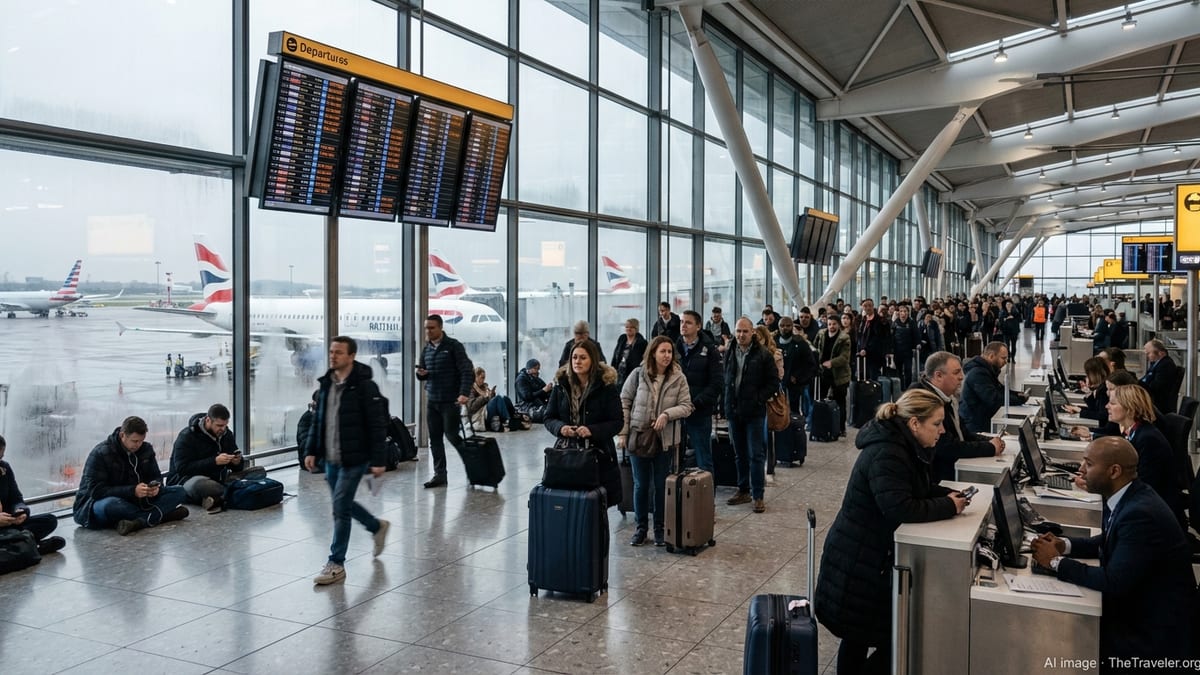
On Tuesday morning, airport departure boards at Heathrow and Gatwick showed a familiar pattern for winter 2026: clusters of delayed flights to European gateways and North American hubs, interspersed with a smaller number of outright cancellations. For passengers, the distinction between the two offers little comfort when delays stretch into several hours and missed connections become unavoidable.
Heathrow and Gatwick Bear the Brunt
London Heathrow, the UK’s primary international hub, has again borne the brunt of the disruption. Recent statistics show that the airport has recorded well over 200 delays in a single day this month, along with several cancellations, as poor weather and operational bottlenecks combine to squeeze capacity at peak times. Heathrow’s complex wave of morning and evening long-haul departures means any early disruption can reverberate for the rest of the day.
Gatwick, the country’s second-busiest airport, has also been hit. Earlier this month it logged more than 60 delays in a single day, according to industry data, as strong winds and heavy rain affected arrivals and departures. While Gatwick has generally seen fewer outright cancellations than Heathrow, its role as a key base for short-haul European flights means that even modest disruption can quickly saturate terminal areas as passengers wait for delayed aircraft and crew.
On Tuesday, affected passengers reported long queues at check-in and security, crowded departure lounges, and repeated gate changes as airlines attempted to consolidate services and work around late-arriving aircraft. With runway operations constrained by weather and air traffic control limits, both airports have urged passengers to arrive early, check flight status frequently, and be prepared for extended waits.
Regional airports have not escaped unscathed. Manchester, Edinburgh, and Bristol all reported significant disruption in recent days, with more than 200 combined delays and several cancellations recorded in a single 24-hour period last week. However, London’s dual role as a global hub and domestic gateway means that disruption there has the widest knock-on effect, particularly for connecting travelers.
Transatlantic Codeshares Complicate Rebooking
The partnership between American Airlines, Iberia, and British Airways, while offering passengers a wide choice of flights and seamless ticketing during normal operations, can also complicate matters when disruption hits. A single physical flight may be sold under several different flight numbers across the three carriers, leaving customers with different booking references and customer-service channels even though they are booked on the same aircraft.
For example, a British Airways-operated flight from a US city to London can simultaneously be marketed as an American Airlines and Iberia service via codeshare agreements. When that flight is cancelled or heavily delayed, passengers booked under each brand may receive different notifications and rebooking options, depending on where they purchased their tickets and which airline’s systems handle their reservation.
On Tuesday, travel advisers reported that some passengers booked through American Airlines and Iberia on British Airways-operated routes into Heathrow were offered re-accommodation on later departures or rerouting via alternative European hubs. Others were encouraged to accept travel vouchers or change their dates of travel, particularly where weather-related issues give airlines wider leeway under European compensation rules.
The complexity of alliance and codeshare arrangements also affects baggage and onward connections. When an inbound transatlantic flight arrives late, bags may miss tight connection windows to short-haul links across Europe. Passengers who make their onward flight while their luggage does not can face delays of a day or more before bags catch up, especially during peak disruption periods when baggage systems are already under strain.
Weather, Staffing, and System Strain Behind the Disruption
Industry sources point to a familiar trio of causes behind the current wave of delays and cancellations: winter weather, staffing shortages, and pressure on air traffic control capacity. In recent days, storms bringing heavy rain, strong winds, and icy conditions across parts of the UK and northern Europe have slowed operations, reducing the number of takeoffs and landings that can safely be handled per hour at major hubs.
At Heathrow and Gatwick, ground handlers and airline operations teams have also faced staffing strains, with sickness and ongoing recruitment challenges affecting crew availability. Even when airports remain open, a shortage of flight attendants or pilots on a particular aircraft can force last-minute cancellations or cause significant delays while replacement crew are located and repositioned.
Europe’s air traffic control network continues to operate with limited spare capacity, particularly on busy north-south routes that cross the UK, France, and the Benelux countries. When weather or technical issues reduce capacity in one sector, aircraft may be held on the ground or forced to take longer routings, contributing to late departures and arrivals. These delays cascade through the system, especially for airlines like British Airways and Iberia that concentrate a large proportion of their operations at specific hubs.
Rising post-pandemic demand has intensified the impact of every disruption. Load factors across European and transatlantic routes have climbed, meaning there are fewer empty seats available to accommodate stranded passengers. On some services this week, disrupted travelers reported being rebooked one or two days later due to a lack of spare capacity on same-day flights.
Passengers at Heathrow and Gatwick Face Long Queues and Tough Choices
For travelers on the ground, the statistics translate into long queues and difficult decisions. At Heathrow’s Terminals 3 and 5 on Tuesday morning, lines formed early at airline customer-service desks as passengers sought rebooking options following overnight cancellations and rolling delays. Some reported waiting more than an hour to speak to an agent, with airport staff handing out water and light refreshments in the busiest areas.
Families heading off on half-term holidays were among the most affected, particularly those traveling with young children or older relatives. Many had arrived early to allow extra time for security screening, only to find their departure delayed or cancelled. With hotel availability near Heathrow and Gatwick already stretched, some stranded passengers resorted to booking rooms in central London or staying overnight at friends’ homes to avoid sleeping in terminal seating areas.
Business travelers faced a different set of challenges. Cancellations and long delays on early-morning departures disrupted day-trip meetings in European cities and same-day returns from North American business hubs. Some passengers opted to abandon trips entirely, switching to virtual meetings rather than risk further disruption, while others paid out of pocket for alternative flights on low-cost carriers from other London airports.
Travel agents reported a spike in last-minute calls from customers seeking advice and emergency rebooking support. In some cases, agents were able to reroute passengers via alternative European hubs, but such solutions often involved additional connections, overnight stays, or higher fares during a period of elevated demand.
Airlines Offer Flexibility but Warn of Limited Options
In response to the ongoing disruption, American Airlines, Iberia, and British Airways have all encouraged passengers to monitor their flight status closely and make use of online rebooking tools where available. Iberia has extended flexibility for certain routes across its network, including services shared with British Airways and American Airlines, allowing eligible customers to change travel dates without change fees under specific conditions.
British Airways has similarly promoted digital self-service, urging passengers to use its website or mobile app to rebook onto alternative flights when their services are cancelled or subject to significant delays. However, with many flights already heavily booked, the range of available options has often been limited, particularly for those traveling in large groups or on tightly scheduled itineraries.
American Airlines customers connecting through London from North America have been advised to leave extra time between flights and to check in online as early as possible. The carrier has worked with its partners to protect key transatlantic flows, but tight turnarounds at Heathrow mean that knock-on delays from inbound services can still force schedule changes at short notice.
All three airlines have apologised for the disruption and pointed to external factors, including weather and air traffic control restrictions, while stressing their efforts to keep as many flights operating as possible. Passenger groups, however, argue that the industry remains too thinly staffed and too reliant on finely tuned schedules that offer little resilience when conditions deteriorate.
Knock-On Effects for Europe and Beyond
London’s role as a major transfer hub means the current disruption is not confined to the UK. Delayed and cancelled departures from Heathrow and Gatwick are feeding through to connections across Europe, North America, and long-haul destinations in Asia and the Middle East. Travelers on onward flights operated by partner airlines have reported missed connections and unplanned overnight stays in cities ranging from Amsterdam and Madrid to New York and Dubai.
Recent data shows that other European hubs, including Amsterdam Schiphol and Madrid Barajas, have also experienced elevated levels of delay and cancellation this month. In many cases the problems are linked, as weather systems and staffing shortages affect multiple airports simultaneously. For alliance carriers like British Airways, Iberia, and American Airlines, this interconnected network means that a disruption at one hub can propagate quickly through shared schedules and codeshare routes.
Airports in Scotland and northern England are also feeling the strain. Manchester and Edinburgh have both reported high numbers of delayed flights in the past week, many of them operated by airlines that also serve London. As aircraft and crews are repositioned to cover gaps in the schedule, regional routes can experience last-minute changes, leaving domestic travelers with fewer options and longer journey times.
Travel analysts say the situation underlines the need for greater operational resilience across European aviation. Proposals include better staffing buffers, more flexible crew rostering, and enhanced coordination between airports, airlines, and air traffic control providers during periods of extreme weather or system strain.
What Travelers Should Do Next
With disruption likely to continue in the short term as winter weather persists, passenger advocates are urging travelers to take a proactive approach when flying through London. They recommend checking flight status repeatedly in the 24 hours before departure, signing up for airline text or app alerts, and allowing extra time at the airport in case of queues at security or check-in.
Travelers with tight connections are being advised, where possible, to book longer layovers or to consider overnight stays at their connecting hub, especially on itineraries that involve separate tickets on different airlines. Those whose flights are cancelled or delayed by several hours may be eligible for assistance such as hotel accommodation, meals, and ground transport, as well as potential compensation depending on the cause of the disruption and the regulations in force at their point of departure.
Experts also highlight the importance of travel insurance that covers delays and missed connections. Policies vary widely, but some offer reimbursement for additional hotel nights, meals, and replacement flights when disruption exceeds a specified threshold. Passengers are encouraged to keep receipts and documentation of delays to support any future claims.
For now, the message from airlines and airports is clear: this is a challenging period for air travel in and out of London. With American Airlines, Iberia, and British Airways managing cancellations, heavy delays, and tightly stretched schedules, passengers are being urged to stay informed, remain flexible, and prepare for the possibility that their journey may take longer than planned.