

More news on this day
Hundreds of air travelers have been stranded in Saudi Arabia after a wave of cancellations at Prince Mohammad Bin Abdulaziz Airport in Medina and King Fahd International Airport in Dammam, as more than 50 flights were scrapped amid wider Middle East airspace disruption and ongoing security tensions.
Get the latest news straight to your inbox!
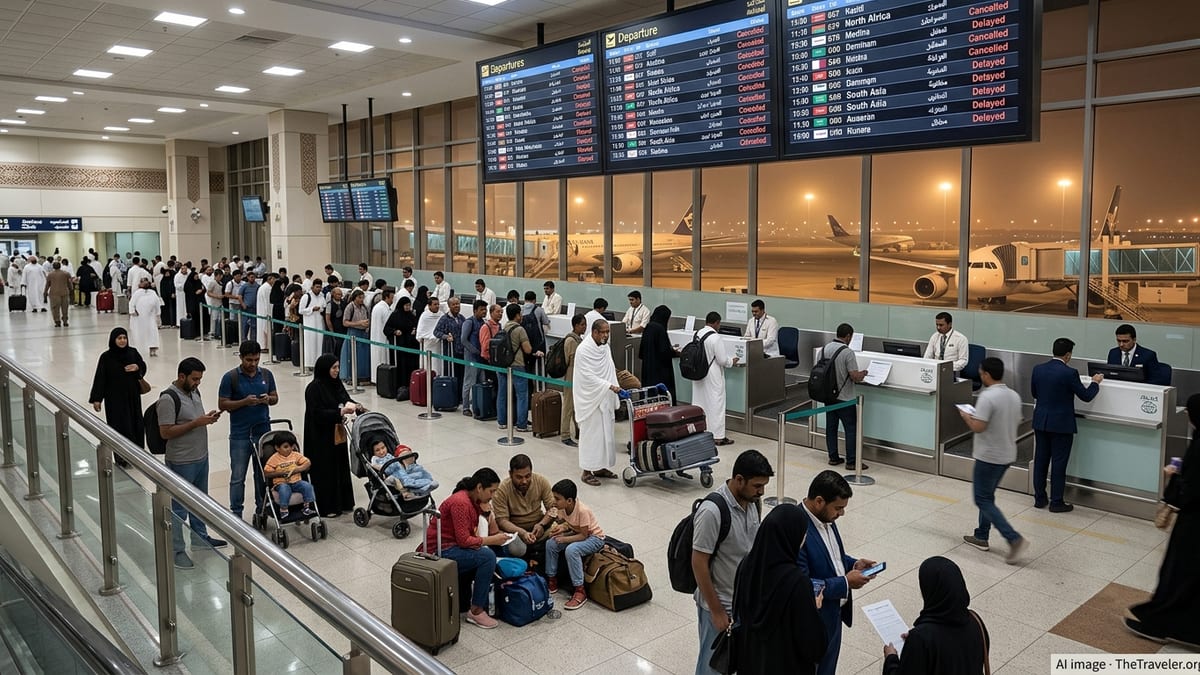
What Happened at Saudi Arabia’s Key Regional Gateways
Published coverage and live flight-tracking data indicate that, over a compressed period in late March 2026, more than 50 departures and arrivals were cancelled across Prince Mohammad Bin Abdulaziz Airport and King Fahd International Airport. The pattern of disruption has been concentrated on international routes and overnight regional services, with some domestic sectors also affected as aircraft and crew were displaced.
The cancellations are part of a wider wave of operational instability across the Middle East, following airspace restrictions and rerouting decisions taken by multiple states in response to regional security concerns. Aviation briefings describe thousands of flights across the region being delayed, diverted, or grounded since the end of February, as airlines reassess the safety and efficiency of established corridors.
At Prince Mohammad Bin Abdulaziz Airport in Medina, data reviewed by travel analysts show clusters of cancelled services to major hubs in the Gulf, North Africa, and South Asia. King Fahd International in Dammam has seen a similar pattern, with several outbound flights to regional connection points removed from schedules and corresponding inbound sectors scrubbed, leaving aircraft out of position.
While some services have since been reinstated, the irregular pattern of cancellations and last-minute schedule changes has left many travelers facing extended layovers, missed connections, and unexpected overnight stays, particularly those attempting to transit onward to Europe, South Asia, and Southeast Asia.
Why Flights Are Being Cancelled Across the Region
Publicly available aviation security assessments link the Saudi cancellations to a broader set of airspace closures and restrictions that followed an escalation in the Iran conflict and related military activity across parts of the Gulf and Levant. In early March, regional briefings recorded widespread closures and capacity limits affecting the airspace of Iran, Iraq, Jordan, Kuwait, Qatar, and others, forcing airlines to redesign routings or temporarily suspend services.
Industry alerts from consultancies and airport authorities describe a highly dynamic environment in which carriers must balance flight safety, crew duty limitations, and air traffic control constraints. Extended detours around closed or high-risk airspace can add hours to flight times, complicating aircraft rotations and leaving some sectors operationally unviable. When that happens, routes are either consolidated onto fewer frequencies or cancelled entirely.
Saudi airports have generally remained open, but are deeply exposed to these regional dynamics because so many flights to and from Medina and Dammam connect through neighboring hubs. When carriers in the United Arab Emirates, Qatar, or Jordan trim schedules or repurpose aircraft for repatriation and essential services, knock-on effects quickly reach secondary Saudi gateways that depend on those networks.
Analysts note that the cumulative effect is similar to a rolling weather disruption: individual airports may report normal runway operations, yet the underlying airline networks feeding them are constrained, resulting in gaps in the timetable and abrupt last-minute cancellations.
How Travelers Are Being Affected on the Ground
Reports from passengers and airport observers describe scenes of crowded terminals, long lines at airline service counters, and families attempting to rebook travel from makeshift seating areas. With certain carriers prioritizing repatriation flights and essential routes, leisure travelers and those on non-urgent trips have in some cases been offered rebooking several days later or full refunds rather than near-term alternatives.
For pilgrims and religious travelers using Medina as a gateway for Umrah and visits to holy sites, the timing has been particularly difficult. Trip organizers have reported disrupted itineraries, with some groups forced to split across multiple flights or reroute via Jeddah or Riyadh to reach their destinations. Similarly, expatriate workers based in the Eastern Province and flying through Dammam have faced uncertainty about return dates and onward connections.
Accommodation has emerged as a key pressure point. When multiple flights are cancelled in quick succession, nearby hotels around both airports can fill rapidly, leaving late-arriving passengers with limited, more expensive options farther from the terminals. Travel advisories recommend that anyone affected document all reasonable expenses related to meals, transportation, and lodging, in case partial reimbursement is later available under airline policies or consumer protection rules.
Travelers are also dealing with information gaps. As schedules are updated throughout the day, online status boards and mobile apps do not always reflect the latest operational decisions at the same time. This can lead to mismatches between what passengers see on their phones, what is announced in the terminal, and what airline agents are able to action within reservation systems.
What You Should Do If Your Flight Is Affected
Consumer advocates and travel-law specialists who have analyzed the current wave of cancellations stress the importance of verifying the legal and contractual framework that governs a particular ticket. Rights and remedies differ depending on where the journey starts, which airline operates the flight, and what jurisdiction’s rules apply. For example, travelers departing from airports in the European Union or on EU carriers may have stronger protections for rerouting and care than those departing elsewhere on non-EU airlines.
In practical terms, passengers stranded at Medina or Dammam are being advised in public guidance to first confirm the latest status of their booking directly through the airline’s official channels before proceeding to the airport or passing through immigration. When a cancellation is confirmed, travelers should ask for all available options, including rerouting via alternative Saudi gateways such as Riyadh or Jeddah, or via different regional hubs that remain less affected.
Specialists also recommend keeping detailed records: screenshots of flight status changes, written confirmation of cancellations, and receipts for meals, ground transport, and accommodation. If an airline provides vouchers or written commitments at the airport, those documents can be important when seeking refunds, reimbursements, or compensation later on, especially if policies are adjusted as the disruption continues.
Those with travel insurance should review their policy wording, as many plans include specific provisions for missed connections, delays beyond a certain number of hours, or security-related disruptions. Insurers may require proof that the cancellation or delay was outside the traveler’s control and that alternative routes were not reasonably available at the time.
Planning Future Travel Through Saudi and the Wider Region
With aviation risk assessments still describing elevated uncertainty over parts of the Middle East, travel experts caution that schedules across Saudi Arabia and neighboring countries may remain volatile through at least the end of March 2026, and potentially longer if security tensions persist. Airlines are likely to continue reviewing routes day by day, which means that new cancellations or timetable reductions can appear with limited notice.
Prospective travelers planning to fly into or out of Prince Mohammad Bin Abdulaziz Airport or King Fahd International Airport are being encouraged to build flexibility into their itineraries. That may include allowing longer connection times, favoring fully refundable or changeable tickets where budgets permit, and avoiding tight same-day links to non-refundable events such as cruises, tours, or examinations.
Some observers suggest that, where practical, passengers might consider routing through airports and carriers that have shown more stable operations during the current disruption period. However, they also note that conditions can change quickly and that an airport which appears unaffected one week may experience significant disruption the next if regional airspace restrictions shift.
Ultimately, the situation highlights how interconnected modern air travel has become. Even when Saudi airports remain physically open, geopolitical events and airspace decisions hundreds of kilometers away can cascade through airline networks and leave travelers stranded. For the coming weeks, anyone flying through Medina, Dammam, or neighboring hubs is likely to benefit from proactive monitoring, flexible planning, and a clear understanding of their rights if flights are disrupted.