

More news on this day
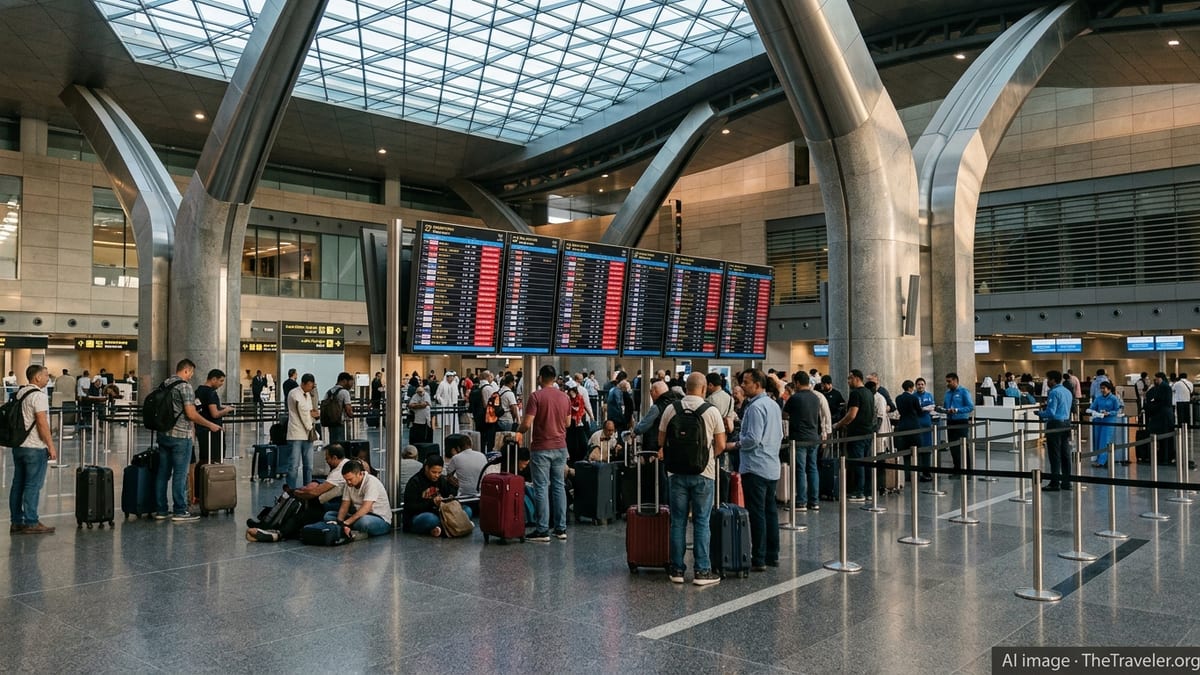
Travel across the Gulf and wider Asia network is facing renewed disruption as Qatar Airways, Gulf Air, and Malaysia Airlines ground at least 25 flights serving Hamad International Airport and key regional hubs, with cascading delays affecting major routes linking Doha, Bahrain, Kuala Lumpur, Riyadh, Kuwait City and beyond.
Get the latest news straight to your inbox!
Conflict-Linked Airspace Restrictions Intensify Disruptions
Publicly available aviation data and recent media coverage indicate that the latest wave of cancellations is closely tied to ongoing security tensions and airspace restrictions across the Gulf region. Since late February 2026, Qatari airspace has been operating under tight limitations after Iranian missile and drone attacks linked to the wider Iran conflict, with Hamad International Airport in Doha repeatedly affected by temporary closures and capacity cuts.
Reports on the regional security situation describe missiles and drones targeting infrastructure in Qatar, Bahrain, Kuwait and other states, triggering precautionary shutdowns of airspace and forcing airlines to cancel or reroute services. Flight tracking platforms show that Qatar Airways has sharply reduced departures from Doha, while operating a small number of repatriation and contingency flights through approved corridors when conditions allow.
In parallel, Bahrain and Kuwait have faced their own restrictions, with published information on Kuwait International Airport noting a full suspension of regular traffic since the end of February. This has pushed carriers including Gulf Air and Kuwait-based operators to juggle limited alternative gateways in Saudi Arabia and Oman, complicating network planning and constraining available capacity for passengers across the region.
Aviation industry summaries for 2026 describe a Middle East system under sustained pressure, with thousands of flights cancelled across multiple hubs. The combination of airspace closures, security checks, and intermittent damage at airports has left airlines with little operational flexibility, resulting in abrupt timetable changes that are now being felt by travelers connecting through Doha, Manama, Riyadh and Kuala Lumpur.
Qatar Airways Cuts Doha Services as Hamad Capacity Remains Restricted
Qatar Airways, which relies on Hamad International Airport as its sole global hub, is at the center of the disruption. Travel advisories, airline communications shared with passengers, and widely reported schedule data suggest that the carrier has cancelled or grounded a significant portion of its Doha departures, including some long-haul links to Europe, Asia and Africa, while operating a narrower set of essential services.
In early March, information released via official channels and echoed in passenger forums pointed to a limited resumption of air navigation over Qatar using emergency corridors, prioritizing repatriation flights to major European capitals such as London, Paris, Madrid, Rome and Frankfurt. Even this skeleton operation has been subject to last-minute changes, with travelers reporting cancellations or rebookings just days before departure and a heavy reliance on alternative routings through third-country hubs.
The current setback, involving at least 25 grounded flights across Qatar Airways, Gulf Air and Malaysia Airlines, reflects these structural constraints at Hamad International Airport. With standard commercial traffic still curtailed, the airline has had to trim frequencies on some high-demand routes while shifting others to nearby airports such as Dammam or Muscat when bilateral arrangements and security clearances permit.
Travel guidance documents circulating since January had already warned of potential delays and cancellations tied to heightened security measures and regional air traffic congestion. Recent events have amplified those concerns, leaving Qatar Airways’ finely tuned banked schedules difficult to sustain and exposing passengers to missed connections and extended layovers.
Gulf Air and Malaysia Airlines Adjust Networks Around Bahrain and Kuala Lumpur
The disruption is not confined to Qatar. Gulf Air, based in Bahrain, has also been reshaping its schedule as regional air corridors shift. Information compiled in flight-disruption forums and schedule trackers indicates that the airline has suspended or rerouted certain services touching Doha, Kuwait and other affected cities, while directing some passengers through Saudi airports such as Dammam to maintain onward connectivity.
Bahrain’s position near several contested airspace zones has required tight coordination of routings and altitudes, leading to prolonged block times and occasional technical stops. These operational complexities have contributed to additional delays and cancellations, particularly on short- and medium-haul sectors within the Gulf Cooperation Council, where turnarounds are usually rapid and margins for disruption are limited.
Malaysia Airlines, meanwhile, has been grappling with knock-on effects at Kuala Lumpur International Airport. Published aviation analyses of the wider 2026 Iran-related conflict highlight how disruptions in the Gulf reverberate across long-haul networks connecting Southeast Asia to Europe and the Middle East. Kuala Lumpur to Doha services, and onward connections from Kuala Lumpur to Bahrain, Riyadh and Kuwait City via Gulf hubs, have been intermittently suspended or retimed as airlines navigate shifting overflight permissions.
For Malaysia Airlines, any sustained reduction in Gulf connectivity complicates itineraries for travelers heading to destinations in North Africa, Europe and the Americas that previously relied on Doha or Bahrain as convenient transfer points. The grounding of multiple flights in the current wave adds pressure to an already constrained long-haul operation and forces greater dependence on alternative partners in East Asia and Europe.
Passenger Impact Across Doha, Bahrain, Riyadh and Kuwait City
The immediate impact for passengers has been a patchwork of cancellations, rolling delays and complex rebookings on key routes linking Doha, Bahrain, Kuala Lumpur, Riyadh and Kuwait City. Accounts shared publicly by travelers describe repeated last-minute schedule changes, with some journeys re-routed via distant hubs such as Beijing or European capitals, adding many hours of travel time.
In Kuwait, the full suspension of regular flights since late February has left many travelers dependent on ground transport to Saudi Arabia for access to international services. Reports from regional outlets and aviation references note that some Kuwait-based passengers have been diverted to secondary airports in Saudi territory, before reconnecting to long-haul flights operated by Gulf Air, Qatar Airways or other international carriers.
Doha-based travelers have faced a similarly uncertain environment. While a small number of emergency and repatriation flights continue to operate, many passengers with tickets dated through mid and late March have reported cancellations and rebookings as airlines adjust to evolving airspace approvals. The result has been crowded call centers, difficulty securing alternative seats, and a surge in demand for fully refundable back-up tickets on competing airlines where routes remain open.
Riyadh, which has remained more accessible than Doha and Kuwait in recent weeks, has emerged as an important fallback for some itineraries. However, the extra demand on Saudi carriers and partner airlines has tightened capacity and raised fares on certain corridors, further complicating last-minute travel planning for those originally booked through Hamad International Airport or Bahrain International Airport.
Broader Aviation Implications and What Travelers Can Expect Next
Aviation analysts tracking the 2026 Iran-linked conflict describe the Gulf as one of the most severely affected regions, with airspace closures in Qatar, Bahrain, Kuwait and neighboring states contributing to thousands of daily cancellations at the height of the crisis. The grounding of at least 25 flights involving Qatar Airways, Gulf Air and Malaysia Airlines this week is viewed as part of a wider pattern rather than an isolated incident.
Industry commentary suggests that even once air navigation over Qatar and nearby states is fully restored, airlines are likely to face a prolonged period of schedule instability. Carriers will need time to reposition aircraft and crews, rebuild hub banks at airports like Doha and Bahrain, and clear passenger backlogs that have built up since the first wave of cancellations in late February.
For travelers, publicly available guidance emphasizes flexibility. Passengers holding tickets on affected routes are being encouraged, in general terms, to monitor airline apps and booking portals for real-time updates, consider alternative routings where feasible, and allow additional time for connections in the region. Travel insurance with robust disruption coverage is increasingly seen as a practical safeguard for itineraries touching the Gulf in the coming weeks.
The experience of Hamad International Airport and its partner hubs in early 2026 underlines the vulnerability of tightly integrated global networks to geopolitical shocks. As long as airspace restrictions and security considerations remain fluid, experts expect further adjustments to flight schedules serving Doha, Bahrain, Kuala Lumpur, Riyadh, Kuwait City and other key nodes, with travelers advised to prepare for continued uncertainty.