

More news on this day
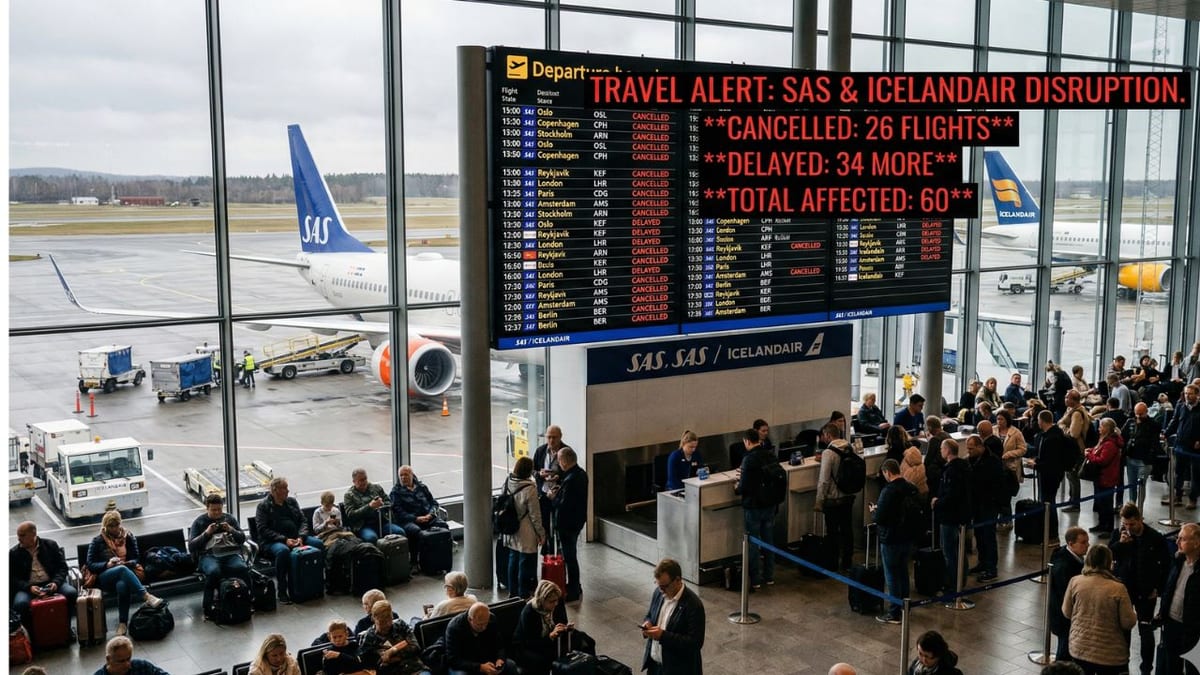
Thousands of air travelers across Northern and Western Europe are facing major disruption after a fresh wave of cancellations and delays on SAS and Icelandair services left passengers stranded or rebooked days later across Oslo, Copenhagen, Stockholm, Reykjavik, London, Paris and several other cities.
Get the latest news straight to your inbox!
Targeted Cancellations Hit Key Scandinavian and Transatlantic Routes
According to publicly available flight data and published coverage, at least 26 flights operated by Scandinavian carrier SAS and Iceland-based Icelandair were cancelled across Europe within a short time window, with a further 34 departures reported delayed. The disruption is concentrated on short haul connectors between Scandinavian capitals and major European hubs, as well as select transatlantic and North Atlantic links routed through Reykjavik.
Current reports on aviation tracking platforms indicate that SAS cancellations are clustered on high frequency corridors such as Oslo to Copenhagen and Stockholm, along with services linking Scandinavia to London and Paris. Icelandair disruptions are centered on services in and out of Reykjavik Keflavik, a critical transfer point for passengers traveling between Europe and North America.
Travel industry outlets describe the pattern as a rolling disruption rather than an isolated technical incident, with cancellations and long delays appearing across multiple departure banks. This has magnified the effect on passengers, who frequently miss onward connections or arrive to find limited alternative departures remaining the same day.
The latest problems come on top of wider schedule cuts already planned by SAS in April as it responds to sharply higher jet fuel prices and ongoing cost pressure, increasing the strain on remaining flights when individual sectors are cancelled at short notice.
Oslo, Copenhagen and Stockholm Bear the Brunt
Scandinavian hubs have again emerged as focal points of the current disruption. Recent tallies from European travel news outlets show waves of cancellations and delays at Oslo Gardermoen, Copenhagen Kastrup and Stockholm Arlanda, where SAS operates dense shuttle-style schedules connecting regional cities with European capitals.
Coverage from Nordic and European travel media notes that passengers in Oslo have faced repeated cancellations on routes to London, Amsterdam, Dublin and other key destinations in recent days, with SAS often at the center of the disruption. When new cancellations are added, remaining flights quickly become oversubscribed, forcing many travelers to accept rebookings one or more days later.
In Copenhagen and Stockholm, reports describe similar scenes as departure boards fill with delayed and cancelled services, particularly during morning and late afternoon peaks. These hubs act as connection points not only for local travelers but also for passengers from secondary airports across Denmark, Sweden and Norway, compounding the number of people affected when a single departure is removed.
Travel-focused reports highlight that this latest cluster of 26 cancellations is part of a broader pattern seen over the first week of April, in which dozens of SAS services have been trimmed or disrupted across the region. For travelers, the immediate impact is confusion at the gate and long lines at transfer desks, but for the airline the deeper issue is how to operate reliably on a network already tightened by planned capacity reductions.
Reykjavik Disruptions Ripple to London, Paris and Beyond
The parallel impact on Icelandair has amplified disruption far beyond Scandinavia. Reykjavik Keflavik functions as a central hub for Icelandair’s transatlantic model, allowing passengers from cities such as London and Paris to connect to North America via short layovers in Iceland. When a cluster of flights into or out of Reykjavik is cancelled or delayed, the effect cascades across multiple origin and destination pairs.
Publicly available flight listings for the current period show cancelled and heavily delayed Icelandair services linking Reykjavik with major European cities, including London and Paris, alongside selected Nordic routes. Passengers who were depending on Reykjavik connections for same day arrivals in North America or back to Europe have reported facing forced overnight stays and multi-day rebookings once the network begins to unravel.
European travel news reports indicate that Icelandair’s disruption intersects with SAS cancellations at several airports, particularly in Scandinavian capitals. At these hubs, travelers may see both airlines posting irregular operations at the same time, reducing the chances of straightforward rebooking options onto alternative carriers or routings.
The timing of the disruption is particularly problematic ahead of the busy late spring and early summer travel period, when demand on transatlantic and Nordic city routes typically rises and spare capacity is limited. Any knock-on effects in the coming days could quickly translate into higher fares and fewer choices for affected travelers.
Fuel Prices, Staffing Gaps and a Fragile European Network
Recent industry analysis points to a combination of factors behind the renewed instability on European routes. SAS has already announced that it will cut at least 1,000 flights in April as part of a response to sharply higher jet fuel costs, with publicly available statements from the carrier citing the need for short term schedule adjustments. This structural reduction leaves fewer backup options when aircraft or crew become unavailable.
Travel trade coverage also highlights ongoing staffing and crew availability challenges across European aviation, affecting ground operations, cabin crew and pilots. While the current set of 26 cancellations and 34 delays involves a relatively small number of flights compared with total daily movements, they emerge in a context where airlines have little margin to absorb further shocks, such as weather or technical issues.
Observers note that EU passenger protection rules require airlines to provide assistance, rerouting or compensation in many cases of cancellation or long delay, but practical implementation can be uneven when disruptions involve multiple carriers and hubs. Passengers whose itineraries mix SAS and Icelandair sectors, or who travel under codeshare arrangements, may encounter additional complexity as operating and marketing carriers differ.
Analysts of the European market emphasize that the current disruption underlines how sensitive regional networks remain to fuel price swings and resource constraints. When one carrier trims its schedule or experiences operational strain, the impact is quickly felt across interconnected hubs like Oslo, Copenhagen, Stockholm, Reykjavik, London and Paris.
Passengers Face Long Lines, Rebookings and Limited Options
Reports from travel forums and consumer media indicate that many affected passengers have had to navigate long queues at airport desks or overloaded digital channels while seeking rebookings. In some cases, travelers describe being offered alternative departures several days later, particularly on popular weekend routes and on transatlantic itineraries linked to Reykjavik.
Advisories from travel organizations and consumer advocates consistently recommend that passengers whose flights are still operating build in extra time at airports and monitor their booking status closely, as same day changes or gate reassignments remain possible when networks are under pressure. Those already affected are typically encouraged to document their disruption, retain receipts for additional expenses and review applicable rights under European passenger regulations.
Publicly available information from airline conditions of carriage and regulatory guidance confirms that entitlement to care, rerouting and compensation depends on the exact cause of disruption and the route involved. In practical terms, however, the immediate priority for travelers stranded across Oslo, Copenhagen, Stockholm, Reykjavik, London and Paris is simply to secure a confirmed seat on a replacement service.
With SAS and Icelandair both operating in a challenging cost environment and broader European aviation still adjusting to fuel price volatility and labor constraints, observers suggest that passengers planning trips through these hubs in the coming weeks should anticipate the possibility of further last minute changes and plan their journeys accordingly.