

More news on this day
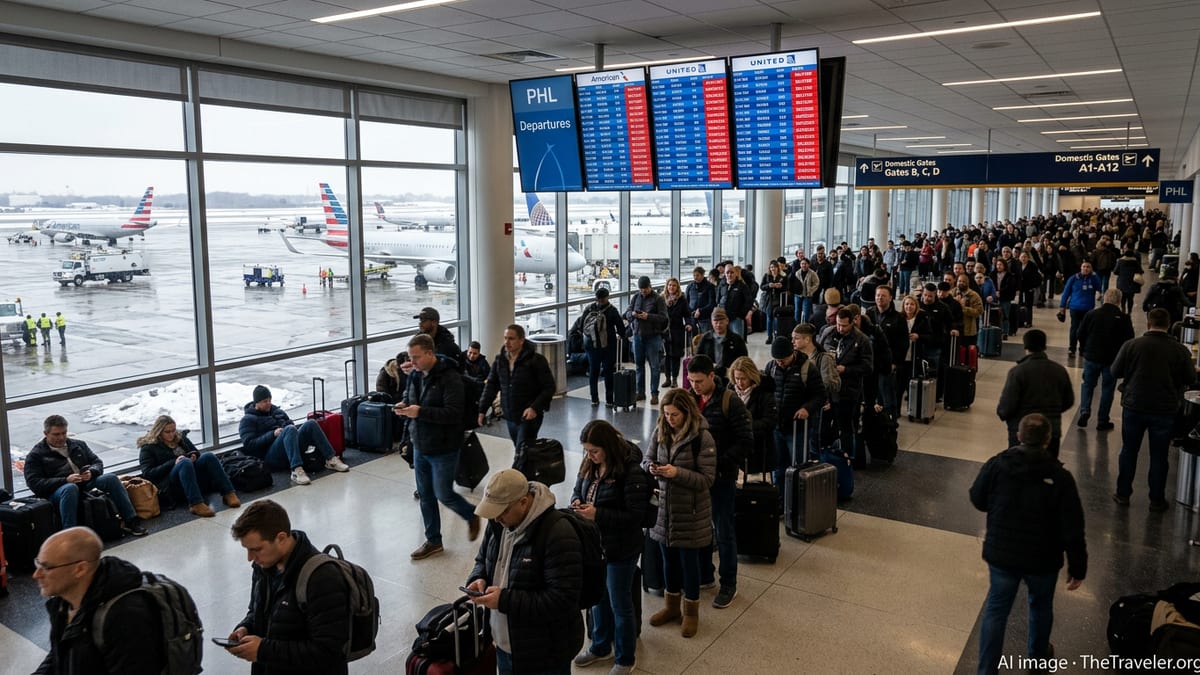
Air travel across the United States and Canada remained severely unsettled on March 15, as widespread weather and operational disruptions converged to create another punishing day for passengers. At Philadelphia International Airport alone, 144 new flights were reported delayed and 80 canceled, compounding rolling issues that have rippled through key hubs and secondary cities from Savannah and Memphis to Raleigh and Toronto.
Get the latest news straight to your inbox!
Philadelphia Delays Deepen a Week of North American Turbulence
Philadelphia International has been one of the hardest hit East Coast hubs in a winter already marked by major storms and strained airline operations. In the wake of the expansive January 23–27 winter system that brought some of the heaviest snowfall in recent years to the Mid-Atlantic corridor, carriers have struggled to return to fully stable schedules. Residual aircraft and crew imbalances have left operations vulnerable whenever fresh bad weather or localized bottlenecks emerge.
On March 15, publicly available tracking data showed 144 newly affected flights at Philadelphia classified as delayed, alongside 80 cancellations added through the day. Those figures sit on top of existing disruptions from earlier in the week, turning what might once have been a routine weather hiccup into an extended period of irregular operations. The result for many travelers has been missed connections, forced overnight stays, and last-minute scrambles for ground transport.
Industry analysts note that the system-wide impact of a single day like this can last well beyond the last listed delay. Aircraft and crew that fail to reach Philadelphia on time often cannot operate onward flights, leading to a cascade of schedule changes that affects other airports hours or even days later. For a hub that connects much of the Northeast with the South and the Midwest, that ripple effect can be felt across the continent.
The strain is particularly evident at transfer hubs where passengers depend on tight connections. Even when skies clear, travelers arriving into Philadelphia often find departure boards dominated by rolling delay times, terminal swaps, and rebooked itineraries, creating an atmosphere of uncertainty that has become a defining feature of this travel season.
Stormy Winter Leaves Savannah, Memphis, Raleigh and Toronto Exposed
The latest Philadelphia disruptions are only one piece of a broader North American picture, shaped by a succession of powerful winter systems. Earlier this year, a sprawling January storm brought serious snow and ice impacts from northern Mexico through the Southern United States and up into Canada, leading to thousands of cancellations and the highest single-day disruption levels since the early pandemic years. That same pattern has left cities such as Savannah, Memphis, and Raleigh exposed whenever regional weather conditions deteriorate.
Raleigh-Durham International has already experienced periods where outbound and inbound flights were widely curtailed, according to local reports and airport communications. Travelers there have described abrupt airport-wide cancellations on storm days, with airlines waiting until close to departure to formally scrub flights that were already tenuous due to worsening conditions and staffing limitations.
In Savannah and Memphis, which serve as important regional connectors rather than massive hubs, passengers have faced a different kind of challenge. When flights are canceled, there are often fewer alternative departures to absorb stranded travelers. Published accounts describe situations where the remaining scheduled flights are quickly oversold, forcing some passengers to drive overnight to larger airports or to their final destinations.
Toronto, meanwhile, continues to wrestle with the aftermath of one of its snowiest recent seasons. Earlier storms this winter brought record or near-record snow totals to Toronto Pearson International, triggering hundreds of cancellations in a single day. Even as conditions have moderated, ongoing de-icing backlogs, congestion on the airfield, and tight crew schedules have left some departures vulnerable to prolonged delays whenever fresh bands of snow or freezing rain arrive.
Thunderstorms, Blizzards and Aging Systems Combine to Snarl Schedules
While winter weather remains a central factor, the current wave of disruption is not confined to snow and ice. Thunderstorms and convective systems in key hub regions have also played a major role. In early March, for example, intense storms and hail over Atlanta produced hours-long holds and inspections for potential aircraft damage, contributing to widespread cancellations and missed connections across multiple airlines.
Travelers posting public updates from airports such as Atlanta, Minneapolis and Philadelphia in recent days have described scenes of crowded concourses, long lines at rebooking counters, and departure boards dense with cancellations. These snapshots match broader patterns revealed in federal and industry data, which show that severe weather remains the leading trigger for mass disruption, but often interacts with existing operational fragilities.
Those fragilities include aging airport infrastructure, tight crew scheduling, and limited slack in aircraft rotations. When a nor’easter forces extensive de-icing at Philadelphia or New York, or when thunderstorms briefly close arrival corridors into Atlanta or Toronto, the resulting backlog can take hours to clear. By that time, some crews may have reached duty-time limits, or the aircraft needed for a later leg may still be stranded at a different airport.
Observers point out that these structural constraints are not easily solved in the short term. Projects such as new runways, expanded de-icing pads, and upgraded airside technology can take years to deliver. Until then, days like March 15, with triple-digit delays and dozens of cancellations at a single airport, are likely to remain a recurring feature of the North American travel calendar.
Passengers Scramble for Alternatives on the Ground and Online
For travelers caught in the latest wave of disruptions, improvisation has become a new norm. Reports from across social media and traveler forums indicate that passengers in cities such as Savannah, Memphis, Raleigh and Toronto are increasingly abandoning their original itineraries when delays mount, opting instead for rental cars, rideshares to alternate airports, or same-day bookings on rail services where available.
In some cases, a canceled connection in Philadelphia has translated into a long overnight drive to reach another major hub in time for an international departure the following morning. Others have chosen to forfeit nonrefundable segments in favor of securing a more reliable routing on a different airline, particularly when their original carrier cannot provide a workable rebooking window for several days.
Digital tools have become central to these snap decisions. Flight-tracking platforms, mobile apps from airlines and online travel agencies, and subscription-based fare services are being used to monitor seat availability in near real time. Guides published in recent weeks highlight how travelers can build self-updating itineraries that react automatically to schedule changes, sending alerts when gates shift or when a delay threatens a connecting flight.
However, reliance on intermediaries has created complications of its own. Consumer-oriented explainers note that when tickets are issued through third-party platforms, passengers may have to navigate two separate support systems to secure refunds or rebookings. On especially chaotic days, that can mean extended time on hold and limited access to remaining seat inventory, which airlines may prioritize for customers who booked directly.
What Flyers Through Philadelphia and Other Affected Airports Can Expect Next
With another round of East Coast thunderstorms expected in the coming days and the tail end of the winter season still bringing the risk of late snow events, the outlook for fully smooth operations remains uncertain. Travel waivers announced by several major carriers for March 16 and March 17 across airports including Philadelphia, Savannah, and other East Coast cities signal that airlines are bracing for additional turbulence.
Publicly available advisories encourage passengers traveling through affected airports to build in additional buffer time, monitor flight status frequently, and consider earlier departures when itineraries involve tight connections. Travelers with flexible plans are being urged to switch to less exposed travel dates within published waiver windows, which can reduce the pressure on peak days and improve the odds of avoiding rebookings.
For those with fixed schedules, practical steps focus on contingency planning. That can include knowing the last departure of the day on alternate routes, checking the feasibility of same-day train or bus connections, and being prepared to arrange overnight accommodation in case of missed onward flights. Some consumer advocates also emphasize the importance of documenting delays and cancellations, as compensation and reimbursement policies can vary depending on whether a disruption is attributed to weather or controllable operational factors.
What remains clear is that the current pattern of intertwined weather and operational challenges is reshaping expectations for travel across North America. As Philadelphia International tallies another day of 144 fresh delays and 80 cancellations, and as airports from Savannah and Memphis to Raleigh and Toronto continue to absorb the knock-on effects, travelers are increasingly approaching every journey with a backup plan close at hand.