

More news on this day
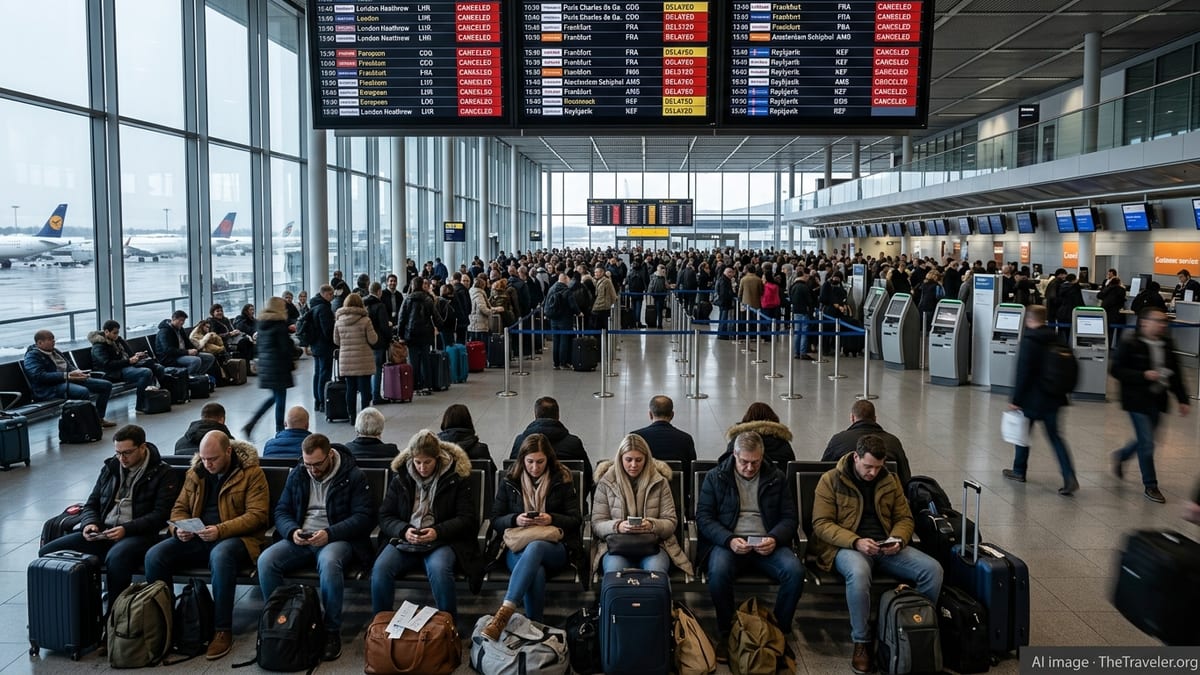
Hundreds of travelers have been left stranded across Europe after at least 39 flights were canceled and 234 delayed at key hubs including London Heathrow, Paris Charles de Gaulle, Frankfurt International, Amsterdam Schiphol, and Reykjavik, causing rolling disruption to connections across the continent and beyond.
Get the latest news straight to your inbox!
Major Hubs Struggle With Fresh Wave Of Disruptions
Recent operational data and published coverage show that Europe’s busiest airports are once again grappling with a spike in cancellations and delays, with the latest wave concentrated at London, Paris, Frankfurt, Amsterdam, and Reykjavik. While daily traffic levels at these hubs are close to seasonal norms, a combination of adverse weather, air-traffic flow constraints, and aircraft rotation knock-ons has pushed disruption beyond typical patterns.
At London Heathrow and Paris Charles de Gaulle, among Europe’s largest intercontinental gateways, the latest figures indicate dozens of services scrubbed and many more operating behind schedule. Even a relatively small number of cancellations at these hubs can cascade quickly, as aircraft and crews scheduled for onward services across Europe and the North Atlantic fall out of position.
Frankfurt International and Amsterdam Schiphol, both central to Europe’s transfer traffic, are experiencing similar issues. Reports indicate that a share of the affected flights involve short-haul European routes, while long-haul departures are being prioritized where possible to maintain global connectivity and manage aircraft utilization.
Reykjavik’s main international airport, a key mid-Atlantic stopover linking North America and Europe, has been drawn into the disruption through weather-related schedule changes and missed connections. As flights into and out of Iceland slip off their planned times, onward links to mainland Europe and North America have become harder to maintain, adding to the number of stranded passengers.
Weather, Winter Operations, And Airspace Constraints
Weather continues to play a central role in Europe’s aviation reliability this season. Coverage of recent winter storms over northwestern and central Europe has highlighted how snow, strong crosswinds, and freezing rain have repeatedly forced airports such as Amsterdam Schiphol and Frankfurt to curtail movements, concentrate traffic on a reduced number of runways, and slow down de-icing and ground-handling operations.
Amsterdam Schiphol has been particularly exposed during heavy snow and gusty conditions, with earlier events this winter seeing several hundred flights canceled and many more delayed as de-icing capacity and runway availability were stretched. Even once the worst weather passes, schedules can remain fragile for days while airlines work through backlogs and reposition aircraft scattered across the network.
In parallel, wider airspace constraints and reroutings linked to geopolitical tensions and ongoing restrictions over parts of Eastern Europe and the Middle East continue to complicate flight planning. Longer routings increase sector times and crew duty hours, leaving airlines with less margin to absorb additional disruption when local weather or airport capacity becomes an issue.
Reykjavik’s transatlantic role means it is also sensitive to shifting weather systems over the North Atlantic, including high winds and changing jet-stream patterns that can affect flight times and aircraft availability. When combined with congestion at larger hubs downstream, even modest local disruptions can contribute to a broader European ripple effect.
Stranded Passengers Face Long Queues And Limited Options
The immediate impact of the latest wave of cancellations and delays has been felt most acutely by passengers already at the airport. Social media posts and local media reports from London, Paris, Frankfurt, Amsterdam, and Reykjavik describe long queues at airline service desks, crowded terminal seating areas, and departure boards showing rolling delays across much of the day’s schedule.
Travelers with tight connections have been especially vulnerable. Missed onward flights can leave passengers stranded overnight, particularly where the remaining services on a given route are already operating close to capacity. Some airports and airlines have activated contingency measures such as distributing meal vouchers and helping arrange hotel accommodation, but availability can quickly run short during multi-day disruptions.
Rail and coach alternatives are absorbing some of the overflow on intra-European routes, especially between major cities such as London, Paris, Frankfurt, and Amsterdam. However, these surface options are limited for long-haul travelers and for those connecting through Reykjavik, where geographic isolation reduces the number of practical alternatives once a flight is canceled.
Rebooking has also become more complex. With previous storms and operational issues already filling many seats in the coming days, some affected passengers are being offered itineraries involving multiple stops or long layovers. Others are choosing to postpone or abandon their trips altogether when suitable alternatives are not available at reasonable cost.
Advice For Travelers Holding Upcoming Bookings
For travelers with upcoming flights through London Heathrow, Paris Charles de Gaulle, Frankfurt International, Amsterdam Schiphol, or Reykjavik in the next several days, publicly available guidance from airlines and travel agencies strongly emphasizes preparation and flexibility. Passengers are being urged to monitor their booking status closely via airline apps and to enable notifications so that any schedule changes are received as early as possible.
Where airlines are proactively offering free date or routing changes, taking advantage of these options before arriving at the airport can significantly reduce the likelihood of becoming stranded. Some carriers are temporarily waiving change fees for journeys passing through the most affected hubs, particularly when weather alerts or air-traffic flow restrictions are already in place.
Travel experts also highlight the importance of leaving extra time for connections, especially when combining separate tickets or mixing airlines. Allowing additional hours between flights, even when the minimum connection time appears sufficient, can provide valuable buffer if inbound services run late or if gate changes and security queues add further delays.
Passengers are further advised to keep essential items and a change of clothes in their carry-on luggage, and to retain receipts for any food, transport, or accommodation expenses incurred due to disruption. These records can be important later when seeking compensation or reimbursement under applicable airline policies or regional passenger-rights regulations.
Broader Questions Over Resilience At Europe’s Busiest Airports
The latest cluster of cancellations and delays has reopened debate about the resilience of Europe’s aviation system in the face of increasingly frequent weather extremes and persistent airspace restrictions. Industry analyses in recent months have underlined how quickly even modest reductions in capacity at a single major hub can propagate through the network, leaving aircraft out of position and passengers stranded far from the original source of disruption.
At London Heathrow, Paris Charles de Gaulle, Frankfurt, and Amsterdam, where schedules are tightly packed and runway capacity is finite, there is limited room to absorb unexpected shocks without knocking on to later waves of flights. Reykjavik’s role as a growing transfer hub between North America and Europe adds another layer of complexity, particularly when transatlantic weather patterns are unsettled.
Discussions within the sector are increasingly focused on how to balance operational efficiency with greater slack in the system, whether through additional ground resources, more robust winter operations, or schedule designs that allow for greater recovery time after major disruptions. For passengers, the current episode offers another reminder that even in an era of dense flight networks and sophisticated planning tools, air travel in Europe remains highly sensitive to a mix of weather, operational, and geopolitical pressures.
With the latest figures already pointing to dozens of cancellations and more than two hundred delays across these key hubs, travelers and industry observers alike will be watching closely in the coming days to see how quickly regular operations can be restored and whether further disruption will ripple through Europe’s tightly interconnected air corridors.