

More news on this day
Hundreds of passengers were left stranded across France today as Paris, Lyon, Marseille and Nice recorded 538 delayed departures and arrivals and 21 outright cancellations, disrupting schedules for Air France, Vueling, Transavia France, Lufthansa, Ryanair and other carriers already operating under pressure from wider European aviation disruption.
Get the latest news straight to your inbox!
Ripple Effects Hit France’s Busiest Airports
Operational data from flight tracking and aviation analytics platforms for April 12 indicates that bottlenecks built steadily through the morning peak and into the afternoon at Paris Charles de Gaulle and Orly, Lyon Saint-Exupéry, Marseille Provence and Nice Côte d’Azur. The clusters of delayed departures created knock-on disruption throughout domestic and short-haul European routes, leaving many travelers facing missed connections and extensive waits in terminal areas.
Published coverage in recent days has already pointed to sustained strain on the French network as carriers absorb earlier schedule shocks across Europe, including air traffic control restrictions, weather-related disruption and capacity constraints. That earlier turbulence meant that today’s delays quickly cascaded, with late inbound aircraft arriving in Paris and Lyon then passing the disruption on to Marseille and Nice as aircraft and crews rotated through the system.
The same datasets show that while most of the 538 affected flights ultimately operated, a significant share exceeded typical delay benchmarks by more than half an hour, with a smaller but still disruptive proportion running over an hour late. For passengers relying on tight connections at Paris in particular, those margins were enough to trigger missed long-haul links and forced overnight stays.
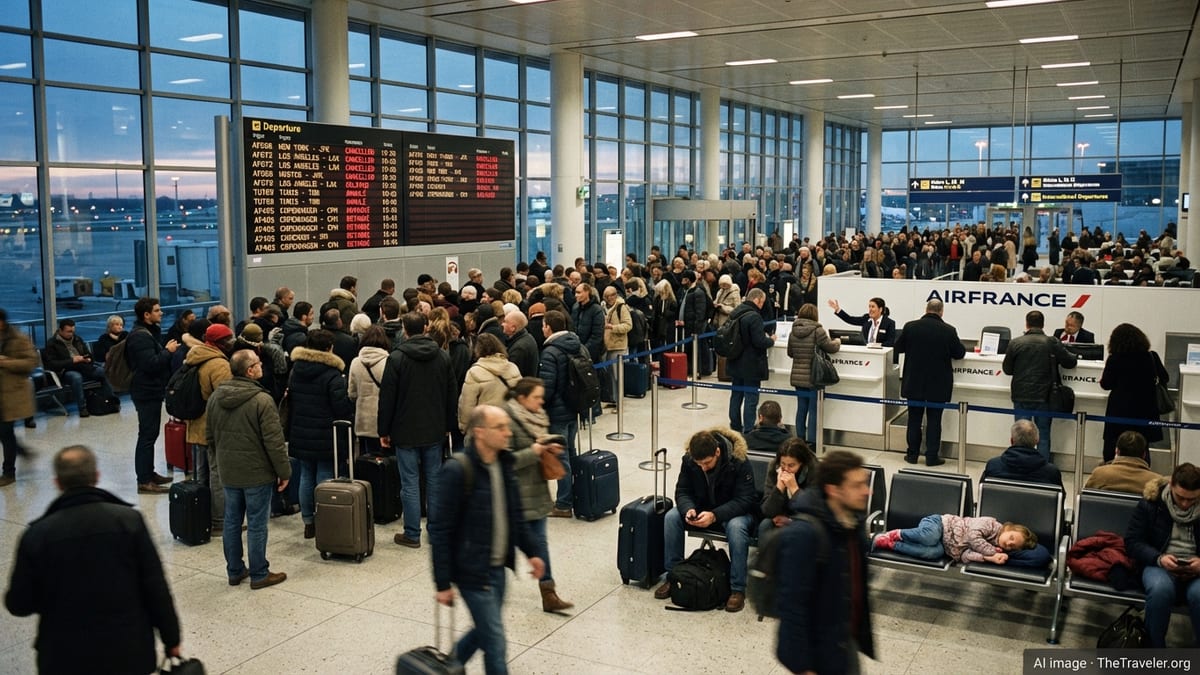
Airport operations reports describe busy but functioning terminals, with long queues at check-in and security points and crowded rebooking desks as airlines tried to redistribute travelers onto later departures. In several cases, aircraft were ready at gates but held for departure slots in congested airspace, further compounding reactionary delays.
Air France, Vueling, Transavia France and Network Carriers Affected
France’s home carrier Air France bore a notable share of the disruption because of its dominant position at Paris Charles de Gaulle and its dense schedule of domestic and European feeder flights linking through the capital. Publicly available flight histories on key trunk routes between Paris and Marseille or Lyon showed an accumulation of moderate to severe delays on services scheduled around the midday and early evening banks.
Low-cost operators Vueling and Transavia France, both with sizable operations at Paris and on Mediterranean routes feeding into Marseille and Nice, were also drawn into the disruption. With tighter aircraft utilisation and shorter turnaround times typical of low-cost models, relatively small schedule slips early in the day translated into more pronounced delays by mid-afternoon on routes to Spain, Italy and domestic French leisure destinations.
Lufthansa and Ryanair, which link their own hubs and focus airports into the French system, experienced a parallel set of issues. Recent reports of industrial action and capacity constraints in parts of the German network, together with high overall traffic levels for Ryanair across Europe, meant that delayed inbound flights into Paris, Lyon and Nice often arrived already off-schedule, giving local ground operations little opportunity to recover lost time.
Other European carriers and regional airlines operating under codeshare agreements with the larger groups also reported schedule irregularities. As aircraft and crews swapped between branded and partner-operated services, the practical distinction between which airline was delayed often blurred for passengers, many of whom only saw rolling departure times and generic disruption notices on airport displays.
Storms, Middle East Tensions and Structural Strain Behind Today’s Disruption
The disruption unfolded against a wider backdrop of stress on European aviation in early 2026. Meteorological data for the current windstorm season in Europe points to a sequence of strong systems impacting the continent in recent weeks, including weather that has periodically constrained operations at large hubs such as Paris and coastal airports around the Mediterranean. Even when conditions improved locally today, aircraft and crews were still out of their ideal positions from earlier events.
In parallel, analysis from aviation consultancies and industry groups in recent days has highlighted how the conflict-driven crisis in parts of the Middle East and associated airspace restrictions have forced airlines such as Air France-KLM and Lufthansa Group to reroute long-haul services. These longer routings increase block times and narrow the margin for on-time performance, causing aircraft to arrive back into Europe later than scheduled and pushing delay pressure onto shorter intra-European legs.
Capacity constraints in ground handling and air traffic management add a further layer. Industry reporting on French airports since late February has described heavy pressure on staff at Paris, Marseille and Nice, with ground operations and security screening often operating close to their limits during peak periods. When even minor irregularities occur under those conditions, delays can quickly become systemic across multiple airports in the same national network.
Today’s pattern of 538 delays and 21 cancellations across four key French airports fits into a broader narrative of a system attempting to operate near pre-crisis traffic levels while still coping with staffing gaps, rerouted long-haul patterns and recurring weather and industrial risks. For travelers on the ground, the result translated into long lines, busy customer service counters and the need for rapid changes to onward itineraries.
Implications for Travelers Flying To, From and Within France
For passengers caught up in today’s disruption, the immediate priority has been rebooking and securing accommodation where necessary. Airline advisories and consumer guidance published around recent European disruption episodes recommend that travelers dealing with multi-hour delays or missed connections work through official airline apps and websites where possible, as digital rebooking tools can sometimes offer alternatives more quickly than in-person desks during peak disruption.
Travel rights under European passenger protection rules are also an important consideration. Under Regulation EC 261/2004, travelers departing from European Union airports may be entitled to assistance, rerouting and, in certain circumstances, financial compensation when flights are significantly delayed or cancelled. Whether compensation applies can depend on factors such as the cause of the disruption and the length of the delay on arrival, but consumer organisations consistently advise passengers to retain boarding passes, booking confirmations and receipts for additional expenses in case claims are appropriate later.
Today’s events also underline the value of building resilience into travel plans involving French hubs such as Paris, Lyon, Marseille and Nice. Aviation analysts and travel advisors have repeatedly suggested allowing longer connection times, particularly when linking short-haul European flights with long-haul services, and considering morning departures where feasible, as early flights tend to suffer less from accumulated reactionary delays across the day.
For those planning trips over the coming weeks, monitoring airport performance trends and checking flights in the days leading up to departure can provide early warning of potential issues. While most flights across France continue to operate close to schedule, the combination of weather risks, ongoing geopolitical tensions affecting routings and seasonal demand spikes means that episodes like today’s network-wide disruption may recur, particularly at the busiest hubs.
Broader European Context Points to Continued Volatility
The French disruption today did not occur in isolation. Recent days have seen reports of significant delays and cancellations at other European airports, along with announcements of industrial action affecting major carriers and infrastructure providers. These developments suggest that European aviation remains in a period of heightened volatility, with limited slack to absorb shocks in any single national network.
Industry data tracking average delay minutes, cancellation rates and traffic growth for leading airline groups shows mixed performance, with some carriers restoring or exceeding pre-pandemic capacity while others, including several traditional network airlines, are still operating with reduced margins. In this environment, localized operational setbacks in Germany, Italy or Spain can quickly transmit into the French system through shared fleets, codeshares and connecting passenger flows.
For France specifically, the combination of its role as a major long-haul gateway and its dense domestic and regional network means that disturbances are likely to be keenly felt by both international visitors and residents moving within the country. As today’s tally of 538 delays and 21 cancellations illustrates, even a single day of irregular operations can strand hundreds of travelers and reshape travel plans well beyond France’s borders.
While airlines and airports continue to refine schedules, invest in resilience and adjust to evolving geopolitical and meteorological conditions, travelers using Paris, Lyon, Marseille and Nice should remain prepared for occasional bouts of disruption. Building flexibility into itineraries and staying informed through airline channels and reputable travel news outlets can help mitigate the impact when the next wave of delays sweeps across the terminals.