

More news on this day
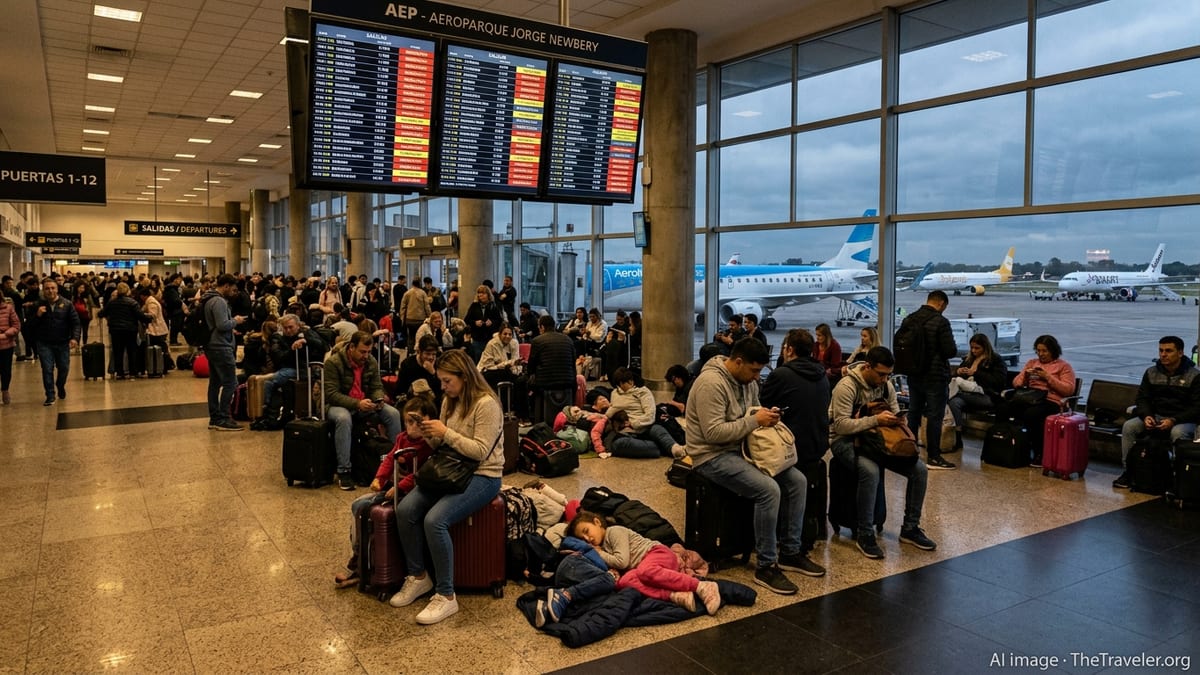
Hundreds of passengers were left stranded across Buenos Aires on Thursday as widespread disruptions at Ministro Pistarini International Airport and Jorge Newbery Aeroparque delayed 44 flights and forced the cancellation of at least 9 services operated by Aerolíneas Argentinas, Flybondi, JetSMART, LATAM and other carriers serving the Argentine capital.
Get the latest news straight to your inbox!
Major Disruptions Across Both Buenos Aires Hubs
The operational problems affected the capital’s two main gateways, the international hub at Ministro Pistarini in Ezeiza and the centrally located Aeroparque Jorge Newbery on the banks of the Río de la Plata. Together, the pair handle the bulk of Argentina’s domestic and regional traffic, as well as many long-haul departures, amplifying the impact of any disruption on travelers in and out of the country.
Publicly available airport status boards and media reports indicated that a combined 44 flights were subject to significant delays, with some departures held on the ground for hours. At least 9 services were canceled outright, affecting a mix of domestic and international routes and creating a knock-on effect for later rotations and onward connections.
The disruption hit at a time when Argentina’s main airlines have been operating with tight schedules and strong demand. Data from the national aviation authority for recent months shows Aerolíneas Argentinas remains the dominant player in both domestic and international markets, with low-cost rivals Flybondi and JetSMART and regional operator LATAM also accounting for a growing share of flights from Buenos Aires.
Passengers Face Long Queues, Missed Connections
Travelers arriving at both airports encountered long check-in and security lines, congested departure halls and crowded boarding gates as airlines attempted to re-slot delayed services. Social media posts from passengers described departure boards filled with “demorado” and “reprogramado” notices, while some reported waiting on parked aircraft as crews awaited clearance or operational windows.
The mix of delayed and canceled flights created particular challenges for those with onward journeys. Buenos Aires functions as a key connecting point between secondary Argentine cities and international destinations in South America and beyond. Even short-haul cancellations can therefore cascade into missed connections, overnight stays and rebookings on already busy services, further stretching airline and airport resources.
Families traveling at the start of the Southern Hemisphere school holiday period, as well as business travelers targeting same-day returns, were among those most affected. With limited spare capacity on some high-demand domestic routes such as Córdoba, Mendoza, Bariloche and regional capitals, many passengers reported being reprotected on flights departing a day or more later than planned.
Multiple Airlines, Shared Airspace Pressures
The delays and cancellations spanned both full-service and low-cost operators. Aerolíneas Argentinas, which accounts for the majority of domestic movements at Aeroparque and maintains a significant presence at Ezeiza, saw several services to key Argentine cities held back or canceled, according to real-time departure data and local coverage. Low-cost carriers Flybondi and JetSMART, both of which use Buenos Aires as a main base, also reported affected operations, alongside regional and international flights from LATAM.
Recent aviation statistics for Argentina underline how concentrated traffic has become at the Buenos Aires airports. Official reports for 2025 show Aerolíneas Argentinas operating well over half of domestic flights, with Flybondi and JetSMART together accounting for a substantial additional share. On international routes, Aerolíneas Argentinas and LATAM rank among the leading operators by flight volume and passenger numbers, supported by a roster of foreign carriers serving Ezeiza.
This dense traffic environment means that even moderate weather, technical or staffing issues can trigger broader operational bottlenecks. When multiple airlines share the same runways, taxiways and airspace, delays tend to ripple across carriers, especially at peak departure banks when aircraft compete for limited takeoff and landing slots.
Strain on an Already Busy Argentine Aviation Network
The latest disruption arrives amid a period of sustained growth and occasional volatility for Argentine aviation. Government statistics for recent months highlight strong passenger demand and generally high load factors across the main domestic airlines, as travelers increasingly rely on air links between distant provinces and the capital.
At the same time, the system has faced recurring pressure points. Industry analyses have drawn attention to frequent delays and cancellations among some low-cost operators, as well as infrastructure constraints and weather-related disruptions at major hubs. In this context, a spike of more than 40 delayed services in a single day at Buenos Aires, combined with outright cancellations, quickly exposes the limited margin for error in the current network.
Travel experts note that Argentina’s geography, with long distances between urban centers and limited high-speed ground alternatives, makes air travel particularly critical. When several dozen flights from the capital are disrupted, the impact is felt not only in Buenos Aires but also across provincial cities that depend on tightly scheduled rotations to maintain connectivity.
Advice for Affected and Future Travelers
For passengers currently stranded or facing rebookings, publicly available guidance from airlines and consumer organizations emphasizes the importance of monitoring flight status through official channels, confirming any changes before traveling to the airport, and keeping documentation of delays and cancellations when seeking refunds or compensation under applicable regulations.
Travel planners suggest allowing additional connection time when routing itineraries through Buenos Aires, especially during peak holiday periods or seasons prone to adverse weather in the Río de la Plata region. Booking earlier departures in the day, when operations are generally less affected by accumulated delays, can also reduce the risk of significant disruptions.
As airlines and airport operators work to stabilize schedules following the latest wave of delays and cancellations, travelers in and out of the Argentine capital are likely to watch closely for any further signs of strain on the country’s busiest air corridors.