

More news on this day
Hundreds of travelers were left stranded at Minneapolis–St. Paul International Airport on Thursday as at least 261 flights were delayed and 25 were cancelled, triggering a fresh wave of disruptions for Delta Air Lines, American Airlines, United Airlines and other carriers across major hubs including Chicago, New York, Dallas and Denver.
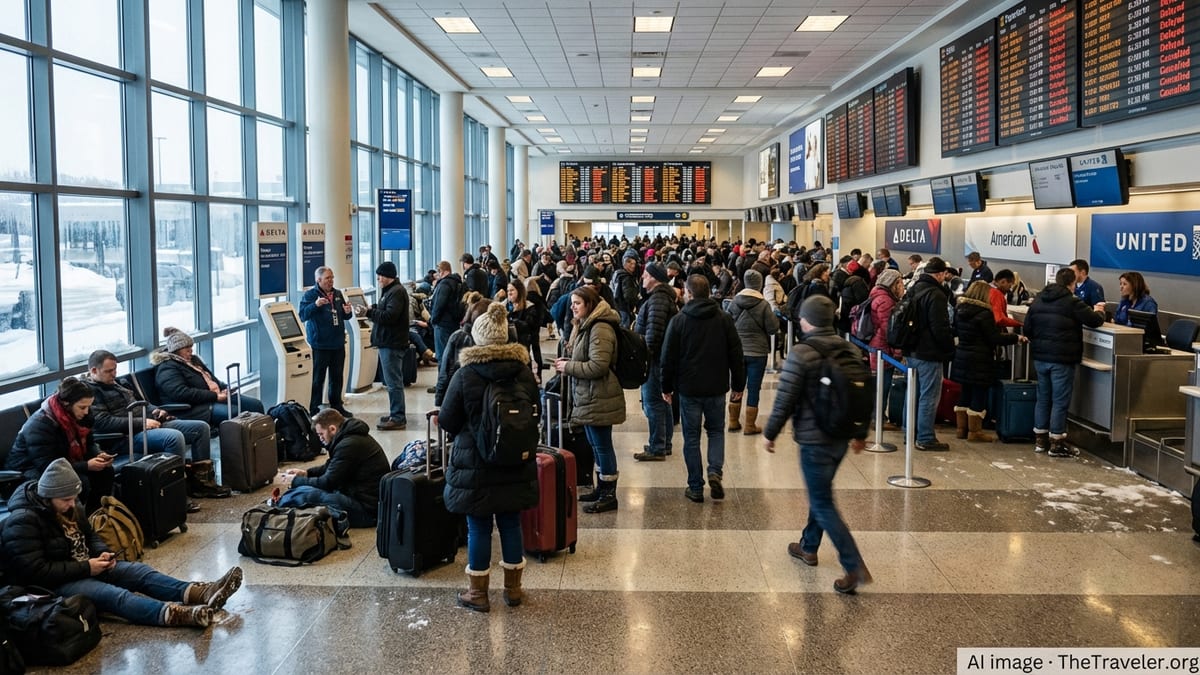
Heavy Disruptions Hit Key Midwest Hub
The problems at Minneapolis–St. Paul International Airport, one of the country’s busiest Midwestern hubs, began early in the day and quickly cascaded into the afternoon and evening. Airlines struggled to move aircraft and crew amid mounting delays, leaving departure boards filled with red and orange alerts as queuing passengers searched for updates.
The airport typically handles around 700 flights a day, but operational data on Thursday showed a significant share of those services running behind schedule. Long lines formed at check in and ticketing counters for Delta, the airport’s dominant carrier, as well as American Airlines, United Airlines and several regional operators. Many travelers found themselves rebooked multiple times or facing overnight stays in Minneapolis as later connections also filled up.
At the peak of the disruption, more than a third of departures were delayed, with knock on effects for arriving aircraft that could not secure gates or had to wait on the tarmac. For passengers watching their plans unravel, the practical impact was hours spent sitting on terminal floors propped against carry on luggage, refreshing airline apps that often offered little clarity.
Ripple Effects Across Chicago, New York, Dallas and Denver
Because Minneapolis–St. Paul serves as a major connecting node between the Upper Midwest and the rest of the country, the disruption quickly spread beyond Minnesota. Flights into and out of Chicago O’Hare and Midway, New York’s LaGuardia and John F. Kennedy, Dallas–Fort Worth and Denver International were among those affected as delayed aircraft from Minneapolis arrived late or were swapped at the last minute.
At Chicago O’Hare, already one of the most delay prone airports in the nation during peak weather and traffic periods, additional late running arrivals from Minneapolis created crowding at some gates and pushed back a series of onward departures to the East and West Coasts. In New York, evening departure banks to the Midwest had to be retimed as crews waited for incoming aircraft stuck on the ground or in holding patterns farther west.
Dallas–Fort Worth and Denver, both central hubs for cross country travel, also experienced rolling delays on routes linked to Minneapolis. Passengers on multi leg itineraries in particular found themselves stranded en route, sometimes far from their original or final destinations, as missed connections forced airlines to reshuffle limited spare seats on remaining flights.
Delta and Other Major Carriers Struggle to Recover
Delta Air Lines, which maintains one of its largest hubs at Minneapolis–St. Paul, bore the brunt of the disruption. The carrier controls a majority of the market at the airport and uses it as a key connecting point between smaller Midwestern communities and major domestic and international destinations. When operations falter there, the effects are quickly amplified across Delta’s network.
The airline has faced increased scrutiny over irregular operations in the past year following multiple high profile disruptions, including technology related issues and severe weather that exposed vulnerabilities in crew and aircraft positioning. Thursday’s delays and cancellations added fresh frustration for passengers who have grown accustomed to long wait times to reach customer service and limited rebooking options when flights go awry.
American Airlines, United Airlines and low cost carriers serving Minneapolis were also hit, though to a lesser degree. Their flights into the hub often rely on tight turnarounds, leaving little slack when inbound services are running late. By mid afternoon, many ticket counters were fielding lines of stranded customers seeking travel vouchers, hotel rooms or alternate routes home.
Weather, Congestion and a Fragile System
While the precise combination of factors behind Thursday’s problems varied by carrier, the episode reflected a broader fragility in the United States air travel system. Even on days without extreme storms, relatively modest bouts of low visibility, freezing drizzle or gusty winds at a key hub can reduce arrival and departure rates, forcing air traffic managers to meter flights and airlines to adjust schedules in real time.
In winter, Minneapolis–St. Paul is particularly vulnerable to disruptions as snow, ice and low clouds prompt deicing operations and careful runway management. Every extra minute spent spraying aircraft or waiting for plows translates into additional time on the ground, which then reverberates through the day’s rotations. When multiple hubs from Chicago to New York and Denver are also dealing with less than ideal weather, the margin for recovery all but disappears.
A decade of tight cost controls has also left airlines operating with lean spare capacity. Many carriers have fewer reserve aircraft and crews than before the pandemic, meaning there are often limited backup options when irregular operations strike. Once a delay wave forms at a hub like Minneapolis, it can take hours and sometimes days before schedules fully stabilize.
Travellers Face Long Lines, Confusion and Mounting Costs
For passengers on the ground, the numbers on a delay chart translated into missed meetings, lost vacation time and unexpected expenses. Families with young children clustered around power outlets in crowded gate areas, watching entertainment on tablets while waiting for updates. Business travelers paced terminal corridors fielding apologetic calls to clients and colleagues as their arrival times shifted repeatedly.
Hotel rooms near the airport and in downtown Minneapolis quickly became scarce and more expensive as airlines issued limited accommodation vouchers and many stranded travelers opted to find their own lodging. Others chose to bed down at the airport itself, curling up on benches and along quieter concourses in hopes of catching early morning departures.
Food courts and concession stands did brisk business but also saw lines stretching into walkways during peak mealtimes. For international travelers or those unfamiliar with the region, navigating rebookings and changing information proved especially challenging, particularly when language barriers, mobility issues or tight onward connections were involved.
Airlines Urge Digital Tools but Call Centers Overwhelmed
As the disruption unfolded, airlines encouraged customers to rely on mobile apps and websites to track flight status and explore rebooking options. Digital tools have become central to airline operations, allowing travelers to change flights, join standby lists and receive push notifications without standing in line at a counter.
Yet many stranded passengers reported that digital channels lagged behind events on the ground or offered only limited choices, such as routing through already congested hubs or presenting options days in the future. When customers turned to call centers, they often encountered hold times stretching beyond an hour as agents grappled with a high volume of cases nationwide.
In the terminals, some travelers said they had better luck speaking directly with gate agents or customer service representatives, who could occasionally access creative solutions not presented in standard app interfaces. However, with staffing levels finite and hundreds of people seeking help at once, patience wore thin on both sides of the counter.
National Context: Delays Becoming a Familiar Story
The chaos at Minneapolis–St. Paul came against a backdrop of nationwide reliability concerns in the United States aviation system. Over the past several years, travelers have seen an uptick in severe delay days as storms, technology outages and staffing constraints expose vulnerabilities at major carriers and airports.
Industry analysts note that while overall on time performance has improved in some markets, large, interconnected hubs remain vulnerable to shock events. Disruptions at one airport, especially a key connector like Minneapolis, can cause a chain reaction affecting travelers thousands of miles away. When several hubs simultaneously grapple with operational challenges, the impact can reach into nearly every region.
Airlines have pledged to invest in more resilient scheduling systems, better crew management tools and modernized technology to reduce recovery times after disruptions. Regulators, meanwhile, continue to pressure carriers to improve communication with passengers during irregular operations and to ensure that existing consumer protections around refunds and rebookings are honored when flights are significantly delayed or cancelled.
What Stranded Travellers Can Do Next
For those still trying to leave Minneapolis–St. Paul and other affected airports, travel experts advised prioritizing early morning flights over evening departures whenever possible, as the first wave of services often experiences fewer knock on delays. Customers were also encouraged to check all nearby airports for alternate routings, including regional fields that might offer seats on less congested flights.
Passengers were reminded to document all expenses incurred as a result of the disruption, including hotel stays, meals and ground transportation, in case airlines offer later reimbursement or goodwill credits. While U.S. regulations do not require compensation for weather related delays, carriers sometimes provide vouchers or frequent flier miles to maintain customer loyalty after prolonged operational issues.
Above all, travelers were urged to keep a close eye on flight status updates and to confirm any new arrangements directly with the airline before heading back to the airport. With aircraft and crew still out of position and delays continuing to ripple through the system, schedules remained fluid well into the evening, and further adjustments were considered likely as airlines worked to restore normal operations.