

More news on this day
Hundreds of passengers were left stranded at Moscow’s three main airports on March 1 as at least 180 flights were delayed and 44 canceled, disrupting domestic and international services operated by Aeroflot, S7 Airlines, Rossiya and other carriers on high-demand routes to Paris, London, Dubai and New York.
Major Moscow Hubs Grapple With Widespread Disruption
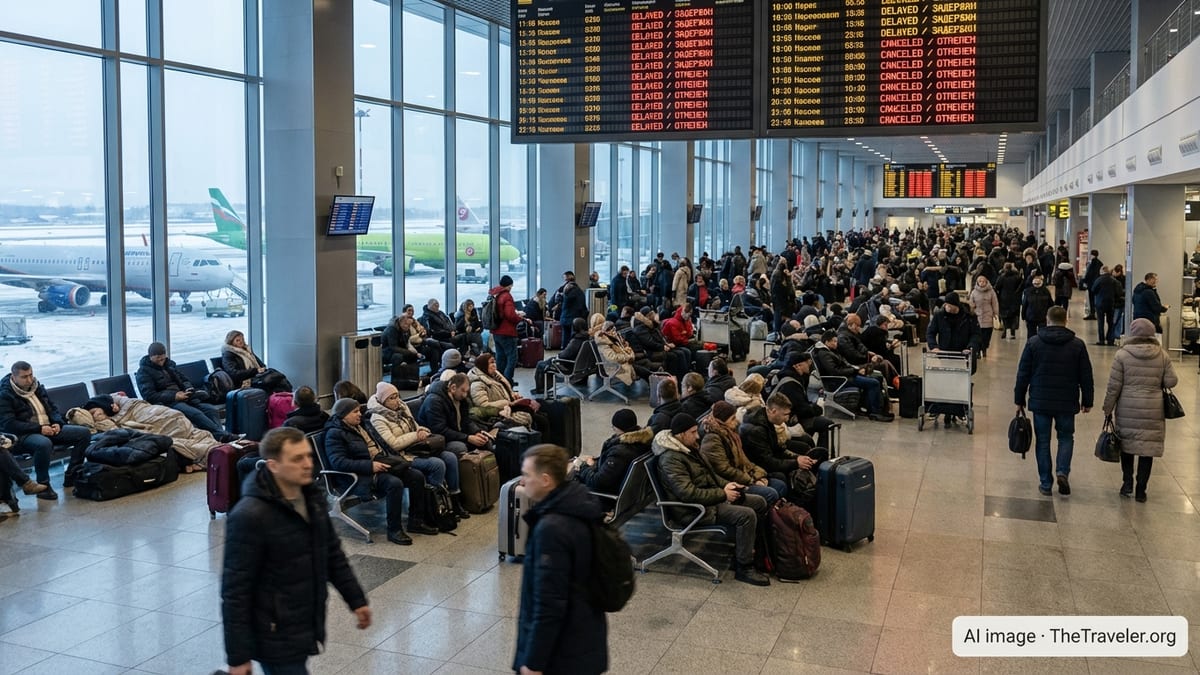
Operational turbulence swept through Sheremetyevo, Vnukovo and Domodedovo on Saturday, turning normally busy departure halls into crowded waiting areas as rolling delays built up through the day. The disruption affected both early-morning bank departures and peak afternoon long haul services, with airlines struggling to reposition aircraft and crews.
By early evening, at least 180 flights were reported delayed and 44 canceled across the three Moscow hubs, according to aggregated airport and aviation data. That figure included a mix of domestic routes to regional centers and international services to major European and Middle Eastern gateways, where connecting itineraries magnified the impact for long haul travelers.
Sheremetyevo, the primary base for Aeroflot and a key transfer point for passengers connecting between Europe, Asia and the Americas, saw the largest number of schedule changes. Vnukovo and Domodedovo also reported clusters of delayed departures and arrivals, with ground-handling bottlenecks and aircraft rotation issues compounding earlier timetable slippages.
Airport authorities said crowding was significant in certain terminals, particularly around check-in zones for evening departures to Western Europe and the Gulf, though security operations and essential services continued to function.
Flag Carriers and Key Routes to Paris, London, Dubai and New York Hit
The knock-on effects were felt most sharply on trunk routes linking Moscow with Paris, London, Dubai and New York, where aircraft and crew are tightly scheduled and connections are critical for onward travel. Passengers bound for Charles de Gaulle, Heathrow and Dubai International reported boarding delays of several hours, missed onward flights and last-minute gate changes.
Aeroflot, Russia’s largest carrier, bore a significant share of the disruption as its long haul network from Sheremetyevo was affected. Services to New York and other North American destinations faced extended ground times and, in several cases, rolling delays that left travelers waiting near departure gates with limited information on revised timings.
S7 Airlines and Rossiya, both key players on domestic and regional routes, also reported multiple delayed departures as aircraft arriving late into Moscow struggled to turn around on schedule. Flights feeding Moscow from cities such as Samara, Yekaterinburg and Sochi were among those running well behind timetable, narrowing the connection window for passengers hoping to continue on to Western Europe or the Middle East.
Gulf routes were under particular pressure, with Dubai services operating close to capacity at the start of a busy spring travel period. Travelers connecting through Dubai to Asia and Africa faced the prospect of rebooking entire itineraries, as missed connections rippled through already crowded networks.
Passengers Face Long Queues, Thin Information and Limited Options
Inside the terminals, scenes were familiar to anyone who has experienced large-scale aviation disruption: long lines at airline service desks, passengers sprawled on the floor with luggage trolleys as makeshift seats, and departure boards filled with delayed indicators. Families with young children, business travelers with tight schedules and tourists at the end of winter holidays all converged on the same help counters in search of alternatives.
Several passengers reported receiving text and app notifications about delays, but said that on-the-ground information often lagged behind what they saw on mobile devices. For those not using airline apps, public address announcements and manual updates to gate screens became the primary, and sometimes inconsistent, source of news about revised departure times.
Accommodation quickly emerged as a pain point. With a high volume of travelers stuck in Moscow overnight, nearby airport hotels moved towards full occupancy, forcing some stranded passengers to seek rooms deeper in the city or to sleep in terminal seating areas. Food outlets and airport lounges saw heavy demand as travelers tried to find relative comfort during the extended wait.
Passengers arriving into Moscow were also caught out, particularly those on separate tickets who needed to recheck bags for onward flights to Europe or the United States. With minimum connection times effectively blown apart by the disruption, many travelers found themselves unexpectedly entering Russia, clearing immigration and then attempting to salvage their journeys at airline sales counters.
Airlines Implement Recovery Plans Amid Broader Regional Strains
By late evening, carriers had begun implementing recovery plans, including rolling rebookings onto later departures, deployment of larger aircraft on selected routes and, in some instances, consolidation of lightly booked services. Airline operations centers worked to reposition aircraft and crews to restore a more stable schedule for Sunday’s departures.
The disruption in Moscow came as air traffic across Europe and surrounding regions has already been strained by wider geopolitical tensions and airspace restrictions, which have narrowed routing options and increased congestion along remaining corridors. Recent waves of delays and cancellations at major hubs from Istanbul to London and Paris have left airlines with reduced margin for error when further operational challenges emerge.
Industry analysts noted that Moscow’s airports are particularly sensitive to ripple effects when multiple carriers face simultaneous constraints. With Aeroflot acting as both a point-to-point and transfer carrier and S7 and Rossiya providing dense domestic feed, schedule shocks can quickly propagate across the country’s network, affecting travelers far beyond the capital.
While aviation authorities emphasized that core safety standards were maintained, they acknowledged that restoring normal operations would likely require several schedule cycles, meaning that residual delays could persist into the next day for some destinations.
What Travelers Through Moscow Should Expect Next
For passengers scheduled to travel through Sheremetyevo, Vnukovo or Domodedovo in the coming 24 hours, airlines and airport officials advised allowing extra time, closely monitoring flight status via official channels and being prepared for gate or timing changes, even if flights remain scheduled to operate. Many carriers have temporarily relaxed rebooking rules, allowing one-time changes without additional fees on affected routes.
Travel agents and corporate travel managers reported a spike in customer inquiries as travelers sought to adjust itineraries to avoid tight connections in Moscow or to reroute via alternative hubs where possible. However, with peak-season demand and limited capacity on some long haul sectors, options remained constrained, particularly for same-day departures.
For now, Moscow’s main airports continue to operate, but with a fragile equilibrium as airlines work through the backlog of delayed passengers and aircraft. Travelers connecting between Russia and key markets such as Western Europe, the Gulf and North America should anticipate potential knock-on effects on their journeys, even after the most acute phase of the disruption subsides.
As schedules gradually normalize, the day’s events serve as another reminder of how quickly pressure on a few critical hubs can cascade across global travel plans, leaving hundreds of passengers stranded and highlighting the importance of flexible booking options and real-time communication in an increasingly volatile air travel landscape.