

More news on this day
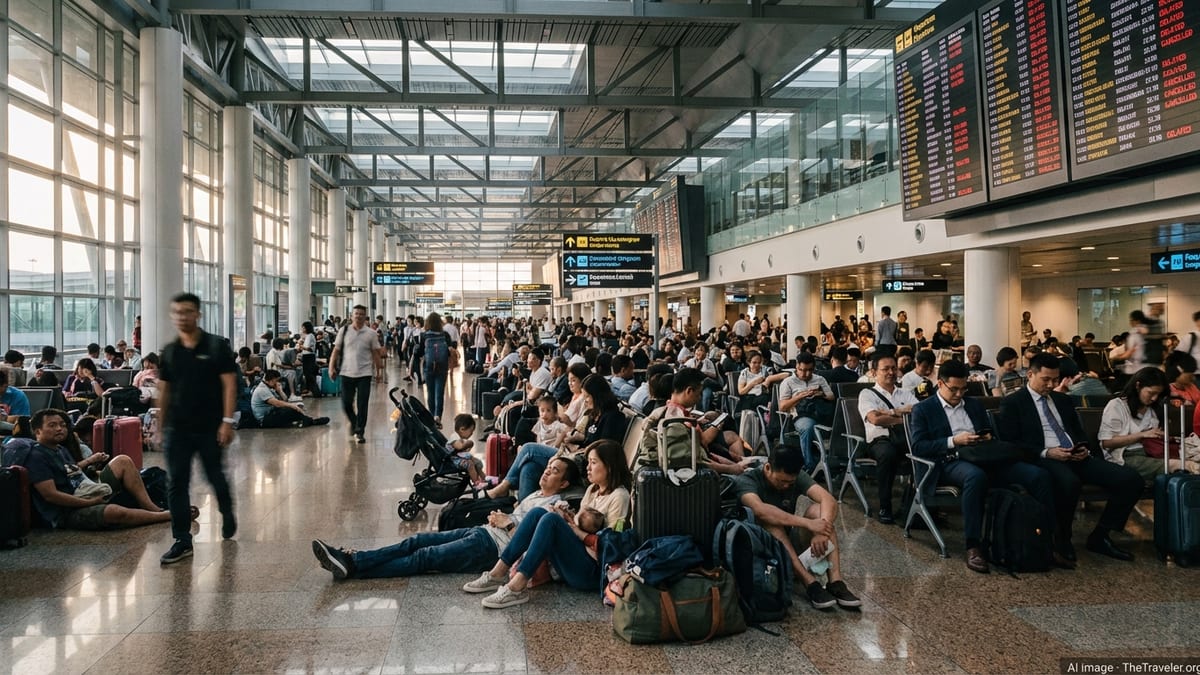
Thousands of air passengers across China have been left stranded after a fresh wave of cancellations and delays rippled through major hubs including Beijing, Shanghai, Guangzhou and Shenzhen, disrupting travel plans in one of the world’s busiest aviation markets.
Get the latest news straight to your inbox!
Wave of Disruptions Hits Key Chinese Gateways
Recent tracker data and industry reports point to a turbulent stretch for Chinese aviation, with several separate disruption waves converging over late March and early April 2026. Travel and tourism outlets describe hundreds of cancellations and thousands of delays across major hubs, from Beijing Capital and Beijing Daxing to Shanghai Pudong, Shanghai Hongqiao, Guangzhou Baiyun and Shenzhen Bao’an.
On individual peak days, operational summaries cited by specialist travel publications list more than 5,000 delayed flights and over 400 cancellations nationwide, with Guangzhou, Shenzhen and the twin Shanghai airports among the worst affected. In another snapshot just days earlier, at least 223 delays and 45 cancellations were recorded across a cluster of Chinese airports including Shanghai, Beijing, Guangzhou, Shenzhen and Changsha, leaving aircraft, crew and passengers out of position.
The latest turbulence follows a January pattern in which China’s network already saw more than 120 cancellations and nearly 2,000 delays concentrated at big-city gateways such as Beijing, Shanghai, Changsha and Xi’an. Combined, the statistics suggest a system operating with little spare capacity, where local weather, airspace constraints or schedule changes can quickly cascade into nationwide disruption.
These interruptions are unfolding as Chinese airports handle steadily rising traffic following the lifting of pandemic-era controls. People’s Daily reporting on the Spring Festival travel rush in February highlighted that Guangzhou Baiyun alone moved more than 5 million passengers over a few weeks, underscoring how even modest operational shocks can have an outsized impact on travelers.
Passengers Face Long Queues, Confusion and Limited Options
Travelers caught in the latest wave of flight disruption describe being stranded for hours in crowded terminals as departure boards filled with delayed or canceled services. Coverage from regional outlets and travel-law advisory sites notes that passengers at hubs such as Shanghai Pudong, Guangzhou Baiyun and Beijing Capital often struggle to obtain clear information about revised departure times, rebooking options or compensation rights.
In several cases, delays stretched across key domestic trunk routes linking Shanghai with Beijing, Guangzhou, Chengdu and Shenzhen. This has knock-on effects for travelers connecting to secondary cities, amplifying the number of people forced to spend unexpected nights in airport hotels or on terminal benches. Reports indicate that some travelers only learned of cancellations at the gate, compounding frustration and complicating their ability to rearrange ground transport or accommodation.
Travel-focused legal analysts highlight growing interest in China’s aviation passenger rights framework, as more travelers seek clarity on when they are entitled to refunds, rerouting or care such as meals and lodging. Advisory pieces published in late March state that some travelers with confirmed bookings experienced lengthy waits to secure alternative flights, particularly where entire sequences of rotations were disrupted rather than a single isolated leg.
While precise experiences vary by carrier and airport, publicly available accounts suggest that uneven communication and limited spare seat capacity remain persistent pain points. For many passengers, the immediate challenge has been less about a single delay than about reconstituting complex itineraries that include domestic connections or onward international legs.
Multiple Factors Behind the Chaos
Analysts and industry commentary point to a mix of causes behind the recurring flight chaos. Several reports reference bouts of adverse weather affecting central and eastern China, including low visibility and storms that constrain airspace capacity and slow turnaround operations at major hubs. When such conditions overlap across regions, the result is a rolling series of ground stops and holding patterns.
In addition, scheduling and maintenance coordination appear to be contributing factors. A recent breakdown of March disruptions in China suggested that planned maintenance, when not precisely aligned with dense daily schedules, can remove critical aircraft from service at short notice. This leaves airlines with fewer options to cover for weather, crew time limits or minor technical issues, and can transform what would otherwise be manageable delays into widespread cancellations.
China’s broader geopolitical and demand environment also exerts indirect pressure on the network. Ongoing reductions in some China to Japan services through March, tied to a diplomatic dispute and reflected in international booking and schedule data, have pushed more travelers onto remaining routes or domestic alternatives. With key airports already running near capacity, even modest rerouting of flows can stress gate availability, ground handling and air traffic management.
Observers note that the pattern of repeated multi-hub disruptions over recent months differs from isolated incidents linked solely to extreme weather or single-airline technical failures. Instead, the data points to systemic fragilities, where small shocks in one part of the network are quickly transmitted to other hubs, overwhelming contingency plans and leaving passengers bearing the brunt.
Airlines and Regulators Under Pressure to Improve Resilience
The scale and frequency of recent disruptions have intensified scrutiny of how Chinese airlines and airport operators manage capacity and communicate with customers. Commentaries in travel-industry publications argue that carriers such as Air China, China Eastern, China Southern and Hainan Airlines are being pushed to refine schedule planning, build more buffer time into rotations and expand digital tools for rapid rebooking.
Regulatory bodies are also being examined through the lens of network resilience. Past analyses of Asian disruption events have noted calls for stronger oversight of contingency planning, better coordination between airports and airlines, and clearer minimum standards for passenger care during extended delays. The recurrence of severe congestion episodes at Beijing and Shanghai hubs is renewing debate over how quickly such measures are being implemented in China.
Industry analysts say that investments in infrastructure at newer facilities, such as Beijing Daxing and Chengdu Tianfu, are designed to spread traffic more evenly across the network. Yet recent statistics show that when large-scale weather or airspace constraints hit, both legacy and newer hubs can still experience bottlenecks. That raises questions about whether improved hardware alone is enough, or whether more flexible crew rostering, strategic reserve fleets and data-driven demand forecasting will be required.
For now, the immediate response appears focused on clearing backlogs and stabilizing daily operations. However, as travel demand continues to climb into the peak summer season, airlines and regulators face mounting pressure to demonstrate that lessons from this year’s chaos are being translated into tangible improvements.
What Travelers Can Do Ahead of Peak Season
With Chinese aviation entering a busier phase after the Spring Festival period, travel advisors are urging passengers to plan for potential disruption, particularly when connecting through Beijing, Shanghai, Guangzhou or Shenzhen. Recommendations in recent consumer guidance articles include booking longer layovers for domestic connections, traveling with essential items in carry-on luggage and monitoring flight status across multiple channels, including airline apps and airport information boards.
Travel-law commentators also underscore the importance of understanding basic passenger rights under Chinese regulations before departure. Knowing when one is eligible for a refund, a free rebooking or assistance with meals and accommodation can help travelers advocate more effectively at crowded service counters during irregular operations.
Some analysts suggest that travelers with flexible schedules consider early-morning departures, which often benefit from more predictable operations before daily delays accumulate. Others note that, on heavily trafficked trunk routes with multiple daily frequencies, keeping an eye on alternative flights operated by the same or partner airlines can shorten unplanned waits when original services are canceled.
As this latest round of flight chaos demonstrates, even routine journeys across China’s dense domestic network can be upended with little warning. Until structural improvements take hold, travelers moving through the country’s major hubs may need to factor disruption management into their trip planning as carefully as they choose fares and routes.