

More news on this day
Thousands of passengers across the Middle East are facing severe disruption as a fresh wave of flight cancellations and delays at major regional hubs snarls air travel and forces airlines to redraw routes across Saudi Arabia, Oman, the United Arab Emirates, Egypt and beyond.
Get the latest news straight to your inbox!
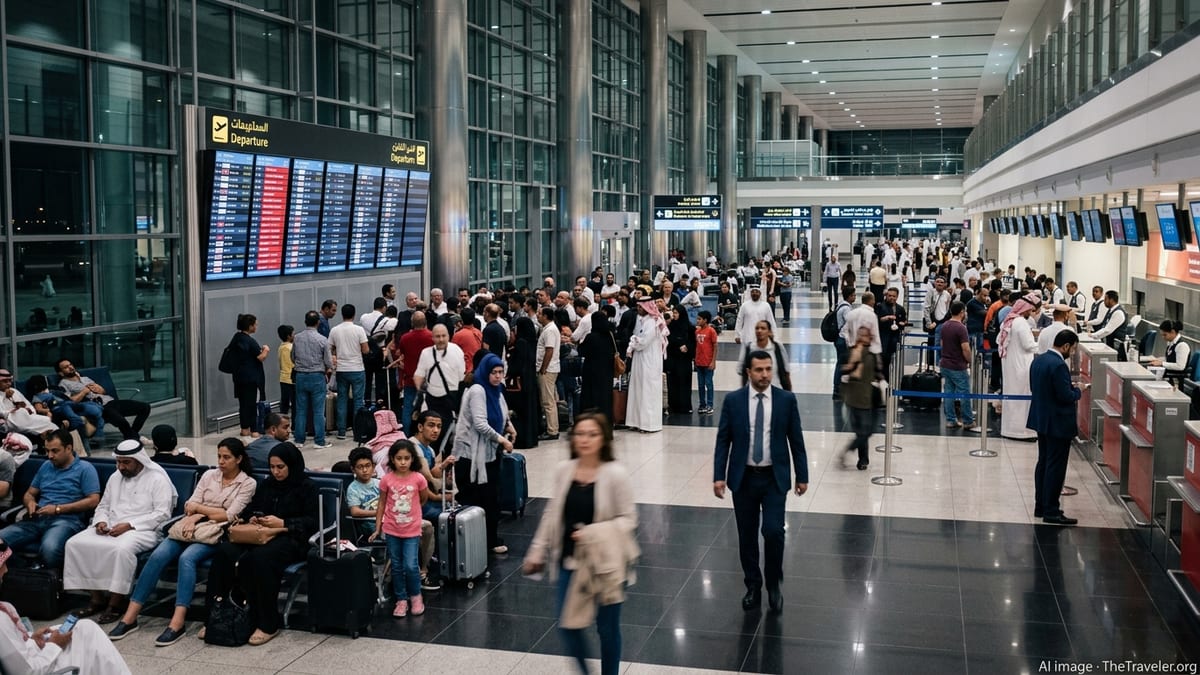
Regional Hubs Buckle Under Fresh Wave of Disruptions
Travelers at King Abdulaziz International in Jeddah, Fujairah International in the United Arab Emirates, Kuwait International and Seeb International in Muscat reported long queues, crowded terminals and scarce information on Friday as airlines cut 22 flights and delayed a further 52 across affected carriers and routes. Publicly available airport data and airline status pages show services being held on the ground for hours or scrubbed entirely as operations teams attempt to navigate restricted airspace and rapidly shifting schedules.
The latest wave of disruption comes on top of weeks of turbulence across Middle East aviation following the escalation of conflict involving Iran, the United States and regional states. Industry advisories issued in early March highlighted extensive airspace closures, capacity caps and rolling ground stops, particularly over parts of the Gulf, which have forced airlines to thin out schedules, consolidate services and resort to longer contingency routings over safer corridors.
At King Abdulaziz International, one of Saudi Arabia’s busiest gateways, a reduced but still significant program of flights has been operating under what travel risk consultancies describe as constrained conditions, with carriers prioritising essential routes and repatriation demand. At the same time, Kuwait International and Fujairah International have seen far more intermittent movements, reflecting tighter local restrictions and the knock-on effect of airspace closures in neighbouring states.
In Muscat, Seeb International has emerged as a relative bright spot, with Oman generally maintaining more open skies than several of its neighbours. Yet even there, passengers are facing timetable changes, rolling delays and late-notice cancellations as airlines struggle to align crews, aircraft and overflight permissions on multi-country routings that can change from one news cycle to the next.
Airspace Restrictions Ripple Through Airline Networks
According to recent travel advisories and aviation operations bulletins, significant portions of airspace over Iran and parts of the Gulf remain heavily restricted or effectively closed to routine civil traffic, pushing airlines to reroute around sensitive areas. This has injected extra hours and fuel burn into long haul journeys, added complexity to crew duty planning and sharply reduced the number of flights that can be completed in a 24 hour period.
Carriers based in the Gulf, including large network airlines and regional operators, have responded by trimming frequencies, consolidating passenger loads onto fewer departures and suspending some point to point links entirely. In several cases, flights that would ordinarily hub through the largest airports in the United Arab Emirates or Qatar are instead being funneled through alternative gateways in Saudi Arabia and Oman, adding pressure to infrastructure at King Abdulaziz International and Seeb International in particular.
Industry analysis published in recent days suggests that airlines in the United Arab Emirates are operating at less than half of their normal capacity, while Kuwait has seen an even steeper contraction. Egypt, sitting on the western edge of the disruption zone, has taken on additional traffic as airlines bend routes over the Red Sea and North Africa, but this workaround has also led to crowding on some Egyptian sectors and extended journey times for passengers traveling between Asia, Europe and North America.
Operational notices from logistics and travel management firms describe the region’s air traffic system as fluid and vulnerable to short notice changes. Even where airports remain technically open, temporary ground stops, diversion of inbound flights and last minute rescheduling are common as airlines react to updated risk assessments and shifting overflight permissions.
Passengers Stranded Amid Cancellations and Rolling Delays
For passengers on the ground, the statistics translate into missed connections, unplanned overnight stays and a scramble for alternative options. Travelers at Kuwait International and Fujairah International have shared accounts on social platforms of queues forming at airline service desks as flight status boards flicker from delayed to cancelled. With so many routes simultaneously affected, options to rebook onto later departures are often limited, particularly for those trying to reach onward connections in Europe, South Asia or Africa.
Reports from Jeddah indicate that some travelers bound for onward destinations via other Gulf hubs have been reprotected onto flights using Saudi Arabia as a primary corridor, only to confront further delays as congestion builds on those same routes. In Muscat, some passengers have managed to continue their journeys via Seeb International thanks to comparatively steadier operations, but published coverage notes that seats on these services are filling quickly as demand is diverted from more heavily impacted airports.
Travel forums and advisory bulletins emphasise that even flights listed as operating are at heightened risk of departure time changes as airlines juggle aircraft rotations and crew rest requirements. In practical terms, this has left many passengers waiting in terminals for extended periods, uncertain whether they will depart later in the day or need to arrange accommodation and new tickets for subsequent dates.
With cancellations and delays concentrated on a relatively small number of key corridors, stranded passengers have also turned to land and sea alternatives where available. Bus links, cross border car travel and limited ferry routes toward more stable hubs are reportedly seeing increased demand, especially for short haul journeys between Gulf states where land borders remain open.
Impact on Tourism, Business Travel and Trade Flows
The cascading flight disruptions are landing a heavy blow on travel dependent sectors across the Middle East. Tourism boards in Gulf states had expected a strong first half of 2026 on the back of earlier investment in events, leisure infrastructure and marketing campaigns, but publicly available economic assessments now point to sharp declines in visitor arrivals and hotel occupancy as travelers postpone or reroute trips.
Business travel has been similarly affected. Conferences and corporate gatherings scheduled to take place in major Gulf cities have been postponed, shifted online or relocated to alternative destinations with more stable air links. For firms that rely on frequent regional travel, the loss of predictable connections through hubs like Jeddah, Muscat and Kuwait City has added complexity and cost, with executives facing multi leg itineraries and overnight stopovers to accomplish what were once straightforward day trips.
Aviation cargo flows are also feeling the strain. Freight advisories circulated to shippers in early March describe a patchwork of partial resumptions and ongoing suspensions, with airlines warning of limited capacity, longer routings and higher rates. Saudi Arabia has taken on a greater role as an east west bypass, but congestion at its gateways has led to slot delays and payload restrictions, complicating planning for industries that depend on just in time deliveries.
Egypt and other states on the fringes of the core disruption zone are absorbing some diverted cargo and passenger traffic, yet the overall picture remains one of reduced connectivity and elevated uncertainty. Analysts warn that if current patterns persist, the region’s broader efforts to position itself as a global aviation, tourism and logistics hub could face a temporary but meaningful setback.
What Travelers Can Expect in the Coming Days
With the geopolitical situation still evolving, travel specialists caution that disruptions at King Abdulaziz International, Fujairah International, Kuwait International and Seeb International are likely to continue in the near term. Airlines are updating schedules in shorter planning windows than usual, sometimes adjusting services day by day, which means that published timetables may not fully reflect the extent of same day changes, rolling delays or tactical cancellations.
Public guidance from aviation regulators and travel risk firms consistently advises passengers to stay in close contact with their airlines, monitor flight status in real time and avoid traveling to the airport unless their departure has been explicitly reconfirmed. Flexible booking policies announced by many carriers allow for rebooking or refunds where flights are cancelled, but processing times can be slow given the volume of affected customers.
Travel experts also note that travelers transiting the region should build additional buffers into their itineraries, particularly when connecting to long haul services in Europe, Asia or North America. Longer routings around restricted airspace, extended ground times and congested alternative hubs increase the risk that tight connections will be missed, even when individual flights ultimately operate.
While some operational improvements are possible if airspace restrictions ease and airlines adapt more fully to new routing patterns, the broader environment remains highly uncertain. For now, passengers planning journeys through Saudi Arabia, Oman, the United Arab Emirates, Kuwait or Egypt in the coming days are being urged by publicly available advisories and industry bulletins to treat current schedules as provisional and to prepare for potential last minute changes to their travel plans.