

More news on this day
Hundreds of travelers were left in limbo in Colombia on February 21, 2026, as airports in Bogotá, Popayán, Cali, Cartagena and Barranquilla reported at least 12 flight cancellations and 67 significant delays, snarling operations for Avianca, LATAM Colombia, Spirit, Air Canada and several smaller carriers at the height of a busy travel weekend.
Major Colombian Gateways Hit by Wave of Disruptions
The latest disruption unfolded across Colombia’s most important air corridors, with flight-tracking data and airport operations reports pointing to a cluster of cancellations and delays centered on Bogotá’s El Dorado International Airport and coastal hubs at Cartagena and Barranquilla. Regional traffic through Cali and Popayán also suffered, amplifying the impact on domestic and international connections throughout the day.
While overall traffic levels at Bogotá remained high, the loss of 12 departures and arrivals, combined with 67 delays, had an outsized effect on connectivity. With many of the affected flights serving trunk routes and feeder services into larger networks, a relatively small number of operational problems quickly cascaded into missed connections, extended layovers and rebookings that rippled well beyond Colombia’s borders.
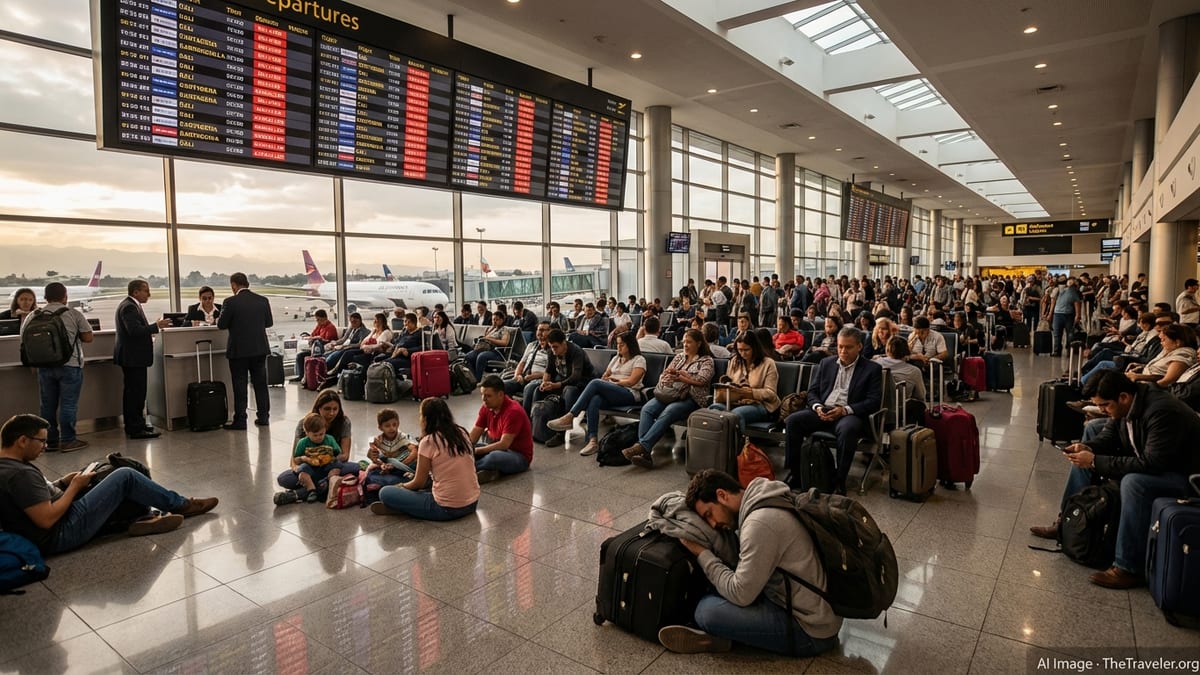
Airport terminals in Bogotá and Cali saw swelling crowds around customer service counters by midmorning as passengers tried to secure seats on later departures. In coastal cities, travelers bound for resort destinations and cruise connections reported long waits with limited information, underscoring how quickly operational strain at a few airports can disrupt complex regional travel plans across the Americas.
Airlines From Full-Service Giants to Low-Cost Carriers Affected
Avianca, Colombia’s largest carrier, bore a significant share of the disruption, reflecting its dominant role on domestic trunk routes linking Bogotá with Cali, Cartagena and Barranquilla, as well as its extensive international network. Several of the cancellations and many of the delays involved Avianca-operated flights or codeshares, according to schedule data reviewed from flight-monitoring platforms and airline status pages.
LATAM Airlines Colombia also reported multiple delayed departures on routes connecting Bogotá, Cali and coastal cities. These delays were particularly troublesome for passengers traveling on multi-leg itineraries through LATAM’s broader South American network, where tight connection windows in regional hubs left little room for schedule slippage.
International airlines were not spared. Spirit Airlines, which operates high-demand low-cost services between Colombian cities and the United States, faced notable delays on routes linking Bogotá and Cartagena to Florida gateways, complicating onward connections for budget-conscious travelers. Air Canada, which links Bogotá with Canadian hubs, saw delayed departures ripple into late arrivals in North America, disrupting both leisure and business travel at the tail end of the week.
Smaller regional and charter operators, often relying on shared ground handling and limited spare aircraft, struggled to restore normal operations once the disruption took hold. With crews and aircraft out of position, some carriers opted for tactical cancellations to protect the rest of their schedules, a move that mitigated further knock-on effects but left affected passengers with fewer immediate alternatives.
Operational Strain and Weather Combine to Snarl Schedules
Airline and airport sources pointed to a mix of operational strain and localized weather challenges as key drivers of the disruption. Morning low clouds and reduced visibility around Bogotá contributed to flow-control measures that slowed departures and arrivals into El Dorado, Colombia’s busiest airport. Even relatively short restrictions can force airlines to reshuffle takeoff slots, pushing early flights into later time bands and compressing already tight rotations.
In coastal cities such as Cartagena and Barranquilla, intermittent showers and gusty winds complicated ground operations, occasionally slowing boarding and aircraft turnaround times. While these conditions were well within normal safety parameters, they added friction to an already tight operational picture, especially for carriers running multiple short-haul sectors with the same aircraft.
Industry analysts noted that Colombia’s air traffic system has been operating near peak capacity on several domestic corridors, leaving limited resilience when disruptions occur. When a single aircraft on a Bogotá to Cali rotation departs late, subsequent legs to Cartagena or Barranquilla can easily be pushed back, leading to rolling delays throughout the day. With many passengers relying on these flights to connect to long-haul services, the margin for error is slim.
Compounding those pressures are broader global challenges facing airlines, including crew shortages in specialized roles, limited spare aircraft and the lingering effects of previous capacity cuts. These structural issues mean that what might once have been a modest operational hiccup can now trigger widespread knock-on effects across entire networks.
Passengers Stranded, Rebooked and Forced to Reroute
For travelers on the ground, the statistics translated into hours of uncertainty. At Bogotá and Cali, long queues formed at airline counters as travelers sought rebooking options or hotel vouchers. Some passengers reported being rebooked on flights departing the following day, while others were offered seats on circuitous routings through secondary hubs in Central America or the Caribbean.
Families heading to Colombia’s Caribbean resorts from interior cities faced particularly difficult choices. With limited same-day availability on coastal routes after the initial wave of cancellations, some opted to reroute through alternative airports or even shift travel to long-distance buses, adding many hours to journeys that would normally take less than two hours by air.
Business travelers and those on tight itineraries reported scrambling to adjust schedules, cancel meetings or shift to virtual participation. For passengers connecting from Spirit and Air Canada services onto domestic flights, the delays meant unexpected overnight stays in Bogotá, often arranged at short notice and at personal expense when weather and operational issues were classified as outside airline control.
Social media posts from frustrated travelers showed crowded departure halls, improvised sleeping arrangements on terminal benches and departure boards peppered with delayed status updates. While some praised frontline staff for their efforts under pressure, others criticized what they saw as slow communication and a lack of clear alternatives when flights slipped further behind schedule.
Impact on Tourism, Business Travel and Regional Connectivity
The timing of the disruption is especially sensitive for Colombia’s tourism sector, which relies heavily on smooth air links between major cities and resort destinations such as Cartagena and the wider Caribbean coast. Hoteliers and tour operators in Cartagena and Barranquilla reported last-minute cancellations and late arrivals that complicated transfers and excursion schedules.
For business hubs like Bogotá and Cali, the delays disrupted regional corporate travel at a time when companies are leaning on in-person meetings to cement deals and partnerships. Canceled or delayed flights between Bogotá, Cali and secondary cities such as Popayán can derail tightly choreographed itineraries that involve multiple site visits in a single day.
Regional connectivity was also affected. Popayán, a smaller city reliant on a handful of daily links to Bogotá and Cali, saw its options squeezed when delays and cancellations hit those core routes. Travelers from the southwestern Cauca region trying to connect to international flights through Bogotá found themselves with fewer viable same-day combinations, raising the risk of missed long-haul departures and additional costs to rebook.
Analysts warn that recurring episodes of disruption risk undermining confidence in air travel reliability on key Colombian routes, particularly for high-yield business passengers and international visitors evaluating itineraries that include multiple domestic hops. Even when total cancellations are limited, repeated days of significant delays can influence traveler behavior and push demand toward more resilient itineraries or competing destinations.
How Airlines and Airports Responded on the Day
Airlines moved quickly to adjust their operations once the scale of the disruption became apparent. Avianca and LATAM Colombia activated schedule recovery measures, including swapping aircraft between routes, consolidating lightly booked services and prioritizing flights with high numbers of connecting passengers. In some cases, carriers extended crew duty times within regulatory limits to complete critical sectors, while others brought in reserve crews to operate late-evening departures.
At the same time, airport operators in Bogotá, Cali, Cartagena and Barranquilla coordinated with air traffic control to smooth departure flows where possible, aiming to maximize runway utilization during windows of favorable weather. Additional staff were deployed in terminals to manage queues and assist passengers with rebooking, although demand for assistance exceeded available capacity during the peak of the disruption.
Digital channels, including mobile apps and text alerts, played an important role in communicating new departure times and gate changes. Some passengers reported receiving timely notifications that allowed them to delay their arrival at the airport or adjust ground transportation, while others said updates lagged behind what was displayed on terminal screens, adding to confusion.
By late evening, operations had begun to stabilize at most affected airports, although some flights continued to depart behind schedule as airlines worked through aircraft and crew repositioning. The full impact of the day’s irregular operations is expected to be felt into the following morning, as networks absorb out-of-position aircraft and crews and attempt to return to normal timetables.
What Travelers Can Do When Disruption Hits
The events in Bogotá, Popayán, Cali, Cartagena and Barranquilla underscore how quickly air travel plans can unravel when a combination of weather and operational constraints converge. Travel experts recommend that passengers build extra buffer time into itineraries involving domestic connections within Colombia, particularly when same-day links feed into long-haul departures to North America or Europe.
Booking through-tickets on a single carrier or alliance can provide greater protection when disruption strikes, since airlines are generally more willing to rebook and reroute passengers whose entire journey is on one booking reference. Travelers on separate tickets, such as low-cost domestic segments connecting to international flights, may find themselves with less formal protection and higher costs if they miss onward departures.
Passengers are also advised to monitor flight status closely in the 24 hours before departure, using both airline apps and airport information feeds. Early signs of widespread delay, such as multiple flights from the same hub shifting to later departure times, can signal a developing disruption and help travelers make proactive decisions about rebooking or adjusting plans.
Finally, comprehensive travel insurance that covers missed connections, overnight accommodation and additional transport costs can soften the financial blow when irregular operations strike. While policies vary in their coverage of weather-related and operational delays, travelers who frequently transit busy hubs like Bogotá or rely on multi-leg domestic itineraries may find such protection increasingly valuable amid a volatile operating environment.