

Hundreds of air travelers were left stranded or severely delayed on Tuesday as a fresh wave of disruptions involving Scandinavian Airlines (SAS), Pegasus Airlines and Air France rippled through major European gateways from Stockholm and Helsinki to Istanbul, Paris, Venice and Prague, compounding a broader pattern of operational strain across the continent’s skies this February.
Patchy Operations Add Fresh Turmoil to Europe’s Busy Winter Travel Season
Flight tracking data and airport reports for February 16 and 17 indicate that European air travel is experiencing another bout of turbulence, with thousands of delays and dozens of cancellations affecting key hubs including Stockholm Arlanda, Paris Charles de Gaulle, Istanbul’s airports, Helsinki, Venice and Prague. Within that wider disruption, services operated by Scandinavian Airlines, Pegasus Airlines and Air France have faced a particularly uneven operating environment, leading to at least half a dozen flight cancellations and around 180 delays across their short and medium haul networks.
The figures form part of a broader pattern rather than a single, isolated incident. Data compiled from airport authorities and independent trackers show more than 2,000 delays logged across 14 major European airports on February 16 and 17 alone, with carriers from low cost to legacy all affected to varying degrees. While not all of those delays are tied to the three airlines at the center of Tuesday’s worst bottlenecks, passengers booked on SAS, Pegasus and Air France services to and from Turkey, France, Italy, Sweden and neighboring countries bore a disproportionate share of the disruption.
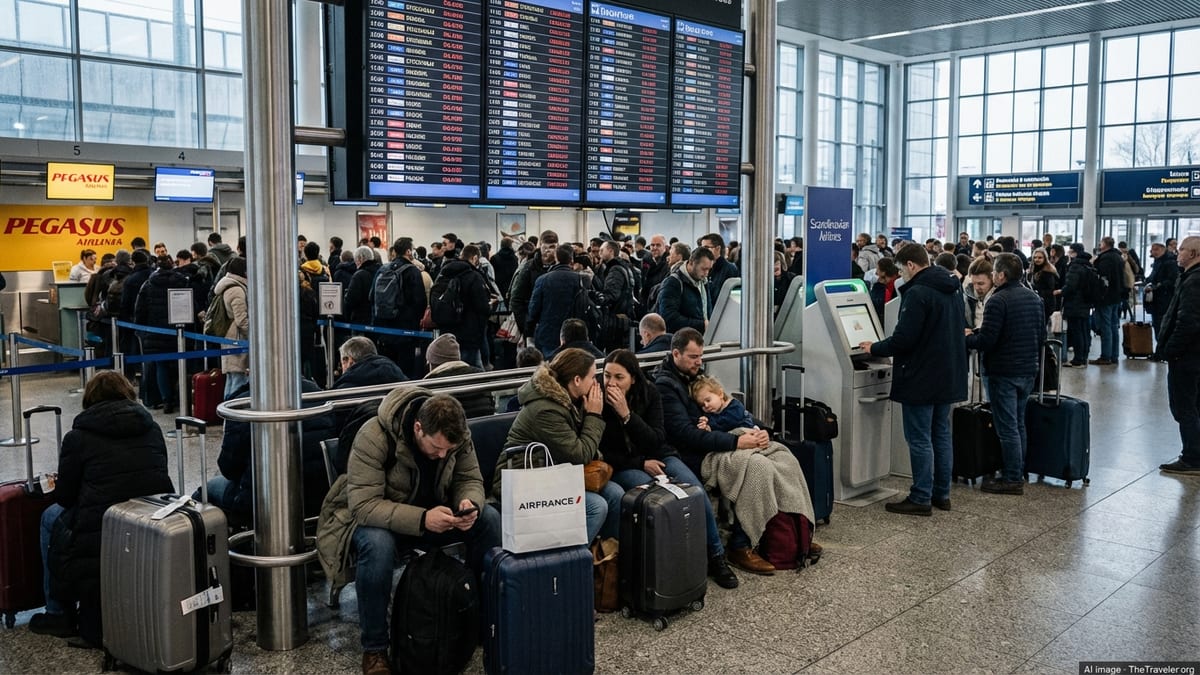
For many travelers, the result has been a familiar but still deeply unwelcome experience: departure boards filling with flashing red notifications, queues growing at service desks and makeshift sleeping areas forming in gate zones. As airlines worked through the afternoon and evening to reposition aircraft and reassign crews, heavily delayed services continued to arrive well into the night, leaving some passengers arriving at their destination hours later than planned and others still waiting for rebooking options.
The disruptions hit at a time when winter schedules are already tight and several European carriers are operating near full capacity on popular city pairs, reducing flexibility to absorb sudden operational shocks. That scarcity of spare aircraft and crew has made it harder for airlines to recover quickly once delays begin to cascade across interconnected networks.
Scandinavian Airlines Disruptions Center on Stockholm, Helsinki and Prague
Scandinavian Airlines, which has been operating an intensive winter schedule linking Nordic capitals with cities across Europe, has seen pressure building around its Stockholm Arlanda and Copenhagen hubs since the start of February. Recent days have brought another round of irregular operations, with flights to and from Helsinki and Prague among those most affected. Passengers on multiple SAS departures reported rolling delays stretching into several hours, as aircraft arriving late from previous sectors pushed back the start of subsequent rotations.
The carrier has only just navigated public scrutiny following an unusual incident earlier in the month, when a flight from Stockholm to Málaga was forced to return to Sweden mid route after a rodent was suspected on board. While that event did not directly cause Tuesday’s irregularities, it underscored the operational fragility that can arise when a single aircraft is taken out of rotation for checks and inspections. With SAS operating a tightly planned fleet, the knock on impact of previous disruptions can linger for days.
Travelers flying from Prague and Helsinki on SAS services early this week reported instances of last minute schedule changes and rebookings as the airline sought to consolidate lightly loaded flights and free up capacity for heavily delayed services. Affected passengers described difficulty reaching agents via call centers or chat services during peak hours, as support teams struggled to keep pace with the volume of inquiries related to cancellations, rebookings and compensation rules under European passenger rights regulations.
By Tuesday afternoon, some of the most acute bottlenecks at SAS-managed check in counters had begun to ease as aircraft positioning stabilized, but residual delays continued to ripple across evening departures. Industry analysts noted that while SAS is far from alone in facing such issues this winter, its network concentration in Scandinavia and reliance on a relatively lean fleet leaves it particularly vulnerable when weather, technical issues or air traffic constraints collide.
Pegasus Airlines Feels Knock on Effects From Istanbul Congestion
In Turkey, Istanbul’s airports once again found themselves at the center of a regional disruption story. Recent data from regional aviation monitors highlighted that the Middle East and Eastern Mediterranean corridor, including Istanbul, has been grappling with heightened levels of delays and schedule changes as a succession of busy travel days strain airport infrastructure and air traffic control capacity. Pegasus Airlines, headquartered at Istanbul Sabiha Gökçen, has been one of the carriers navigating that turbulence.
On Tuesday, Pegasus flights serving European destinations including Stockholm, Paris and other secondary cities faced extended ground holds and departure delays, in part due to congestion building up in and out of Istanbul’s airspace at peak times. Even when meteorological conditions are stable, bottlenecks can quickly arise when multiple carriers attempt to push out banks of departures in narrow windows, forcing air traffic managers to meter traffic flows and leading to creeping delays across the board.
For passengers, the experience was one of uncertainty rather than outright cancellations. Many Pegasus departures operated, but often well behind schedule, with estimated departure times repeatedly revised on airport displays. Families connecting through Istanbul from Northern Europe to holiday destinations reported concerns about missed onward connections and overnight layovers. Some travelers who had already endured earlier delays on inbound flights found themselves stranded in Istanbul as their connection windows evaporated.
Pegasus has previously acknowledged the operational challenges associated with running a dense schedule from a busy base airport, particularly during peak holiday periods and in the shoulder seasons when crews and aircraft are rotated intensively to maximize utilization. The carrier has focused on quick turnarounds and high aircraft usage to remain competitive on ticket prices, leaving only limited slack when disruptions cascade through its network.
Air France Delays Spread From Paris to Venice and Beyond
In France, Air France has been managing its own share of irregular operations from its primary hub at Paris Charles de Gaulle, where recent days have seen elevated delay numbers relative to seasonal norms. Data compiled for February 16 and 17 placed Air France among the European carriers with the highest volume of delayed departures, reflecting a combination of local congestion, crew and aircraft rotations and knock on impacts from earlier disruptions.
One particularly visible incident in recent days involved a Paris to Beirut flight that was forced to declare an emergency and divert to Venice following smoke being detected in the cabin. The Airbus A330 involved landed safely in Italy and no injuries were reported, but the diversion removed an aircraft from its planned pattern and required rapid adjustments to crew and fleet assignments. While such safety first decisions are standard practice, they inevitably introduce operational complexity that can resonate across multiple routes in the following days.
At the same time, routine short haul services from Paris to Venice, Stockholm and other European cities have experienced a series of moderate delays as aircraft arrived late from previous legs or awaited new departure slots during congested afternoon waves. Routes such as the Paris to Venice connection, ordinarily operating on a narrow turnaround schedule, have been among those running behind schedule on multiple consecutive days.
Passengers holding Air France tickets on Tuesday reported wait times at customer service desks and busy phone lines as they sought confirmation of rebooked flights or clarification on missed connections. Many ultimately reached their destinations, but often several hours later than planned, with some travelers in Venice and other cities hustling to rearrange rail links, hotel check ins and onward ground transport at short notice.
Travelers Stranded and Stressed Across Stockholm, Istanbul, Paris and Venice
Across the affected cities, the human toll of the disruptions was visible in crowded terminal halls and improvised rest areas. At Stockholm Arlanda, lines snaked from SAS check in counters deep into the departure hall at various points during the day, as frustrated travelers queued to secure new boarding passes or request meal vouchers under European air passenger rules. Airport staff handed out information leaflets and directed passengers to rebooking kiosks, but many found digital channels lagging under peak demand.
In Istanbul, a city accustomed to heavy transit flows, the sight of passengers resting on their luggage in gate areas of Sabiha Gökçen Airport was a reminder of the region’s recent spate of delays. One group of travelers bound for Northern Europe described missing evening connections after their inbound Pegasus flight from the Gulf arrived hours late, leaving them searching for overnight accommodation and scrambling to update employers and relatives about changed arrival times.
In Paris and Venice, the atmosphere was slightly calmer but still tense, with Air France customers watching departure screens flicker between new departure times and gate changes. At Venice Marco Polo Airport, the diversion of long haul traffic and the accumulation of delayed short haul arrivals led to a congested apron during peak daylight hours, complicating ground handling operations and adding incremental minutes to turnarounds.
For holidaymakers as well as business travelers, the immediate concerns were pragmatic: making it to meetings or events on time, salvaging prepaid hotel nights and excursions, and finding food and rest in terminals ill suited for extended stays. Social media posts from stranded passengers captured a mix of frustration and resignation, as many acknowledged that airlines were grappling with genuine operational constraints even as they voiced concerns about communication lapses.
Causes Range From Aircraft Availability to Airspace Congestion
Aviation analysts caution against attributing the week’s disruption to any single cause, pointing instead to an accumulation of stresses on the European air transport system. After several years of demand swings linked to external shocks, airlines have built schedules that push aircraft utilization and crew productivity close to practical limits. In such an environment, any unplanned removal of an aircraft from service, whether due to a technical issue, an onboard incident or a diversion for safety reasons, can ripple through multiple rotations.
Airspace congestion is another significant factor. The European network manager and national air navigation service providers have been open about the challenges of managing heavy traffic volumes over busy corridors connecting Northern Europe, Central Europe and the Eastern Mediterranean. When weather, staffing or military airspace restrictions reduce available capacity even slightly, air traffic control units must introduce flow management measures that slow departures and extend routings, immediately lengthening block times and fueling delays.
For airlines like SAS, Pegasus and Air France, whose networks heavily intersect over these traffic hotspots, the impact can be disproportionate. Each relies on tightly timed departure and arrival banks to feed connecting passengers through hubs such as Stockholm, Istanbul and Paris. Once a bank is disrupted, knock on effects make it harder to protect onward connections, leading to more missed flights, rebookings and, in some cases, cancellations of lightly loaded sectors to free up aircraft.
Operational resilience measures, including strategic spare aircraft and reserve crew, can mitigate some of these pressures but are costly to maintain. In the current competitive environment, many carriers have opted for leaner resilience in favor of keeping fares attractive, which leaves limited buffer when multiple challenges coincide across regions, as appears to have happened this week.
Airports and Airlines Scramble to Restore Normal Schedules
By late Tuesday, airlines and airports were focused on restoring stability to their schedules before the next wave of peak travel days later in the week. Operations control centers at SAS, Pegasus and Air France were tasked with rebalancing fleets, identifying sectors where aircraft swaps were possible and prioritizing flights with high numbers of connecting passengers or limited alternative transport options.
At Stockholm, airport operations teams worked closely with ground handlers to speed turnarounds for delayed aircraft, reallocating gate positions and ramp equipment to avoid further bottlenecks. In Istanbul, air traffic managers adjusted departure sequences to clear accumulated backlogs, while emphasizing safety margins in busy approach and departure corridors. In Paris and Venice, efforts focused on smoothing the afternoon and evening waves of departures to avoid overnight stranding of passengers wherever possible.
Despite those efforts, aviation experts warned that residual delays would likely persist into Wednesday on some routes, particularly where rotations involve aircraft that had already accrued several hours of lateness earlier in the week. Passengers on future SAS, Pegasus and Air France flights were advised to monitor their flight status closely and allow extra time for connections, especially at hub airports.
Some carriers have quietly trimmed frequencies or retimed select services in recent weeks to build in slightly more buffer to flight schedules, acknowledging that a modest reduction in capacity may be preferable to recurring episodes of severe disruption. However, any such adjustments take time to filter through reservation systems and may not bring immediate relief to travelers booked on near term departures.
What Passengers Can Do When Delays and Cancellations Hit
For travelers caught up in Tuesday’s turmoil, the immediate priority has been finding a path to their destination or returning home. Consumer advocates recommend that passengers first use official airline apps and websites, which often update rebooking options more quickly than airport desks can process long queues. Many airlines, including SAS, Pegasus and Air France, will automatically rebook travelers on the next available service when a flight is canceled, although those solutions may not always match passengers’ preferred times or routings.
Under European passenger rights regulations, those flying from or within the European Union generally have clear entitlements to assistance and, in some circumstances, financial compensation when flights are significantly delayed or canceled for reasons within the airline’s control. That support can include meals, hotel accommodation for overnight delays, and the option of a refund or re routing. However, the rules are complex and depend on factors such as notice periods, length of delay and cause of the disruption, which can lead to confusion and disputes.
Experts advise travelers to keep all boarding passes and receipts for expenses incurred during a disruption, document the timeline of delays and any communications received from the airline, and submit claims promptly through official channels once their journey is complete. In more complex cases, particularly when carriers dispute liability or responsibility across codeshare partners, specialized claims services may assist passengers in asserting their rights.
Looking ahead, seasoned travelers say a few practical steps can reduce exposure to disruption, even if they cannot eliminate it entirely. Booking longer connection windows at congested hubs, traveling with carry on luggage where possible, and scheduling critical events at least a day after planned arrival can all provide valuable margin when the European air travel system encounters turbulence such as that seen this week.