

More news on this day
Hundreds of passengers were left stranded across Northern and Western Europe today after SAS, Lufthansa, German Airways and Scandinavian Airlines Ireland canceled 17 flights and delayed 149 more, disrupting tightly linked route networks serving Oslo, Stockholm, Amsterdam, Barcelona, Brussels and several other major hubs.
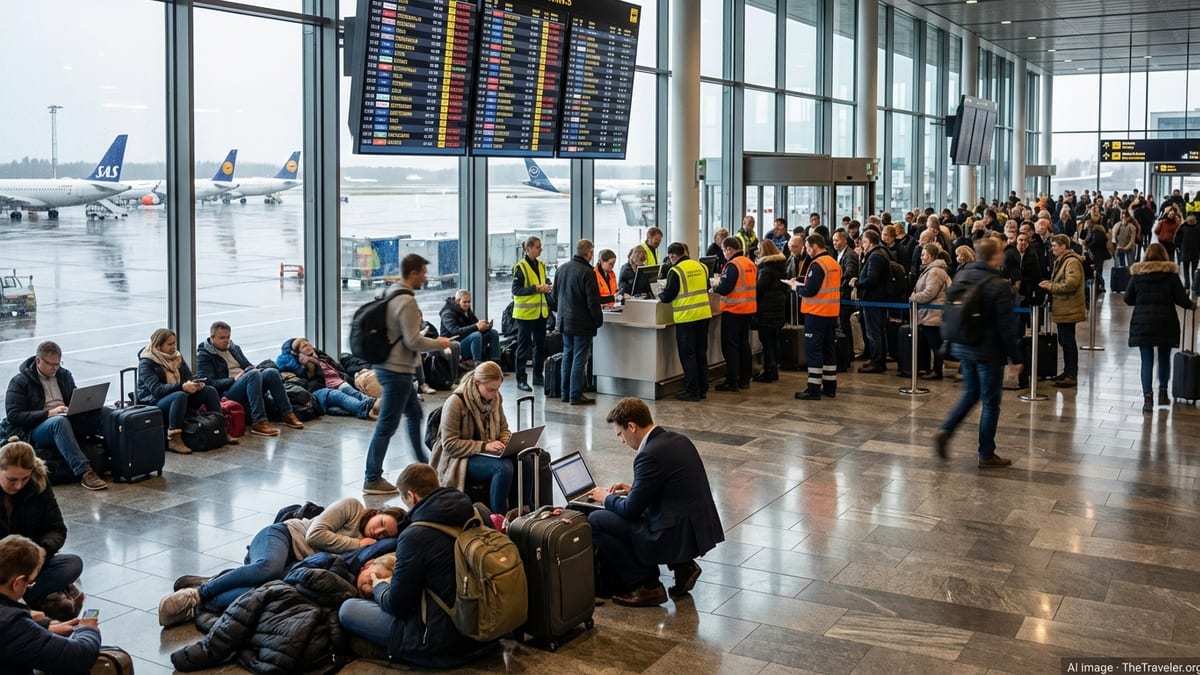
Widespread Disruptions From Scandinavia to Southern Europe
The latest wave of cancellations and delays hit some of Europe’s busiest short-haul corridors, with airports in Norway, Sweden, the Netherlands, Spain and Belgium reporting clusters of grounded or heavily delayed departures. Operational problems at SAS and its Irish subsidiary, together with schedule disruptions at Lufthansa and German Airways, rippled through shared codeshare and feeder services, leaving passengers in limbo at multiple airports.
Oslo Gardermoen and Stockholm Arlanda were among the hardest-hit Nordic hubs, where travelers reported long queues at rebooking desks and mounting delays on departures to other European capitals. Further south, Amsterdam Schiphol, Brussels and Barcelona El Prat all saw knock-on effects as aircraft and crews failed to arrive on time from Scandinavia and Germany.
Airline data for the day showed 17 outright cancellations linked to the four carriers and 149 flights experiencing significant delays, typically defined as departures running at least 30 minutes behind schedule. Although this represented only a fraction of total daily movements, the concentration of disruptions on high-frequency routes magnified the impact on passengers with onward connections.
Key Routes and Airports Most Affected
At Oslo Gardermoen, SAS and Scandinavian Airlines Ireland grounded several intra-Nordic services, affecting flights to Copenhagen, Stockholm and smaller Norwegian cities that depend heavily on hub connections. Travelers trying to reach continental Europe from Norway faced missed links in Copenhagen and Amsterdam, forcing many to rebook for later in the day or even the following morning.
Stockholm Arlanda saw a similar pattern as regional departures to destinations in Norway, Denmark and northern Germany were delayed or canceled. For passengers booked on Lufthansa and German Airways services from Stockholm via Frankfurt, Munich or Düsseldorf, disruptions on feeder legs translated into missed long-haul and European connections.
Amsterdam Schiphol and Brussels Airport, both vital nodes for business and leisure traffic, felt the combined strain of delayed arrivals from Scandinavia and Germany. As late inbound aircraft rotated onto new routes, departure boards filled with mounting delays on services to Spain, France and other parts of Western Europe. In Barcelona, disruptions were acutely felt on northbound services that rely on aircraft originating from northern Europe, adding to congestion during already busy afternoon departure waves.
Passengers Face Long Queues, Confusion and Missed Connections
For travelers on the ground, the operational statistics translated into hours of uncertainty. In Oslo, queues snaked through terminal check-in halls as SAS ground staff tried to accommodate passengers whose flights had been canceled. Some were offered rerouting via alternate hubs such as Copenhagen or Frankfurt, while others were placed on later evening services with limited remaining seats.
In Stockholm and Amsterdam, passengers reported difficulty obtaining up-to-date information as rolling delays were extended in 30-minute increments. For those with tight onward connections, particularly to long-haul flights, the shifting departure times created a dilemma over whether to wait at the original gate or attempt to rebook preemptively.
Families returning from winter holidays in Spain and business travelers heading to meetings in Brussels and the Dutch capital were among those most affected. In Barcelona, several passengers found themselves stuck landside as check-in counters closed when flights were finally canceled, forcing them to queue again for rebooking and accommodation assistance in already crowded terminals.
Operational Pressures Behind the Cancellations
While airlines did not immediately provide a single overarching cause, aviation analysts pointed to a familiar mix of pressures that have repeatedly strained European operations this winter. Seasonal weather systems have created fragile schedules, where minor delays in one region can quickly cascade through interconnected networks serving multiple countries.
For carriers such as SAS and its Irish operating unit, which run dense regional patterns linking secondary cities to hubs like Oslo, Stockholm and Copenhagen, even small disruptions can push crews and aircraft out of position. When combined with tighter post-pandemic staffing levels and aircraft utilization, operators often have little spare capacity to recover quickly, making cancellations more likely as the day progresses.
Lufthansa and German Airways, both key players in feeding traffic into major German hubs, also face similar structural constraints. Their role in multi-leg itineraries across the continent means any single cancellation can strand passengers not just at origin points such as Oslo or Brussels, but also at connecting airports where onward capacity may already be close to full.
Impact on Tourism, Business Travel and Local Economies
The disruptions arrived at a sensitive moment for tourism and business travel in Northern and Western Europe. Cities such as Oslo, Stockholm and Amsterdam are in the midst of a busy period for winter city breaks and conferences, while Barcelona and Brussels continue to attract steady flows of short-break visitors and corporate travelers.
Tour operators reported frustrated clients whose carefully timed itineraries were thrown off by missed arrivals. In Barcelona, some inbound groups from Scandinavia and Germany were forced to shorten their stays after arriving a full day later than planned. In Brussels, delegates en route to EU-related meetings and corporate events scrambled to join sessions remotely when they could not secure timely rebooking.
Local businesses, from airport hotels to restaurants and ground transport providers, experienced a mixed impact. While airport hotels near hubs such as Oslo, Amsterdam and Brussels reported a spike in last-minute bookings from stranded travelers, downtown properties and attractions in destination cities faced lost revenue from shortened or canceled visits.
Airlines’ Response: Rebooking, Vouchers and Limited Compensation
In response to the disruption, SAS, Lufthansa, German Airways and Scandinavian Airlines Ireland deployed additional staff at key airports to manage rebooking queues and customer queries. Passengers whose flights were canceled were generally offered alternative departures later in the day or on the following day, subject to seat availability on remaining services.
Some travelers reported being provided with meal vouchers and, in cases where overnight stays became unavoidable, hotel accommodation and ground transport support. However, other passengers said they were directed primarily to self-service digital tools and mobile apps during peak disruption periods, leading to further frustration when systems slowed under heavy demand.
Under European air passenger rights rules, travelers whose flights are canceled or severely delayed may be entitled to compensation, depending on the cause and circumstances of the disruption. Many passengers at Oslo, Stockholm and Amsterdam said they were advised by airline staff to file claims once their journeys were complete, a process that can take days or weeks to resolve.
Strain on Airport Operations and Ground Services
The ripple effects extended beyond the airlines themselves to airport operators and ground-handling companies. At Oslo and Stockholm, late-notice schedule changes required rapid reallocation of gates and stands, with aircraft sometimes parked at remote positions and passengers bused to and from terminals, adding to turnaround times.
In Amsterdam, Brussels and Barcelona, already-busy security and border control lanes came under added pressure as departure times shifted and waves of passengers converged on new boarding times. Ground handlers reported stretched staff resources as they juggled late baggage loading, de-icing requirements in northern hubs and sudden gate changes across multiple carriers.
Airport authorities in several of the affected countries reiterated calls for travelers to arrive early, keep a close eye on departure boards and airline notifications, and be prepared for last-minute changes throughout the day as operations gradually normalized.
Outlook for Travelers in the Coming Days
Although the 17 cancellations and 149 delays recorded today were expected to ease as operations stabilized overnight, residual effects may linger into subsequent rotations. Aircraft and crew scheduled for early-morning departures from Oslo, Stockholm or Amsterdam may still be out of their optimal positions, requiring minor timetable adjustments and potential gate changes.
Travel advisers recommended that passengers flying with SAS, Lufthansa, German Airways and Scandinavian Airlines Ireland in the coming days build in additional buffer time for connections, particularly when transiting through major hubs in Norway, Sweden, the Netherlands, Spain and Belgium. Checking flight status frequently and confirming boarding gates shortly before departure were also emphasized as practical steps to reduce stress.
Industry observers noted that the latest disruption underscores the continued fragility of Europe’s aviation system during the winter season, when weather, tight staffing and complex scheduling can intersect. For travelers, the events in Oslo, Stockholm, Amsterdam, Barcelona and Brussels served as another reminder that even on seemingly routine short-haul routes, contingency planning and flexibility remain essential parts of modern air travel.