

More news on this day
Hundreds of passengers were left stranded across Türkiye on Thursday as a wave of disruption swept through Istanbul, Antalya and Ankara, delaying 253 flights and forcing 26 cancellations that hit carriers from Pegasus Airlines and SunExpress to Lufthansa and Qatar Airways.
Get the latest news straight to your inbox!
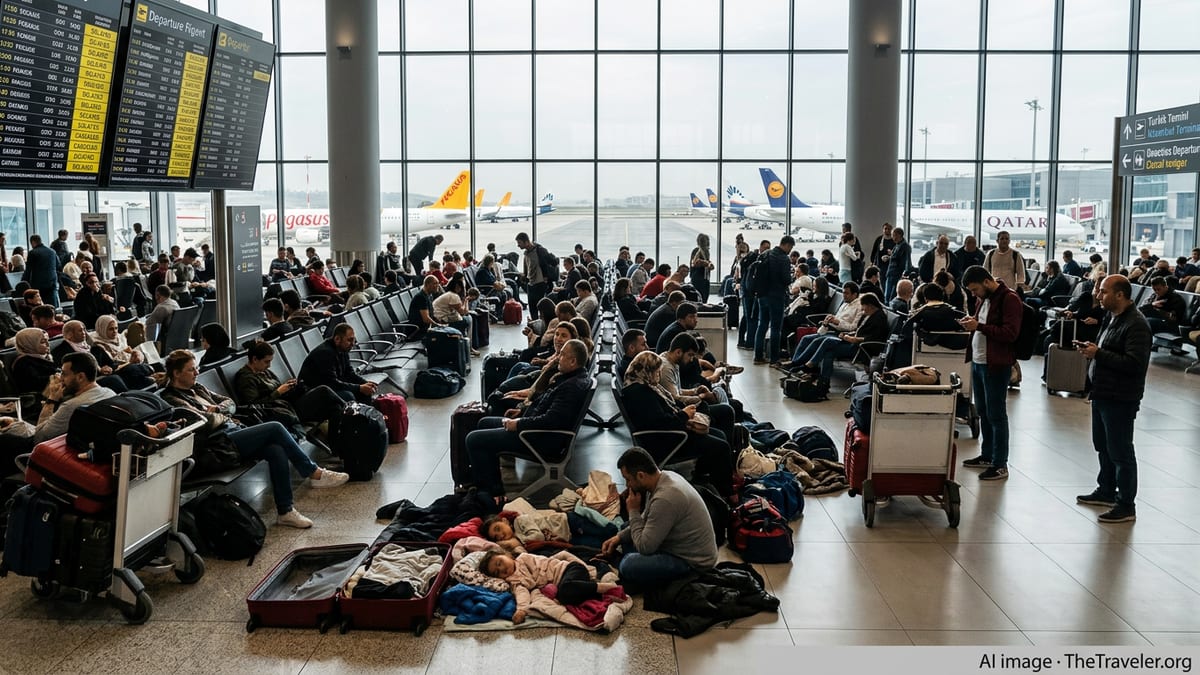
Major Turkish Hubs Grapple With a New Day of Disruption
Airports in Istanbul, Antalya and Ankara reported one of their most challenging operating days of the season as tight schedules collided with regional airspace constraints and knock-on delays from earlier in the week. The disruption was most visible on crowded departure boards at Istanbul Airport and Sabiha Gökçen, where rows of delayed flights built up from the early morning peak and continued into the afternoon.
Operational data reviewed by aviation analysts showed 253 flights delayed and 26 outright cancellations across the three major hubs, affecting both domestic services and international routes that connect Türkiye to Europe, the Middle East and Asia. While the majority of services eventually departed, many passengers missed onward connections or faced long waits for rebooking.
The latest turmoil comes as airlines across the wider region are already contending with rolling cancellations and complex reroutings tied to airspace closures over parts of the Middle East. For Turkish hubs that market themselves as flexible, high-capacity connectors between continents, the margin for error has narrowed considerably.
Airport authorities in Istanbul and Antalya said ground teams were working with carriers to recover schedules but warned that residual delays could persist into the night bank of departures as displaced aircraft and crews gradually return to position.
Pegasus, Lufthansa, SunExpress and Qatar Airways Among Hardest Hit
The disruption cut across the full spectrum of airlines using Turkish hubs, from low cost to full service, but several carriers stood out in terms of passenger impact. Istanbul based Pegasus Airlines, which has a dense network of short and medium haul routes from Sabiha Gökçen and Antalya, suffered clusters of late departures as turnaround times stretched and aircraft arriving late from previous legs struggled to regain schedule.
Germany’s Lufthansa, which relies on Istanbul and Antalya for a mix of leisure and connecting traffic into its Frankfurt and Munich hubs, reported a handful of cancellations alongside lengthy delays on some core European routes. For passengers, that translated into missed transatlantic connections and extended overnight stays in both Türkiye and Germany while alternative routings were arranged.
SunExpress, the Antalya headquartered joint venture between Turkish Airlines and Lufthansa, also faced mounting delays on key tourist routes linking the Turkish Riviera with German, Swiss and Austrian cities. Seasonal leisure services are particularly vulnerable when rotations are compressed, and today’s pattern of late arriving aircraft had a cascading effect on afternoon returns to Europe.
Qatar Airways, which typically operates multiple daily flights between Doha and Istanbul as part of its global hub strategy, saw its services from Türkiye pushed back amid the broader regional congestion. Even modest delays at departure can create tight connection windows at its Gulf hub, and passengers reported being rebooked onto later long haul flights as Doha arrival times slipped beyond minimum connecting thresholds.
Passengers Face Long Queues, Missed Connections and Overnight Stays
For travelers on the ground, the statistics translated into hours spent in terminal queues, crowded boarding areas and impromptu overnight stays. At Istanbul Airport, lines stretched in front of airline transfer desks as passengers sought new itineraries after missed connections to cities in Europe, the Gulf and Southeast Asia.
Families returning from winter sun breaks in Antalya and business travelers shuttling between Ankara and European capitals described a familiar pattern: initial short delays announced in 30 minute increments, followed by rolling updates that ultimately pushed departure times back by several hours. In some cases, evening flights were eventually scrubbed altogether as crew duty limits were reached.
Hotels near the airports filled quickly as airlines arranged accommodation for eligible passengers whose flights were canceled or who faced particularly long rebooking windows. Others opted to remain in the terminals, stretched out on benches and floor space in quieter corners while waiting for early morning departures.
Travel agencies reported a spike in calls from stranded customers looking for alternative routings that bypassed the most affected hubs. However, with surrounding European and Middle Eastern airports also managing residual disruption, options to rebook via third countries were limited and often came at a premium.
Operational Pressures and Regional Airspace Constraints Collide
Aviation experts point to a layered mix of causes behind today’s problems, combining local operational pressures with wider regional challenges. High aircraft utilization rates across Turkish carriers mean that even minor technical issues or late inbound flights can quickly ripple across multiple rotations. When hubs are operating near capacity, finding spare gates, crews and aircraft to plug gaps becomes increasingly difficult.
At the same time, ongoing airspace restrictions and rerouting around parts of the Middle East have extended flight times on certain corridors linking Türkiye with the Gulf and South Asia. Even a modest increase in block times can push aircraft and crews closer to regulatory limits, leaving less slack in the system when unexpected ground delays, weather or technical checks arise.
For international carriers such as Lufthansa and Qatar Airways, Turkish airports are part of multi‑leg itineraries that depend on precise timing at several hubs. A delay in Istanbul or Antalya does not only affect local passengers; it can also cascade into missed onward services in Frankfurt, Munich or Doha, putting additional strain on already crowded networks and customer service operations.
Industry analysts warn that these structural pressures will continue to test the resilience of Türkiye’s aviation system, particularly during peak holiday periods and in the event of further regional volatility that constrains airspace options or drives sudden shifts in demand.
What Travelers Through Türkiye Should Expect in the Coming Days
With aircraft and crews still out of position, airlines operating through Istanbul, Antalya and Ankara are expected to run slightly padded schedules in the short term as they work to restore regularity. That could mean longer planned connection times, modest schedule changes and, in some cases, further tactical cancellations of lower demand frequencies to protect core routes.
Passengers booked to travel via Turkish hubs in the next several days are being advised by carriers and travel agents to monitor flight status closely, make use of airline mobile apps for real time updates and, where possible, allow additional buffer time for connections. Those on complex itineraries involving multiple airlines or self‑connected tickets may face the greatest vulnerability if early‑stage segments run late.
Consumer advocates note that travelers whose flights are significantly delayed or canceled should retain boarding passes, booking confirmations and receipts for essential expenses such as meals and accommodation, which may be required when seeking reimbursement or compensation under applicable passenger rights frameworks.
While today’s disruptions underscore the strain on Türkiye’s role as a fast growing crossroads between Europe, Asia and the Middle East, industry sources stress that the country’s main airports and airlines have become adept at recovery operations. For stranded passengers, however, the experience remains a stark reminder of how quickly tightly tuned global flight networks can unravel when local congestion meets regional uncertainty.