

More news on this day
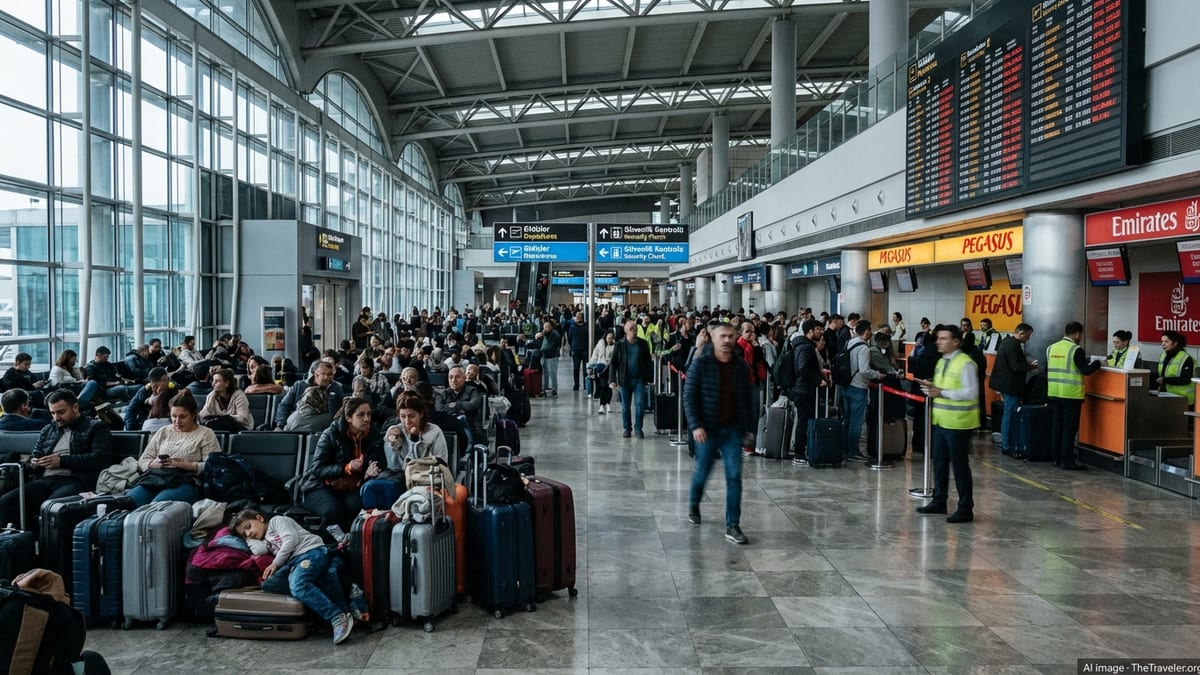
Hundreds of passengers were left stranded at airports across Turkey today as Istanbul, Antalya and Ankara recorded 82 cancellations and 184 delays, disrupting operations for carriers including Pegasus Airlines, SunExpress, Emirates and Qatar Airways amid widening airspace closures linked to escalating tensions in the Middle East.
Turkey’s Hubs Reel From Regional Airspace Shutdown
The disruption unfolded on March 1 as Turkey’s key aviation gateways found themselves on the edge of a fast-moving regional crisis. With multiple Middle Eastern countries, including Iran, Iraq and several Gulf states, closing portions of their airspace after overnight strikes on Iran, airlines were forced to reroute or suspend services, rippling into Turkish schedules.
While Istanbul’s two major airports typically act as diversions and overflight alternatives during regional upheaval, the sheer volume of detours and last-minute operational changes created knock-on delays. Additional congestion at control points and rerouted traffic flows through Turkish airspace contributed to a mounting backlog of aircraft movements.
By late afternoon, flight-tracking and aviation data showed 82 services to and from Istanbul, Antalya and Ankara cancelled, with a further 184 delayed, affecting both domestic links and international connections to Europe, the Gulf and Asia. Passengers reported long queues at service desks and scarce information as carriers scrambled to rework schedules in real time.
The cancellations and delays in Turkey formed part of a much wider pattern of regional aviation disruption, with thousands of flights across the Middle East and Asia either scrubbed or severely delayed as airlines sought to avoid closed or high-risk airspace.
Major Airlines From Pegasus To Emirates Forced To Cut Services
Turkey-based low cost carrier Pegasus Airlines, which operates a dense domestic network feeding Istanbul Sabiha Gökçen from cities such as Ankara and Antalya, was among the hardest hit by Saturday’s turmoil. The airline had already been cancelling services to Gulf and South Asian destinations after safety concerns prompted a wave of regional airspace restrictions, and the latest closures further constrained its operations.
SunExpress, the joint venture between Turkish Airlines and Lufthansa that focuses heavily on leisure routes into Antalya and Izmir, also saw selected departures scrubbed or delayed, particularly services connecting German and other European cities with Turkey’s Mediterranean coast. At Antalya Airport, screens showed clusters of delayed departures to holiday markets that rely heavily on high aircraft utilization and tight turnaround times.
Global long haul carriers that rely on the Middle East as a connective bridge between continents were not spared either. Emirates and Qatar Airways, both of which link Turkish cities to their Dubai and Doha hubs, had to trim or retime services as their home bases contended with suspended operations and airspace closures around the Gulf. Passengers in Istanbul and Ankara heading for onward connections to Asia and Africa were among those most affected.
Other carriers, including regional operators and European airlines using Turkey for both point to point and connecting traffic, also faced significant operational headaches. Some opted to cancel services outright rather than operate extended and fuel intensive detours around restricted airspace, while others attempted to preserve schedules by swapping aircraft and crews at short notice.
Passengers Face Long Queues, Confusion And Limited Options
For travellers on the ground, the statistics translated into a day of uncertainty and frustration. At Istanbul’s airports, passengers described scenes of crowded departure halls and ad hoc lines forming around airline counters, with many waiting hours for rebooking or hotel vouchers as staff tried to digest rapidly changing flight plans.
In Antalya, where many visitors were either completing winter sun holidays or arriving for early spring breaks, stranded tourists clustered around information boards and customer service points as package tour operators negotiated with airlines for alternative transport. Some travellers reported being offered rebookings several days later because of limited spare capacity across regional routes.
Ankara’s Esenboğa Airport, a key domestic and diplomatic gateway, saw a mix of delayed departures and cancellations on both domestic and international sectors. Passengers connecting to onward flights through Istanbul or Gulf hubs found itineraries unraveling as one missed connection cascaded into multiple rebookings. With many Middle Eastern hubs either temporarily closed or working through large backlogs, the usual fallback of rerouting via a different city was often unavailable.
Consumer groups in Turkey urged airlines to provide clear information about passenger rights, including entitlement to refunds, rebooking and care such as meals and accommodation. Travel agents recommended that affected passengers keep all receipts related to disrupted journeys to support later compensation claims where applicable under local and international regulations.
Tourism And Trade Brace For Ongoing Impact
The timing of the disruption could prove particularly painful for Turkey’s tourism sector, which has been counting on a strong 2026 season driven by pent up demand from European and Middle Eastern markets. Antalya, a flagship destination for package holidays, relies heavily on smooth air connectivity from Gulf carriers and low cost European airlines alike.
Industry analysts warned that if airspace restrictions and route suspensions persist for several days, tour operators might be forced to consolidate or cancel departures from key markets, denting arrivals in early spring. Hotels in coastal resorts and major cities such as Istanbul had already reported an uptick in bookings linked to regional transfer traffic via Turkish hubs, a trend that could be reversed if travellers perceive the region as unstable.
Beyond tourism, cargo and business travel were also hit. Freight carried in the bellies of passenger aircraft, including e commerce shipments and time sensitive industrial components, faced significant delays as airlines restructured networks. Companies in Europe and Asia that rely on just in time supply chains through Istanbul and Gulf hubs were warned to brace for delivery slippages and potential cost surcharges as carriers rerouted freight.
Turkish officials and industry representatives emphasized that the country’s airports and air navigation services remained open and operational, positioning Turkey as a potential stabilizing transit option once the most acute phase of the crisis passes. However, they acknowledged that as long as neighboring airspace remains constrained, Turkish carriers and airports will continue to experience spillover disruption.
Authorities And Airlines Monitor A Fluid Situation
Regulators and aviation authorities in Turkey spent much of the day in close contact with counterparts across the region and with international bodies as they monitored risk levels and the evolving airspace map. Operators were instructed to maintain heightened situational awareness and to avoid affected areas in line with international advisories.
Airlines said they expected further schedule adjustments into Sunday and potentially beyond, depending on how quickly airspace restrictions in Iran and neighboring states are eased. Some carriers were already planning extended routings around closed corridors, adding flight time and fuel burn but providing a path to resume at least partial operations.
Travel experts advised passengers due to fly to or via Turkey in the coming days to check flight status frequently, register contact details with their airline or travel agent, and allow extra time at the airport for security and check in. Flexibility, they noted, would be essential as departure times, routings and even destination airports might change at short notice.
As Saturday’s disruptions in Istanbul, Antalya and Ankara showed, events far beyond Turkey’s borders can reshape the country’s skies within hours, leaving passengers and airlines alike at the mercy of shifting geopolitical winds and rapidly redrawn aviation corridors.