

More news on this day
Travelers across the United States faced another day of serious disruption on March 12, as 207 flight delays and eight cancellations rippled through Harry Reid International Airport in Las Vegas, New York City, Chicago and other major hubs, leaving passengers stranded and airline operations stretched from Southwest and United to JetBlue and smaller regional carriers.
Get the latest news straight to your inbox!
Disruptions Mount From Las Vegas to New York
The latest wave of delays centered on Harry Reid International, one of the country’s busiest leisure gateways, where departure holds and rolling schedule changes quickly spilled into long lines at check-in counters and security lanes. Southwest, the airport’s largest carrier, reported dozens of delayed departures, with United and other airlines also forced to push back flights as they adjusted aircraft and crews already out of position from earlier disruptions.
In New York, congestion at both John F. Kennedy and LaGuardia compounded the national logjam. Airlines flagged a mix of tight airspace, residual weather and crew-availability issues for the growing list of delayed departures. JetBlue, which has a major presence at JFK and Boston Logan, saw its afternoon and evening schedules slowed, frustrating travelers on already packed transcontinental and Florida-bound routes.
Chicago’s O’Hare International, a key hub for United and a bellwether for the broader network, reported rising delay totals through the day as thunderstorms and low clouds to the west created a knock-on effect for arrivals and departures. As banked waves of connecting flights slipped behind schedule, passengers faced missed connections and unexpectedly long layovers, with rebooking desks quickly overwhelmed.
By early evening, flight-tracking services showed 207 delays and eight cancellations tied to the day’s disruptions across Las Vegas, New York, Chicago and other major US airports. While the numbers were modest compared with the worst days of winter, they were concentrated at critical hubs and on high-demand routes, magnifying the impact on travelers at the start of the spring break period.
Southwest, United and JetBlue Struggle to Keep Schedules Intact
Among individual airlines, Southwest again found itself under pressure at Harry Reid and other sunbelt airports. The carrier has been operating near full capacity into Las Vegas as visitor numbers remain strong, which leaves little buffer when air traffic control programs or weather trigger even short ground delays. Once one departure window is missed, aircraft and crews can end up out of sequence for the rest of the day.
United, which relies heavily on its Chicago and New York hubs to funnel domestic and international connections, was also forced to rebalance its network. Delays at O’Hare created inbound bottlenecks for flights bound to the East Coast and Mountain West, while schedule changes at New York forced some passengers to be rerouted through secondary hubs, adding hours to itineraries originally planned as simple nonstop journeys.
JetBlue, whose customer base is particularly sensitive to schedule reliability on business and leisure routes in the Northeast, reported clusters of delayed flights from JFK and Boston to Florida, the Caribbean and the West Coast. Even when flights ultimately operated, many departed well behind schedule, upending plans for cruisers, package holiday travelers and short-break visitors counting on tight connections.
Regional and contract carriers flying under major airline brands were also caught in the disruption, particularly on thinner routes linking smaller cities to hubs like Chicago and New York. On some of these flights, the eight recorded cancellations left entire planeloads of passengers with limited same-day alternatives, forcing overnight stays and last-minute hotel searches in already busy airport districts.
Passengers Face Long Lines, Missed Connections and Limited Support
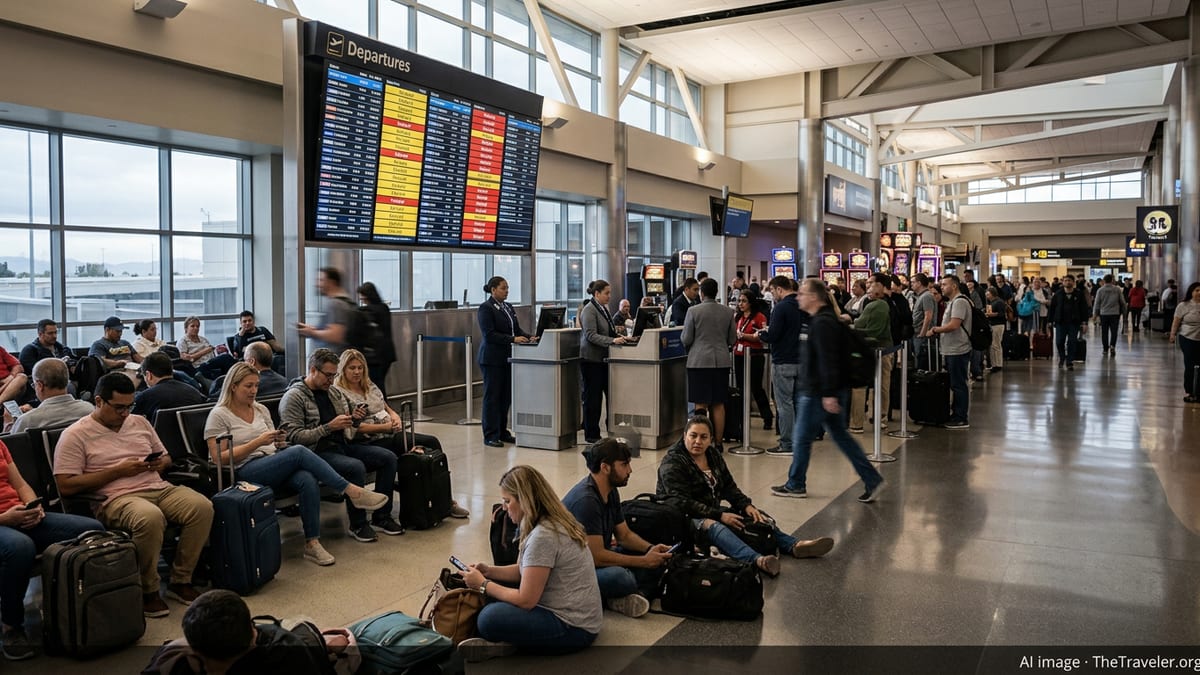
Inside terminals, the operational strain translated into a familiar scene: departure boards lit with orange and red delay markers, serpentine queues at customer-service desks and overburdened gate agents fielding questions they often could not fully answer. At Harry Reid, where the layout channels large crowds through relatively tight gate areas, families with small children and travelers heading to conventions or weekend breaks squeezed into every available seat.
For many passengers, the most immediate challenge was uncertainty. Estimated departure times moved in 15- and 30-minute increments, making it difficult to know whether to leave the gate area for food or attempt to switch flights. Travelers in New York and Chicago reported receiving conflicting updates from airline apps, airport departure boards and gate announcements, a discrepancy that has become a recurring frustration during busy travel periods.
Missed connections were a particular problem for international travelers using East Coast and Midwest hubs as gateways. A delay of an hour or more on a domestic inbound flight, especially on routes into New York and Chicago, was enough to break carefully planned itineraries to Europe and Latin America. With long-haul services often operating near full, rebooking options were limited, and in several cases passengers were told they would need to wait until the following day to depart.
While airlines provided meal vouchers and hotel accommodations in some instances, many travelers reported that assistance desks were overwhelmed, leaving them to navigate complex rebooking rules and expense policies on their own. Social media feeds from Las Vegas, New York and Chicago filled with images of crowded concourses and weary travelers camping out near power outlets to keep phones charged for crucial updates.
Weather, Air Traffic Control and Tight Schedules Behind the Chaos
Industry analysts pointed to a mix of short-term and structural factors behind the latest disruptions. Early spring weather systems moving across the central United States contributed to low ceilings and gusty winds near key hubs, prompting the Federal Aviation Administration to slow arrivals and departures at various points in the day. Even brief ground delay programs can quickly stack up to dozens of late flights when airports are operating at or near capacity.
At the same time, the lingering effects of a busy winter storm season have left airline schedules and crew rotations more fragile than usual. When storms in January and February forced mass cancellations, carriers were able to reset operations over several days, but also tightened schedules and repositioned aircraft to recapture lost revenue. That leaner operation, while efficient under normal conditions, leaves less slack to absorb new disruptions.
Crew availability has also emerged as a recurring pain point, particularly for flights late in the day. Federal duty-time limits mean that once delays reach a certain threshold, crews can time out and are no longer legally permitted to operate. Airlines must then scramble to locate reserve crews or cancel flights outright, a pattern seen in several of the eight cancellations recorded in the latest episode.
Analysts note that while airlines and airports have invested heavily in technology to predict and manage disruptions, the combination of high demand, tight schedules and more volatile weather continues to test the resilience of the system. For travelers, that often translates into longer-than-expected delays on what might once have been routine domestic flights, especially through pressure points like Las Vegas, New York and Chicago.
What Travelers Can Expect in the Coming Days
With spring break traffic building and overall passenger numbers still climbing, airlines are warning that delays may continue to flare up even in the absence of major storms. Any bout of strong winds, low clouds or convection around key hubs can quickly ripple through the national network, turning isolated slowdowns into multi-city disruptions that strand passengers in multiple time zones.
Passengers departing from Harry Reid and other busy leisure gateways in the Southwest are being urged to arrive earlier than usual and to keep a close eye on airline apps and text alerts for schedule changes. Boarding times may be adjusted as carriers look to turn aircraft as quickly as possible when weather and air traffic control restrictions ease, leaving less margin for late arrivals at the gate.
Travelers connecting through New York and Chicago should prepare for tighter connection windows and consider building extra time into itineraries where possible, especially when linking a domestic leg with an international departure. Travel advisers continue to recommend morning flights, which statistically face fewer knock-on delays than afternoon and evening departures that rely on aircraft completing earlier segments on time.
For now, the latest count of 207 delays and eight cancellations serves as a reminder that the US air travel system remains highly interconnected and vulnerable to even modest shocks. As airlines, airports and regulators search for ways to improve resilience, passengers are likely to remain on the front line of disruption, navigating long lines and shifting departure boards whenever conditions deteriorate at a handful of critical hubs.